
Atlas Obscura recently added to its corpus a listing for a sculpture of a wild boar in front of Sydney Hospital, in Australia. Contributor Lakehurst wrote, “Anyone who has ambled through the Mercato Nuovo in Florence will experience an immediate sense of déjà vu: this is an exact 1:1 scale replica of Il Porcellino, the famous 17th-century masterpiece sculpted by Pietro Tacca.”
I did indeed experience an immediate sense of déjà vu but I have never been to Florence, Italy, or Sydney for that matter. How could I recognize a work of art I have never seen? Slowly the answer came into focus. I walked to my bookshelves and pulled down The Art Commission and the Municipal Art Society Guide to Manhattan’s Outdoor Sculpture.
There, on page 130 of the 1988 book by preservationist Margot Gayle and art historian Michele Cohen (Prentice Hall Press), is Wild Boar, in Sutton Place Park in Manhattan. (The generic English name is how the sculpture is inventoried by the New York City parks department.) The odd thing is that other than on page 130 of the guide, I had never seen the Sutton Place copy either.
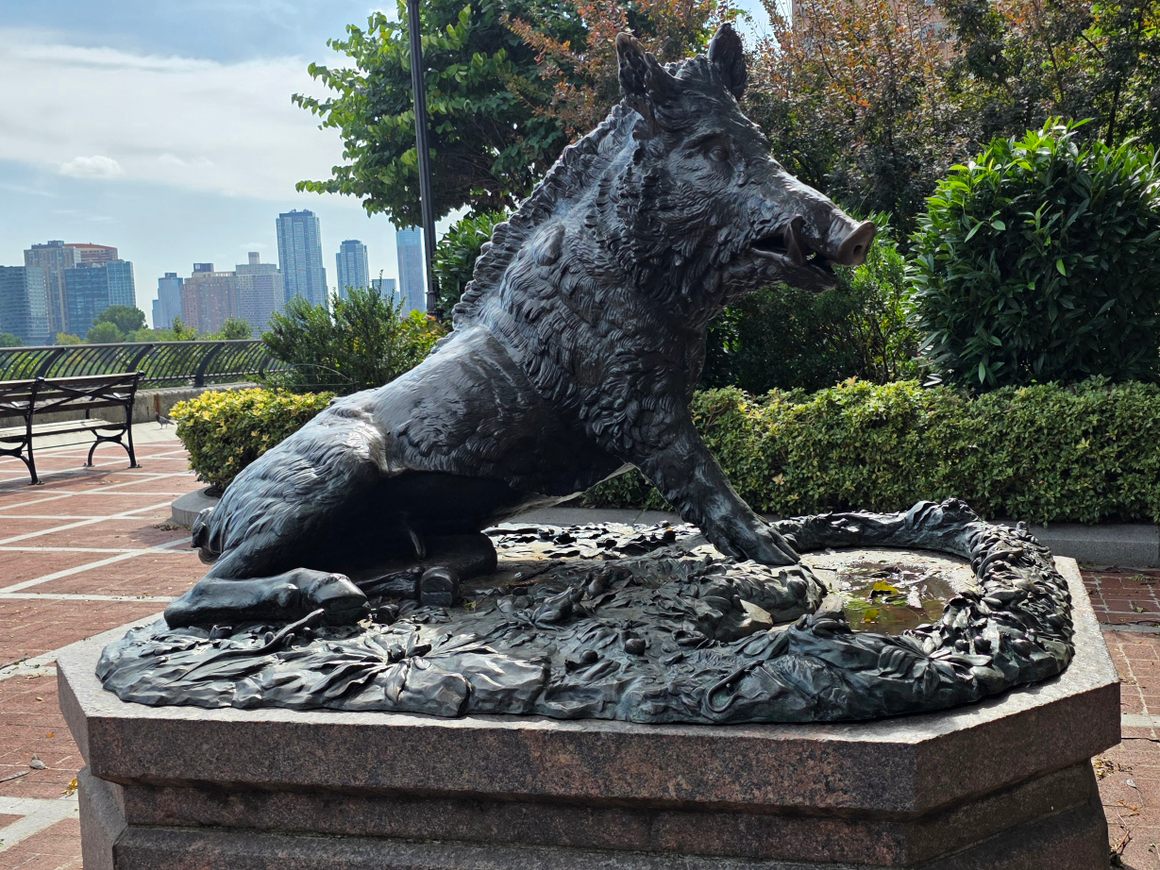
If there are two replicas of the 1633 Florentine sculpture—itself a replica of a Hellenistic original in marble, adding further to the sense of dislocation—it reasoned that there were others. According to Wikipedia, there are over four dozen around the world. (Tongue firmly in cheek, I note that Sus scrofa is generally considered an invasive species outside of its native Eurasian range.)
Perusing the list on Wikipedia, I realized I have been blind to Il Porcellino. I have twice visited Country Club Plaza, in Kansas City, Missouri, and I have been to the Main Street Station and Casino in Las Vegas, but I don’t remember seeing the copies of the sculpture at either location. (At the casino, I searched for and found a portion of the Berlin Wall in a men’s room.) “The little pig,” the literal translation, has been hiding in plain sight.
The replicas of Il Porcellino caused me to remember an even older sculpture, the Capitoline Wolf, which depicts a scene from the legend of the founding of Rome. The age of the allegorical artwork, created at two separate periods, is disputed. The wolf figure, long thought to be an Etruscan work from the fifth century BC, has been radiocarbon dated to 1021-1153. The infant twins, Romulus and Remus, are believed to have been added in the late-15th century. The original sculpture has been housed since 1471 in a palazzo on the Campidoglio, the Capitoline Hill, hence the artwork’s name.
There are, with Wikipedia again my source, almost twice as many replicas of the Capitoline Wolf as Il Porcellino, with almost 15 percent of the copies to be found in the United States. (Many of the replicas were donated by the Italian dictator Benito Mussolini, leading to debate during and after World War II about the correctness of displaying the sculptures.) I first saw the Capitoline Wolf in front of the Rome [Georgia] City Auditorium, although I cannot remember when.
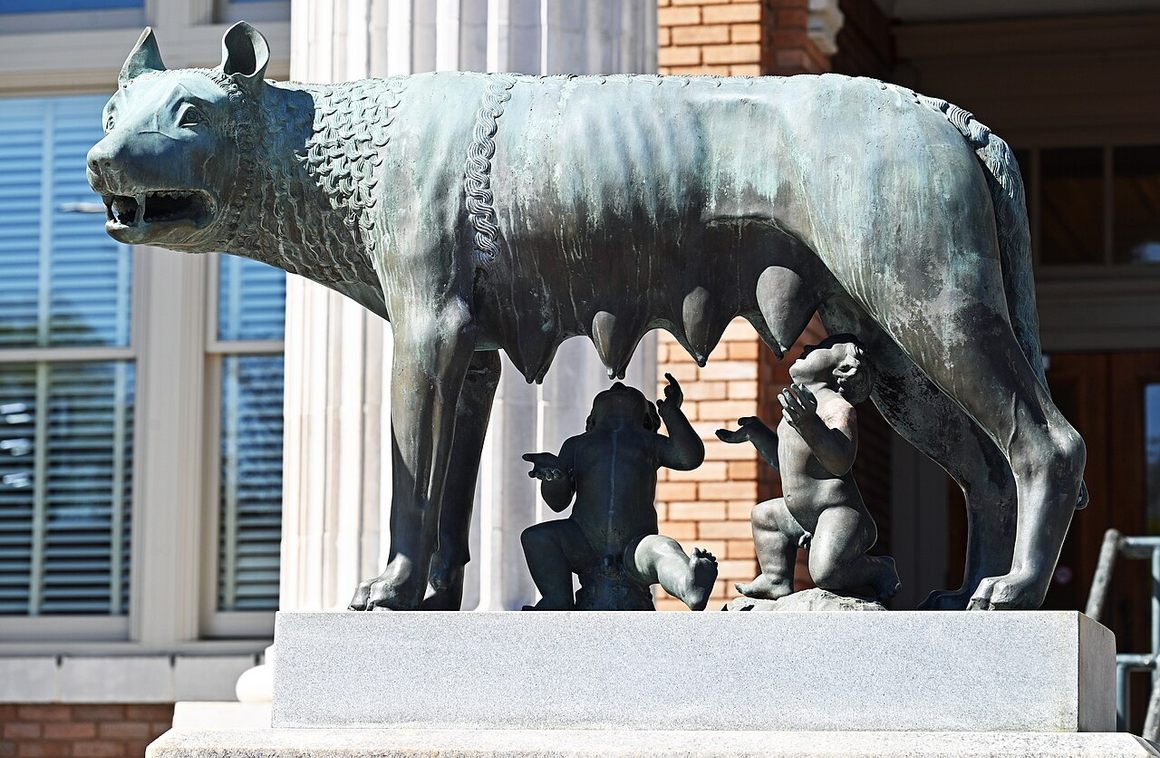
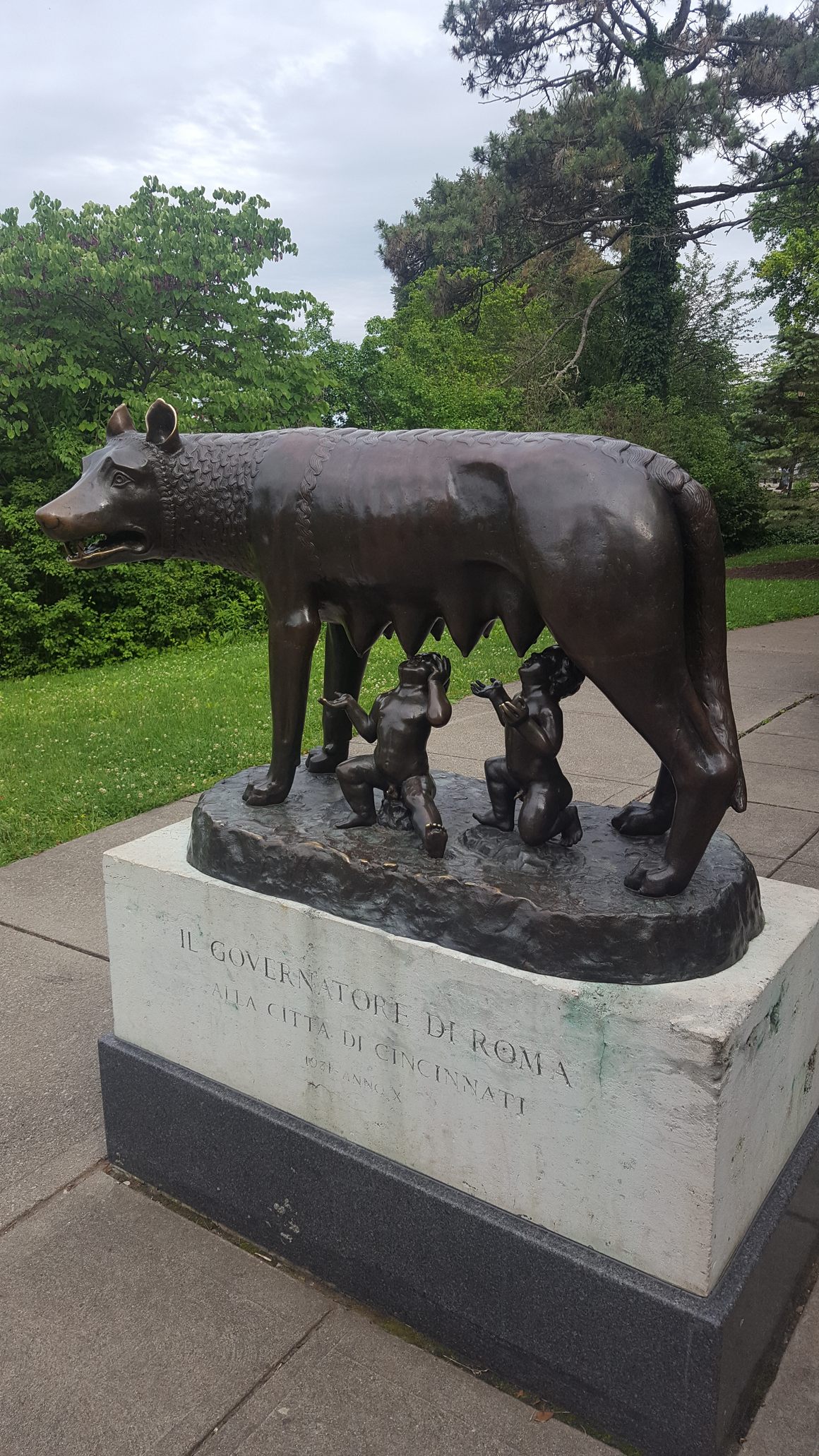
I confess to sometimes having completist aspirations but I am not insane. The sheer number of copies of these two sculptures and their global dispersion nullifies any idea of attempting to see them all. Not so for the Madonna of the Trail, 12 identical monuments honoring “pioneer” (meaning of European descent) women.
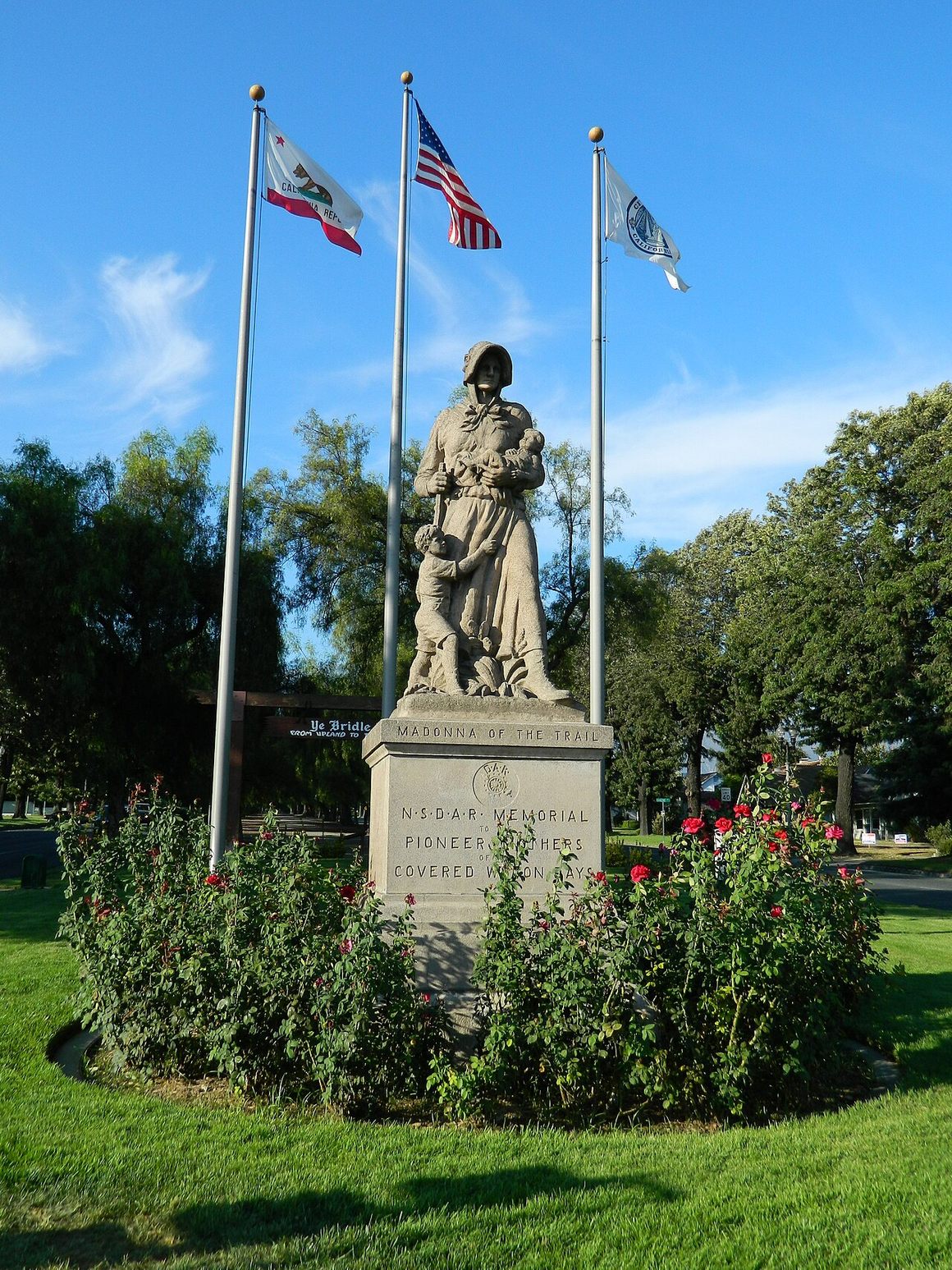
The Daughters of the American Revolution erected the statues in the 1920s, one in each of the states through which the National Old Trails Road traveled. Established in 1912, the National Old Trails Road followed first the Cumberland Road from Cumberland, Maryland, to Vandalia, Illinois. Once known as the “Main Street of America,” the Cumberland Road was the first great federally financed highway in the the United States.
Further west, the Santa Fe trail became the forerunner of the National Old Trails Road, which terminated in Los Angeles. Much of the route today is part of U.S. Highways 40 and 66, although with the creation of the Interstate highway system, portions of the earlier United States Numbered Highway System have also been realigned.
I didn’t have plans for another cross-country trip but through a process of association, a bristly swine 10,000 miles away by air now has me contemplating an itinerary that visits a dozen identical bonneted women, hardened determination written on their faces, a babe in their arms, and a boy clutching their skirts for maternal reassurance. And what else might I see between the 12 statues? Perhaps other copies of Il Porcellino or the Capitoline Wolf.
