
Picture it:
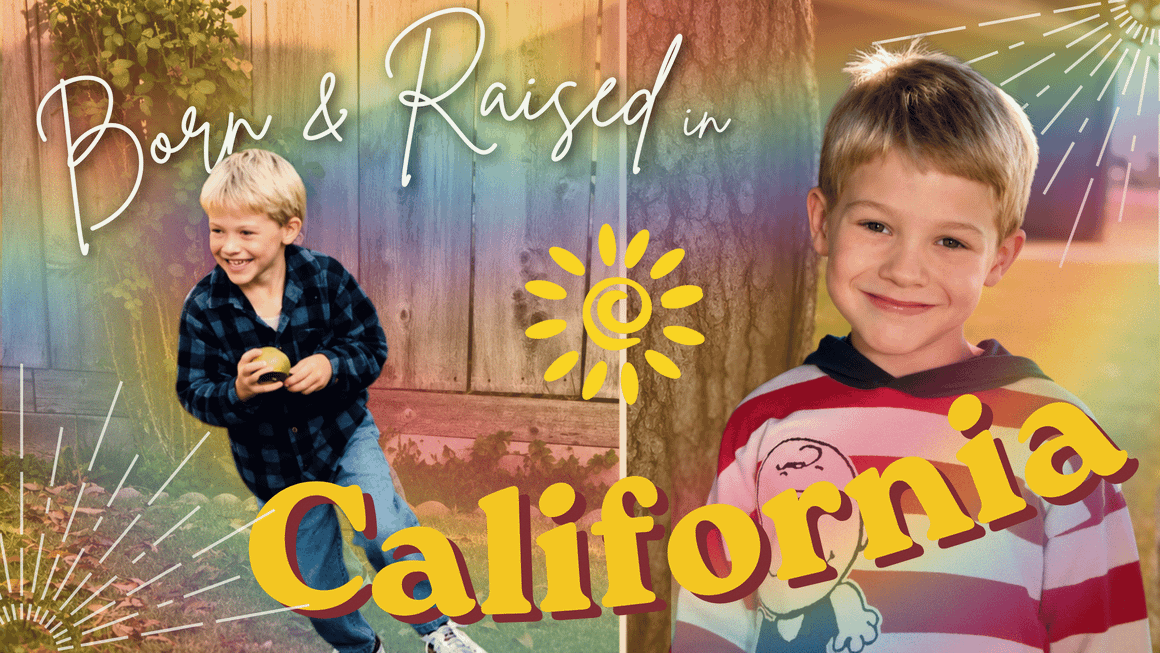
Summer 1995, and it's hot in my grandparents' huge, sprawling house in Visalia, California (they were rich, not me!). I'm six years old, dancing in front of my grandma's full-length dressing mirror with a bath towel wrapped around my head like the fiercest updo you've ever seen, lip-syncing to Des'ree's "You Gotta Be" off my Princess Diana Tribute CD.
This is what small-town gay life looks like before you have a word for it. You're just a kid who walks on his toes, who dances in his grandmother's heels, who would rather explore the orange groves out back than sit still for five minutes. Nobody in Visalia in 1995 was handing out vocabulary for that. They were handing out bruises, mostly. I stuck out like a sore thumb, and the only plan I had was get out.
So I did. Riverside, where I went goth and skipped school to chain-smoke with friends, taking every bit of California sunshine completely for granted because I was sixteen and miserable in the specific way only Southern California suburbs can make you miserable.
Then Seattle, where I became a drag queen and dated the DJ (yes, I know, I know, it is the single most clichéd gay origin story in existence and I lived it anyway) until I lost the friends, the boyfriend, and most of myself along with them.
Then Sacramento, where I came back to California like a wounded animal crawling home, and where I actually learned to walk again: got sober, started rebuilding, took solo trips down to San Francisco just to be somewhere that felt like mine.
Then Los Angeles, for school and for the version of my life I thought I was supposed to be living, until 2020 happened and everything got strange and small and indoors.
And now? Now I'm back in Riverside, closer to where this all started than I've been in twenty years, and for the first time I'm actually curious about where I'm from. Here's the thing nobody tells you about running away from a place: you can outrun a hometown, but you can't always outrun a state.
California has been my home through every single one of those chapters — my refuge, my sanctuary, the thing that kept catching me. And it wasn't until very recently that I realized I'd been living an entire queer life inside this state for almost twenty years without knowing a single thing about the queer history running underneath it.
So that's the mission now. Not tourism. Excavation.
I want to know who the badass, ridiculous, furious, fabulous people were who made it possible for a kid from Visalia to grow up, eventually, into someone who gets to write this sentence in public.
I'm starting in LA, because LA is where I keep ending up anyway, and from there: San Francisco, where my boyfriend and I got together (be still my heart), San Diego, and — if anyone out there knows where to point me at here — Visalia itself, the town I left without ever learning its history.
Here's my most honest confession in this entire piece: I don't know anything about Visalia's queer history. Not one name, not one bar, not one footnote. I just knew, with total certainty, at six years old with a towel on my head, that I needed to leave.
But the last time I visited, I literally saw queer teenagers just existing on the street downtown — visibly, unbothered, the way I never once got to be — and it wrecked me a little, in the good way.
If anyone reading this knows anything about Central Valley queer history — a bar, a person, a protest, a rumor — please, send it my way. I want to go back and actually look.
But if you're from a small town and you've got that same restless, towel-on-your-head, feet in some heels energy: get out. Go explore. Date the cliché DJ if you have to. But don't stay away forever. There's always something new to learn about your roots — you just have to be brave enough, or curious enough, to go digging.
Thank you Atlas Obscura!


