

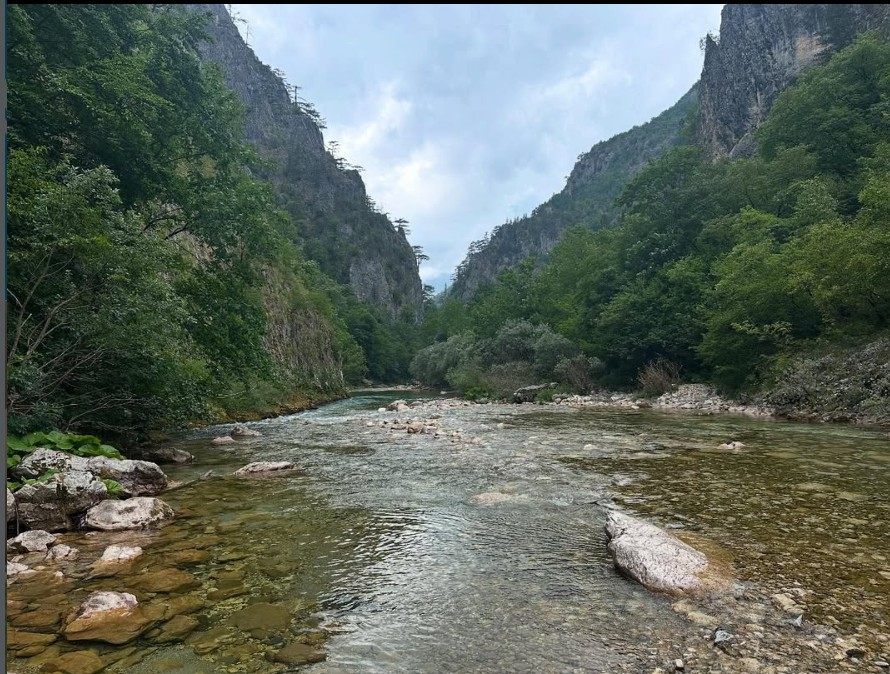
I first learned about Komarnica canyon through Dr. Iva Njunjić, a National Geographic Explorer and cave biologist, and Dr. Menno Schilthuizen, an evolutionary biologist and biodiversity researcher. Through Taxon Expeditions, they organize field expeditions into threatened or understudied environments. I originally reached out to them with the intention of joining their Borneo expedition, but in that initial meeting with them, they told me about a proposed hydroelectric dam that threatens to flood the canyon of Komarnica, which could harm endemic species and silence one of Europe’s last untouched wilderness corridors. This wouldn’t just be an ecological and cultural loss; it would also be an irreversible leveling of a library of zoological, anthropological, and botanical history. So, it didn't take any more than that to sway me, and I set off to be a part of that expedition instead, wanting to better understand the area, and should fortune smile on us, to help protect it.
The scientific purpose to explore Komarnica was relatively straightforward on the surface: to document what lives there while there is still time. However, with this being something of an open season for scientific discovery, I very much underestimated just how many topics and subtopics of science, politics, and geographic as well as cultural history we would tackle.
Our team included scientists, university students, naturalists, photographers, and explorers. Each day, we entered the canyon carrying specimen containers, insect traps, hydrologic testing equipment, cameras, ropes, food, and emergency supplies. We searched for insects in leaf litter and beneath stones. We measured stream conditions. We examined soil chemistry and recorded features of the surrounding environment. The work was as methodical as you would expect in a scientific endeavor, but unlike the controlled environment of a laboratory, Komarnica is built vertically.
To reach some study areas, we descended approximately 365 meters, or 1,200 feet, from the upper slopes to the canyon floor. Some sections of our hike approached a 45-degree incline. Loose rocks shifted beneath our boots, vegetation concealed unstable ground, and even after the descent down, you had to be mindful that every piece of equipment had to be carried back up-- if not that same day, then in the coming ones.
Having traveled from Florida, a place not exactly known for its mountains, I felt every meter but loved the results of our hard work. For the views there were astounding. Seeing pristine, nigh-untouched caves, river systems, and canyon walls is both a privilege and an honor I try to always express my gratitude for. Also, the physical difficulty was part of what protected Komarnica from the more extractive and destructive elements of tourism and industry. The canyon has resisted easy access, intensive construction, and mass tourism all this time in part due to how isolated and wild it is. Its remoteness has allowed ecological relationships to persist in places that remain poorly studied.
Photos alone cannot do this place justice. Komarnica is part of a karst landscape shaped by soluble limestone. Water has carved caves, underground passages, springs, cliffs, and narrow channels throughout the region in a way that you would have to see to truly grasp. Above ground, forests cover steep slopes and deepen the shade around the river, giving it an almost magical feeling. Beneath them, organic matter accumulates in the soil and supports a web of fungi, plants, invertebrates, and microorganisms.
During the expedition, I measured soil pH and examined the characteristics of the canyon’s Cambisols in a support role to a fellow researcher in the team, who was studying snails of that region as part of her research project. Cambisols are relatively young soils that can support highly productive ecosystems. These were quite rich in organic matter, or humus. More holistically, the soil promotes life to the endemic species that have adapted to the valley’s unique climate and hydrology for millennia.
As Dr. Menno Schilthuizen said to me at one point in the expedition. The animals relying the most on soils are often easiest to overlook. Tiny insects hide under bark, within moss, beneath stones, and deep inside caves. Some may occupy extremely small geographic ranges and a single species adapted to one cold cave, tributary, or isolated section of a canyon may exist nowhere else in the entire world. To the species in question, that microcosm is an entire world in itself.
One insect that caught my attention, which is a possible member of the order Archaeognatha, was encountered inside an ice cave. In fact, it was the first ice cave I had ever stepped inside. Members of this insect order are commonly known as jumping bristletails. The order includes about 600 species worldwide and is considered one of the most evolutionarily ancient insect groups, dating back to the Middle Devonian period. This is just speculation on my part, as I am not a trained entomologist, but I wonder if that ancient quality it has is what gives me the immediate thoughts of a clawless lobster or shrimp every time I look at it.
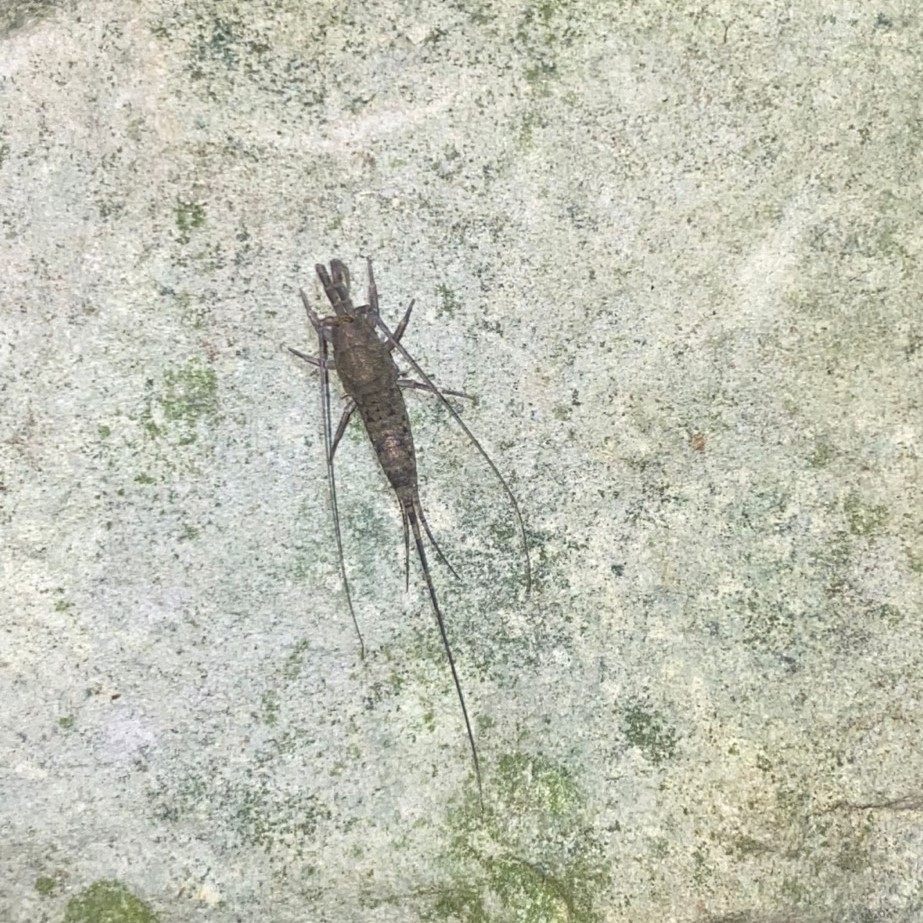
It is important to note that the specimen we collected requires expert study before anyone can determine the exact identity. It may belong to a known species, represent a new regional record, or prove to be something previously undescribed. The latter would be an incredible honor, but I don't want to get ahead of myself.
Scientific discovery rarely happens in a dramatic instant. A specimen must be collected or photographed, preserved, compared with existing records, and examined by a specialist. Months or years may pass before a confident identification is possible. In the interim, I have taken to jokingly calling it "Schrödinger's insect" for that reason. Regardless, the canyon still contains questions that science has not answered fully. There are surely things in this wild place that have not yet been documented.
Now, like I mentioned earlier, there are cultural and political dimensions to exploration. This was especially true in the case of this place. Throughout the expedition, I spoke with several Montenegrin residents, conservationists, and scientists who have spent years studying and/or living near the valley. Many are fully transparent in their desire of economic opportunity, reliable infrastructure, and a strong future for their communities. At the same time, they also question whether those goals require the permanent transformation of Komarnica.
Before I get any further, let me say I do try to be fair and give credit where it is due. Renewable energy can play an important role in reducing greenhouse gas emissions and strengthening energy security. But no energy source is truly environmentally neutral, and no project should be evaluated solely by the fact that it isn't a fossil fuel source. This expedition showed me that renewable energy does not always mean "green".
Back home in the United States, the Hoover Dam offers a powerful comparison. It is rightly regarded as an extraordinary feat of engineering. Beyond generating hydroelectricity, it helps control flooding and has supported the storage and delivery of water for cities, industry, and agriculture across the American Southwest. Its powerplant has historically produced large amounts of electricity each year. Those are real achievements and dismissing them would prevent an honest discussion.
But hydropower technology also demonstrates that the benefits of renewable infrastructure can come with consequences that extend far beyond the construction site. By impounding the Colorado River and creating Lake Mead, the project submerged landscapes and archaeological sites that could never be fully recovered. This mirrors what could happen to Komarnica. Its completion also marked the beginning of major changes to the hydrology and movement of sediment through the lower Colorado River and its delta.
As I get older and more experienced in exploration, I find myself encountering "two things are true" situations with greater frequency. Hydroelectric projects can produce low-carbon electricity while still destroying habitat, altering a river’s natural functions, and erasing biological and cultural records that cannot be reconstructed elsewhere. Calling the resulting electricity “green” does not automatically make every consequence of producing it green, and I think that is an important thing to consider, as well as something I overlooked unknowingly most of my life.
During the expedition, I spoke with Montenegrin residents, conservationists, and scientists who have spent years studying or living near the valley. Many want economic opportunity, reliable infrastructure, and a strong future for their communities. They also question whether those goals require the permanent transformation of Komarnica. The people working with the NGO Spasimo Komarnicu (Save Komarnica) have helped bring international attention to the canyon and the proposed dam. Their argument is not that the region should remain economically frozen, but that the project’s projected energy contribution does not justify the ecological and cultural losses it would impose.
I was told recently that the good news is that Komarnica has been proposed as one of Montenegro’s future Natura 2000 sites, placing it within the orbit of Europe’s flagship network of protected areas. That proposal is significant because Natura 2000 is designed to safeguard habitats and species of exceptional ecological value, recognizing places beyond their beauty, such as their biological importance and long-term conservation potential. In practical terms, Komarnica’s inclusion would strengthen the case that this valley is not an expendable frontier awaiting development, but a landscape of continental importance whose forests, river systems, caves, and endemic life forms deserve careful stewardship and safeguards.
I traveled to Montenegro as a scientist and explorer. My professional work at home normally focuses on water conservation and science in Florida, thousands of miles from the Balkans. Despite that, the central question was familiar from issues I encounter at home. How should societies balance development with the protection of water, ecosystems, and communities?
There is rarely a perfect answer, I admit that. However, irreversible decisions require a higher standard than ordinary ones. Some decisions are reversible, but a one-of-a-kind canyon cannot be brought back from being drowned. The work of our expedition will contribute to the scientific record of Komarnica. The work of local residents and organizations will determine whether the valley remains a living landscape rather than becoming a description of what once existed.
For now, the river still runs through the canyon and Komarnica still has a future.
Learn more:
I encourage readers moved by Komarnica’s story to learn more about Taxon Expeditions and the work of Spasimo Komarnicu, and to watch Komarnica: The Wild That Remains, attached to this post. The documentary introduces the people involved in the campaign and expedition, presents the beauty of the canyon, and provides additional information about how to support its protection.
