
Argentine ants (Linepithema humile) are distinctive insects in many ways, most prominently because they have demonstrated an unusually strong ability to instantly recognize any unannounced visitor as either part of their supercolony or not by assessing the chemicals on the guest's exoskeleton. Those visitors whom they identify as being fellow citizens of their community ("One of us!" "One of us!") are promptly welcomed and integrated into society. Those perceived to be foreign intruders are rapidly vanquished.
It’s an epic world-war clash, taking place less than a half inch off the ground.
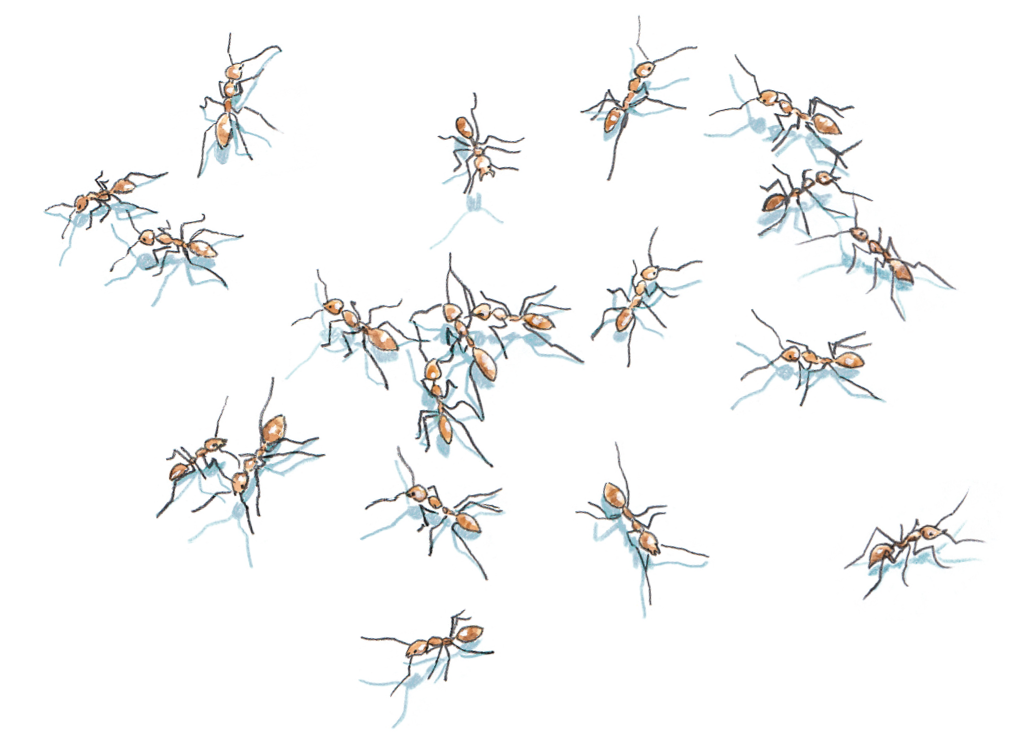
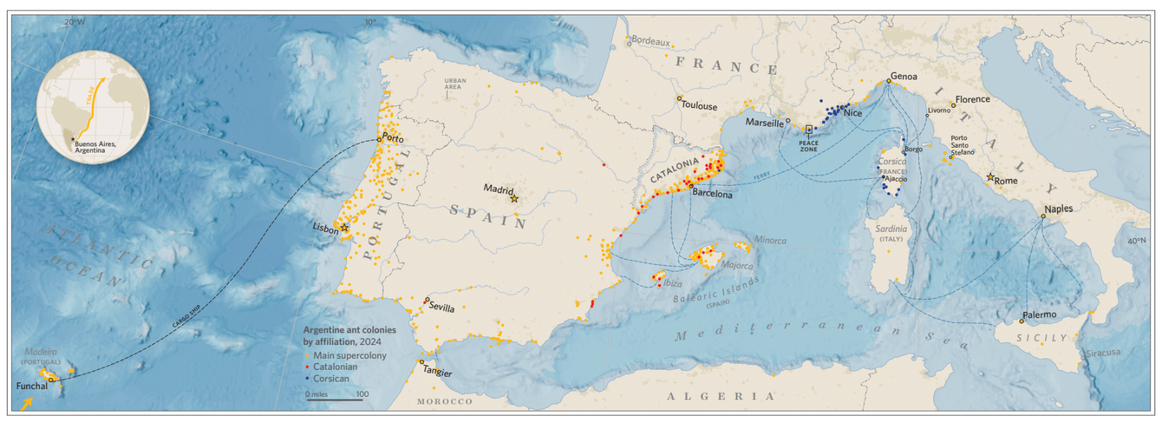
After they were inadvertently plucked from their native forest floor in the mid-1800s, the ants found themselves transported to a foreign place unlike any they had ever known—5,000 nautical miles from their Southern Hemisphere home. Their arrival in Europe helped spawn a transcontinental empire that now spans 3,600 miles from Portugal to Italy, populated by billions of individuals, creating what researchers have called the "largest cooperative unit ever recorded."
But that largest colony, known simply as the "main supercolony," has competition. In 2002, a team of Danish, French, and Swiss scientists conclusively showed that what had at first appeared to be one giant supercolony stretching across Europe was, in fact, at least two groups, which demonstrated "extremely high" aggression toward each other.
The antagonistic Catalonian supercolony is presumed to have a similar origin story, possibly arriving independently of the main colony’s introduction on a ship transporting cork between Madeira and Spain. Perhaps as the result of a distinct introduction from Argentina into Europe, this second wave of arrivals did not bear the same chemical signatures as the main supercolony, meaning that they were viewed not as brothers and sisters, but as foreigners. The rise of a competing Argentine ant supercolony soon created a transcontinental collision. In 98 percent of cases, clashes between the two groups were fatal.
In 2010, the ants' story became further complicated when a French researcher named Dr. Olivier Blight reported that he had discovered a third Argentine ant supercolony, on the Mediterranean island of Corsica. As with the first two, this third supercolony was also found to be universally aggressive toward anyone outside of their network.
Then, three years later, something weird happened.
Blight was part of a French research team that discovered what he described as a "peace zone" on the borderline between the main supercolony and the Corsicans. This zone features a site in southeastern France where aggression between the two groups was conspicuously absent, despite the mutually antagonistic colonies rubbing right up against each other. Blight's leading theory for this is that, at some point, a small number of male workers were, perhaps inadvertently, welcomed into the opposing community—something possible only because tensions between the two groups are generally milder than with the Catalonians.
Those males then mated with the females from the other side, over time creating "colony fusion" by diluting the ants' natural aggression toward one another. In other words, through generations of reproduction, they started to see bits of themselves in their former enemies and became more tolerant as a result. [View map]
As he gazed out over Marseille's majestic port from a high peak in Parc Émile Duclaux, Blight watched the lines of tiny tourists bustling along the waterfront and told me that many other "peace zones" likely exist all along the borderlines of Europe's ant supercolonies. It's just that nobody's looking.
This post was adapted from the author's new nonfiction travelogue, The Hidden Nations of Animals.


