About
It all started with an unlikely meeting between a teenage cowboy, a Yale paleontologist, and a mighty Lakota chief. The year was 1874, and researcher O.C. Marsh had come all the way from Connecticut in search of fossils. He’d gotten a tip that the local Indigenous people knew where to find them. The only trouble? Marsh didn’t speak a lick of Lakota. So, he enlisted a visiting cowboy—17-year-old James Cook—to act as translator.
The meeting between Marsh, Cook, and their Oglala Lakota Nation representative—the imposing, 53-year-old Chief Red Cloud—was fruitful in more ways than one. For Red Cloud and Cook, it sparked a friendship that spanned more than three decades. For Marsh, it kickstarted a career. The young scientist went on to find dozens of fossils in the hills around the Niobrara River, sparking a nationwide flurry of new discoveries and rivalries that modern-day paleontologists still refer to as the “Bone Wars.”
One of those early discoveries was that of the “Devil’s Corkscrew of Agate”—a six-foot-high, tubular earthen helix unearthed from a hillside. Years later, researchers found the skeleton of a beaver-like mammal inside the helix—and discovered that the Devil’s Corkscrew was actually the preserved casting of the creature’s spiraling burrow.
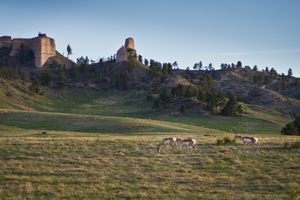
Today, Agate Fossil Beds National Monument is a tribute to Cook, Marsh, and Chief Red Cloud—and to the corners of 1800s American society that they represent. You’ll find a collection of Oglala Lakota artifacts that Red Cloud gifted to Cook over the years—from moccasins and pipe bags to traditional hide clothing hand-sewn for Cook’s sons. Some of Red Cloud’s own apparel is also on display, delicately beaded and impeccably preserved. Outside, replica teepees give visitors a glimpse into the roving lifestyle of a Great Plains hunter, and trails crisscross a sea of grass, weaving among bluffs and tracing some of the same paths the state’s early cowboys trod.
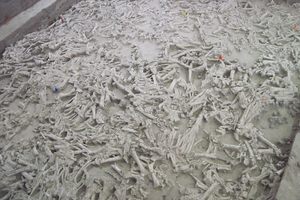
In the visitor’s center, though, you’ll find the park’s true jewel: its groundbreaking fossil collection. By the early 1900s, O.C. Marsh was long gone but the Bone Wars raged on—and the discoveries at Agate kept on coming. Over the years, researchers dug up a number of intact skeletons of ancient beavers, gazelle-like ungulates, and carnivores called beardogs. These discoveries gave early paleontologists their first real glimpse of North American life after the dinosaurs and became the key to our modern understanding of mammal evolution. Today, you can see many of the skeletons arranged in an expansive diorama that’s known to paleontologists around the world.
Know Before You Go
Agate Fossil Beds National Monument is open year-round, though winter hours are more limited; check online before your visit. There is no public transportation to the monument. There are a few ways to drive here, but taking U.S. Highway 20 is your best bet; parts of River Road between Marsland and Agate Fossil Beds are unpaved and can make for tough driving in dry conditions.


Published
May 1, 2025