About
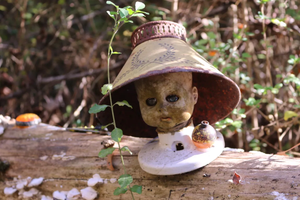
Nearly a decade after the notorious “Anatomy Murderers” William Burke and William Hare were apprehended in 1828 in Edinburgh, Scotland, two boys discovered a collection of tiny dolls, each nested into a miniature coffin hidden away in the city park called Arthur's Seat.
At first, theories on the dolls' significance ranged from witchcraft to child’s toys, but eventually, it was suggested the that the 17 tiny figures could be effigies for the murder victims a decade earlier. There is also a belief that the figurines were meant to represent sailors lost at sea who hadn't received a proper burial. Arthur's Seat – part of Holyrood Park – where the dolls were discovered, has a clear view of the Firth of Forth estuary. Even the nearby St. Anthony's Chapel ruins were said to act a lighthouse. There is a possibility that these were funeral effigies.
Between 1827 and 1828, William Burke and William Hare lured in and murdered their lodgers in a scheme to provide fresh bodies to the local anatomy school. Dr. Robert Knox, a brilliant and well-known local anatomy lecturer, purchased the bodies and most likely knew that something was a bit suspicious about his supply chain.
The crimes were exposed when another lodger discovered the body of a previous tenant and reported it to the police. Burke and Hare were apprehended along with Burke's mistress, Helen McDougal, and Hare's wife, Margaret Laird. Despite finding the body of this last lodger in Knox’s classroom, ready for dissection, the evidence was not truly damning until Hare turned on Burke and gave a full confession. William Burke was hanged in January 1829. His body was handed over for dissection, and his skeleton is housed at the Anatomical Museum, which is part of Edinburgh's medical school. A book bound from his skin is part of the collection of the Royal College of Surgeons, Edinburgh.
The four-inch-long dolls were in the hands of a private collector until 1901, when eight of them were handed over to the National Museum of Scotland where they can be visited today. Although it is generally agreed that the mysterious little dolls are associated with the crimes of Burke & Hare, no one is certain who among the killers created them. DNA studies conducted in 2005 using DNA extracted from Burke’s skeleton attempted to prove that they had been created to assuage the guilty conscience of William Burke, but the test proved inconclusive so the truth of their creation may never be known.
It has been theorized that the bodies of the dolls were made from wooden toy soldiers that were popular at the time, post the Napoleonic War. All the dolls are wearing military-style boots and there is a line across their foreheads, indicating some form of a hat.
It has also been speculated that the dolls were the work of a cobbler. Tools used to carve the coffins are similar to those used by persons of this profession. As are the hinges and nails used in their construction.
Burke and Hare's death masks are currently housed at the Scottish National Portrait Gallery (on temporary loan from the University of Edinburgh's Anatomical Museum). Burke's skeleton is on display at the Anatomical Museum and there is a book bound in his skin stored across town at the Surgeon's Hall Museum.
Know Before You Go
Daith Comes In Gallery, Level 4 1/2, National Museum of Scotland. Access to the museum is free. The most direct line to the dolls is to take the lift/elevator at the back of the museum to Level 5 and take the first set of stairs down one flight. Look for the wooden hearse & metal coffin. The display will be on your left, past the mourning jewelry & before the mystical charms.
Community Contributors

Added By

 robjoblin26 profile photo
megkodonnell profile photo
Edited By
-
hrnick
-
SEANETTA
- robjoblin26 profile photo robjoblin26
- megkodonnell profile photo megkodonnell
-
 rbenn250
- loremipsum profile photo loremipsum
- Helen Rose profile photo Helen Rose
-
 JR Wetmore
- theannemeadows profile photo theannemeadows
Published
March 18, 2013