About
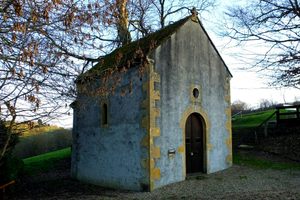
On a remote hill in the middle of nowhere in southern Burgundy stands a small chapel. Nobody knows exactly how long it has been around and why it was built. What is certain is that it suddenly appeared as a ruin on plans and maps in 1672.
For a long time after that no mention can be found. The chapel seems to have been forgotten again. Somebody must have renovated it, but nothing is known about this either. Then, in 1870, the chapel was mentioned again. At that time the parish of the nearby city of Gueugnon used the chapel as a starting point for pilgrimages. Some pilgrimages went to Paray-Le-Monial or Lourdes. Many also went to Santiago de Compostela in Spain on the Camino de Santiago.
It is very likely that the chapel was originally used for pilgrimage purposes, because it is dedicated to Saint Thibault, born in 1033, who went on many pilgrimages himself, including the Camino de Santiago to Santiago de Compostela. There are also stone ornaments on the facade and inside the chapel depicting the scallop. This shell can be found everywhere on the Camino de Santiago and is a symbol of it.
After a short revival as a starting point for the pilgrimages of the people of Gueugnon, the chapel was long forgotten again. After standing empty for a long time, the chapel fell into a very poor condition. In 1997 it was rediscovered and renovated. The doors were provided with viewing windows so that one can also see the interior of the chapel. Most of the time the chapel is completely deserted. It is only used once a year for an open-air service.
About halfway up the hill to the chapel is the Saint Thibault spring. It is said that the water has healing powers. That's why locals come here and fill their bottles with the water. Now and then pilgrims come by here and take a rest.
Next to the chapel stands a very old chestnut tree. Its trunk is hollow so that one can enter it like a cave. The tree is shaped very, very strangely. This is because a long time ago farmers were not allowed to cut down trees. So they cut branches from the trees to use them as firewood, but also to have more space and light in the fields. They did this again and again over the centuries. Such a deformed tree is called “écornât” in this area. This comes from the word "écorner" (to cut something off).
Related Tags
Know Before You Go
It is possible to visit the chapel at all times.
There is room to leave a car before you walk up to the chapel and the spring.
It is not possible to go inside.
Community Contributors

Added By
Published
July 17, 2026