About
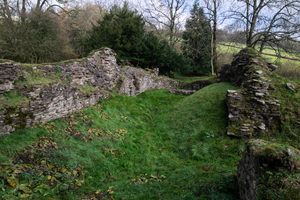
If you ever find yourself in western Herefordshire right by the Welsh border, you might chance upon an eerie, ruined castle on a massive mound known as a motte. The history of the castle is extensive, going back to a time when England was under Norman control.
In 1070, William FitzOsbern, the 1st Earl of Hereford, constructed an early motte-and-bailey castle known today as Clifford Castle atop a cliff overlooking a ford on the River Wye. The site, once occupied by Browning, was transformed into a strategic stronghold meant to safeguard a burgeoning Norman settlement planned along the River Wye's banks. The settlement was envisaged to encompass roughly 200 plots, extending uphill for half a mile towards Llanfair, where St. Mary's church was perched on the hill's summit. While the original church, St. Mary's, exists today, albeit significantly altered during the Victorian era, the castle's proximity to the River Wye facilitated its defence strategy by utilising seasonal floods to create a natural barrier. A dam on the western side of the site further fortified the castle by creating a shallow lake or marsh during floods.
Following FitzOsbern's demise in battle at Flanders, the castle was passed to his son, Roger de Breteuil, the 2nd Earl of Hereford. Roger's rebellion against the king in 1075 resulted in the forfeiture of his lands, leading to the castle's grant to Ralph Tosny by the Crown. The Tosny family, mainly occupied in Normandy, reconstructed the castle in stone, resembling their Conches Castle. Gilbert, Sheriff of Hereford, rented the castle for 60 shillings during Ralph Tosny's tenure.
After Ralph's daughter Margaret married Walter Fitz Richard, who later assumed the name Walter de Clifford, the Clifford lineage began its association with the castle. Rosamund Clifford, renowned for her beauty as the Fair Rosamund and mistress of Henry II until her death in 1176 or 1177, added to the castle's lore. Walter's grandson, also named Walter de Clifford, rebelled against King Henry III's rule in 1233, leading to a brief siege of Clifford Castle and subsequent reconciliation with the Crown. Walter's defiance resurfaced years later, resulting in the loss of some of his privileges as a Marcher Lord.
With no male heir, the castle passed to Walter's daughter, Matilda Clifford, in the 1260s. During the Second Barons' War, John Giffard of Brimpsfield seized the castle, subsequently marrying Matilda. Despite legal ramifications of the controversy surrounding the marriage, Matilda chose to live with Giffard until his death in 1299, after which the castle was granted to the Mortimers of Wigmore by the king.
Although its history is rich, this castle currently stands in ruins in the present day. It is a brilliant sight to visit, given that it is often overlooked and has been in a state of abandonment and ruin for 600 years.
Community Contributors

Added By
Published
August 7, 2026