About
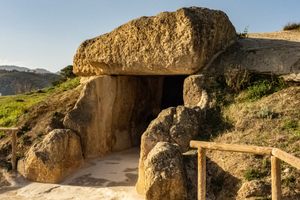
If the pyramids of Giza and Stonehenge are marvels in how ancient rocks were moved with rudimentary technology, then the Dolmens of Viera and Menga in Antequera, Spain, must be equally so. While the blocks of the pyramids weighed an average of 2.3 metric tons and the rocks of Stonehenge weighed up to 30 tons, at least one used for these ancient burial mounds measured as much as 180 tons! This makes them some of the largest stones moved in prehistory. Furthermore, these stones had to be moved up a hill and balanced on top of each other.
Dolmens are megalithic tombs in which the buried are placed under a “table” formation. They are among the oldest forms of Western European monumental architecture. Menga and Viera date to around 3700 BCE and 3250 BCE, respectively, making them significantly older than the Egyptian pyramids and Stonehenge. While many of these have been found, few are as large as those at Antequera, nor do many others retain their earth mound covering.
Viera’s entrance points towards where the sun rises on the summer solstice, indicating a sophisticated knowledge of the seasons. More uniquely, Menga points towards the nearby Peña de los Enamorados mountain, indicating that it held special religious significance for the prehistoric people. Indeed, caves at that mountain showcase motifs similar to those at Menga.
Community Contributors
Added By
Published
July 29, 2025