

About
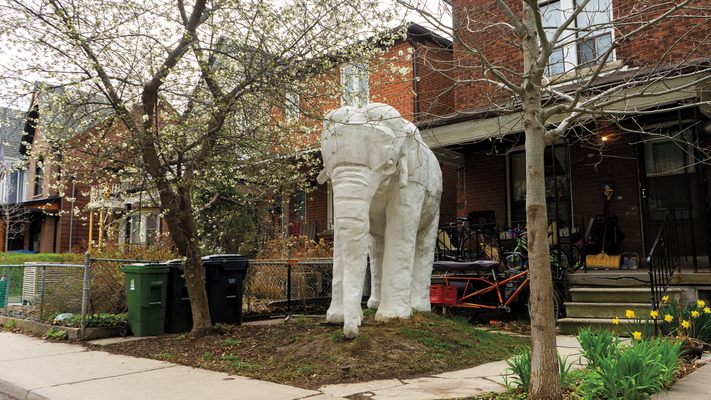
Embedded within a residential zone of Toronto’s Christie Pits area, a full-scale African elephant sculpture has been strategically positioned in the front yard of a standard brick dwelling. Constructed from fiberglass and measuring approximately 9.5 feet in height, this installation has produced notable behavioral responses among pedestrians and motorists, including visual double-takes and hesitation, indicative of its high-impact presence within the local environment. Over time, it has evolved into an unofficial landmark with significant recognition among area residents.
The distinguishing feature of this installation lies not solely in its dimensions or context, but in its sheer incongruity within the urban landscape. There is a deliberate absence of interpretive signage, guided explanations, or commercial elements. The juxtaposition is immediate: a series of uniform residential facades interrupted by an anomalous, hyper-realistic pachyderm. Such an abrupt visual anomaly is statistically rare in metropolitan settings characterized by architectural homogeneity.
Originating as an art school project in the late 1990s, the elephant was relocated to its current site in 2003, where it has since remained stationary, effectively serving as a static sentinel on Yarmouth Road. The sculpture is not enclosed or otherwise inaccessible, permitting unrestricted visual engagement by the public—rendering the location an informal, open-air exhibit.
Historically, the installation included supplementary components—specifically, concrete sheep and a bronze red herring—though these have since been removed, resulting in the elephant’s solitary presence. This reduction arguably intensifies the symbolic impact and the interpretive ambiguity of the piece.
In summary, this object functions not merely as public art but as a persistent stimulus for inquiry and social interaction within its community. It exemplifies the potential for unexpected, site-specific installations to disrupt routine visual experiences and catalyze public dialogue, serving as empirical evidence that urban environments can accommodate elements of unpredictability and whimsy.
Community Contributors

Added By
Published
November 17, 2025


