About
South Natick is a relatively scenic area along the Charles River in a suburb of Boston. Right next to the South Natick Falls is the Bacon Free Library. A smaller location compared to other libraries in the Metrowest region, but within it is housed the Natick Historical Society. Here, not only is there a wealth of information pertaining to local history, but one artifact on display has had a significant impact on world and human history.
When European colonists first arrived in America, one of their biggest priorities was to establish Christianity in the New World both by bringing in settlers from Europe, but also by converting the indigenous population. The first printing press in British North America was established in Cambridge, Massachusetts in 1639 and very shortly after began publishing material related to the Bible. The Bay Psalm Book published in 1640 was the first book printed in British America.
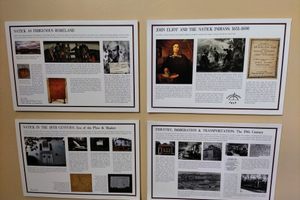
Puritan missionary John Eliot arrived in Massachusetts in 1631 with the objective of converting the native population. Eliot soon came to realize the ineffectiveness of trying to spread Christianity in English as most indigenous people had little to no understanding of it. As a result, Eliot decided to learn the Massachusett language and began translating all 66 books of the Bible which took around 14 years. Various native Christian converts assisted him with the process and by the time it was completed, Eliot had become fluent in Massachusett and began preaching in the language.
Despite successfully translating the Bible, finding a publisher who was willing to print the entire work in the indigenous language would prove challenging. In 1649, Parliament established the New England Company in London with the goal of spreading missionary activity in America. Eliot worked with local printer Samuel Green and a one volume textbook primer catechism in Massachusett was published in 1653. Several years later, three books from the translated Bible were printed and sent to the New England Company as a sample of what the completed Bible would look like. The company approved the work and sent professional printer Marmaduke Johnson to Massachusetts in 1660. In order to accommodate the transcription of phonemes for the Massachusett language, an extra set of “Os” and “Ks” had to be ordered for the printing press. In 1661, 1,500 copies of the New Testament were printed and in 1663, 1,000 copies of the entire Bible were printed in a 1,180-page volume.
The Eliot Indian Bible, called Mamusse Wunneetupanatamwe Up-Biblum God in Massachusett, became the first Bible published in an indigenous language and the first Bible printed in the entire Western Hemisphere. Although Eliot had hopes of spreading the Bible far and wide across New England and North America, such plans would not come to fruition with the outbreak of King Philip’s War a little over a decade later. An alliance of indigenous tribes fought back against European encroachment and English settlers destroyed many copies of Eliot’s Bible. Native Christian converts including many from Natick were rounded up on suspicion of aiding the enemy and sent to internment camps on Deer Island in Boston where most would perish. Very few copies of the first edition have survived, and in 1685, the New England Company published a second edition with 2,000 copies. The first Bible in English would not be printed in America until decades later in 1752.
The Eliot Bible was explicitly created for colonial purposes of spreading Christianity in America and replacing indigenous religions and cultures. Through a combination of European settlement, warfare, disease, and enslavement, many tribes in Massachusetts and New England have become extinct. However, centuries later, Eliot and his Bible found a new purpose. In 1993, linguist Jessie Little Doe Baird began the Wôpanâak Language Reclamation Project in order to preserve and revive the Wampanoag language. The Eliot Bible would be crucial to this effort as it was one of the few surviving documents providing a written record of Massachusett and Wampanoag and by comparing it to the English Bible, many words and grammar structures were rediscovered.
The copy of the Eliot Bible on display at the Natick Historical Society is from the second edition and dates to roughly 1685. Despite being over 300 years old, it’s in remarkable condition and is a significant primary source related to Native American and colonial history during the 17th century. A powerful reminder of the past and to endeavor to create a new beginning. An artifact which once served as a relic of a darker time has now been transformed into a tool to ensure indigenous history and culture will not be lost or forgotten again.
Know Before You Go
The historical society is open Tuesdays and Thursdays from 10 am to 4 pm and on Wednesdays by appointment only.
Community Contributors

Added By
Published
June 19, 2026
Sources
- https://www.bibleodyssey.org/articles/bibles-in-early-america/
- https://www.library.illinois.edu/rbx/2006/04/03/the-first-bible-printed-in-the-western-hemisphere/
- https://www.technologyreview.com/2008/04/22/220796/saving-a-language/
- https://www.thecrimson.com/article/2024/3/2/eliot-bible/
- https://www.dartmouth.edu/library/Library_Bulletin/Apr1993/LB-A93-Hoefnagel.html
- https://blogs.loc.gov/loc/2024/08/eliots-bible/
- https://eliotbible.web.illinois.edu/
- https://archive.org/details/mamussewunneetup02elio
- https://www.masshist.org/database/viewer.php?item_id=54&pid=15