Places Foods Stories Newsletters
Top Destinations
Latest Places
Most Popular Places Random Place Lists Itineraries
Add a Place
Download the App
Top Destinations
View All Destinations »
Countries
  • Australia
  • Canada
  • China
  • France
  • Germany
  • India
  • Italy
  • Japan
Cities
  • Amsterdam
  • Barcelona
  • Beijing
  • Berlin
  • Boston
  • Budapest
  • Chicago
  • London
  • Los Angeles
  • Mexico City
  • Montreal
  • Moscow
  • New Orleans
  • New York City
  • Paris
  • Philadelphia
  • Rome
  • San Francisco
  • Seattle
  • Stockholm
  • Tokyo
  • Toronto
  • Vienna
  • Washington, D.C.
Latest Places
View All Places »
Salle du Jeu de Paume
Abandoned Facade
Arden Point and Glenclyffe
World’s Tallest Barber Pole
Gnome Crossing
Gnome Hill
Loading...
Loading...

No search results found for
“”

Make sure words are spelled correctly.

Try searching for a travel destination.

Places near me Random place

Popular Destinations

  • Paris
  • London
  • New York
  • Berlin
  • Rome
  • Los Angeles
Places Foods Stories Newsletters
Sign In Join
Places near me Random place
All Tanzania Monduli Engaruka Ruins

Engaruka Ruins

The culture that built these Tanzanian ruins displayed advanced knowledge of irrigation technology before mysteriously disappearing.

Monduli, Tanzania

pardeewalmsley profile photo
Added By
Alex Walmsley
Email
Been Here
Want to go
Added to list
CAPTION
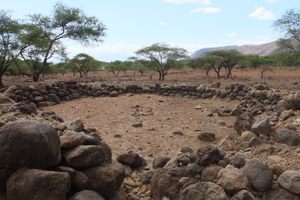
Ruins of large public building.   pardeewalmsley / Atlas Obscura User
Central Fields   pardeewalmsley / Atlas Obscura User
Abandoned furrows   pardeewalmsley / Atlas Obscura User
Abandoned terrace   pardeewalmsley / Atlas Obscura User
Been Here
Want to go
Added to list

About

The history of Africa, and the Rift Valley in particular, is not a static one. Throughout history, the movement of different groups of people - hunter-gatherers, pastoralists, agriculturalists - have created one of the most unique and complex landscapes on the planet. The archaeological remains of this part of the world thus remain enigmatic, with few links between the people who created them and those who inhabit the area in the present day. So it is with the Engaruka ruins, which today overlook a dusty arm of the Rift Valley in north-western Tanzania.

The story, as told by the archaeology, is vague. Sometime in the 15th century, locals began experimenting with the small-scale cultivation of indigenous African crops such as millet and sorghum. Over the next three centuries, however, their success in these small-scale endeavors led to a vast expansion in the farming system and a significant increase in population. A huge amount of labour was invested over this time in building furrows to canalize the Engaruka River and redistribute water to the fields, which sprawled at the foot of the Rift escarpment. Large terraces were constructed, repaired, and reconstructed such that over time, they reached a cumulative height of over 3 meters in places. On the slopes overlooking these fields, villages expanded to incorporate a burgeoning population, which at its height may have included over 8000 men, women, and children.

Visiting the site today, its location does nothing to betray its prominent history. What once may have been one of the biggest inland centers in eastern Africa is now a quiet corner of Tanzania, on the edge of the much more popular and touristic Ngorogoro Conservation Area. The road to get here is long and unpaved. You must either catch the bus that runs twice a day from Mto wa Mbu on the shore of Lake Manyara, or else risk life and limb on a one-and-a-half-hour dirt bike (‘Piki-Piki’) ride through the bush. Either way, you are not likely to encounter any of the safari traffic of Ngorogoro, but instead the rush-hour gridlock of dozens of Maasai pastoralists herding their goats in the middle of the road. Once here, the climb up the Rift escarpment to the location of the village can be brutal in the midday 40°C heat. You may wonder, among the other unsolved mysteries of the site, why in God’s name the inhabitants of Engaruka chose to build on a slope like this. Then, looking back over the abandoned field system stretched out below, you may begin to realize what a huge project the building of this site was, and what a significant place it must have been. Tally this with how little is known about the site, and the questions multiply.

For all its "natural" wonders, the human agency that created the landscape of eastern Africa is often overlooked. In fact, much of what is considered ‘natural’ about the east Africa landscape is the product of thousands of years of human interaction with and within the environment. The Serengeti plains, for instance, are a carefully managed anthropogenic landscape that has been shaped through the sustained grazing of pastoralist herds for the past two thousand years. This makes Engaruka even more important as a site: for standing out as a testament to the rich human history of an area of the world whose human history is often forgotten.

Sometime in the 18th century, the villages of Engaruka were abandoned and the fields at the foot of the Rift escarpment ceased to be cultivated. On par with the rest of what is known about the site, the reasons for this sudden desertion are unexplained. Nowadays, locals at the modern village of Engaruka, about four kilometers from the ancient site, have their own theories about who lived here 500 years ago, while archaeologists return again and again with ever more elaborate equipment to answer ever more elaborate questions. The answers to these questions, however, will necessarily rely in part on mere speculation.

Places

Discover your next amazing Atlas Place.

Get more unusual and extraordinary places each week with the Atlas Obscura Places newsletter.

Your newsletter subscriptions with us are subject to Atlas Obscura's Privacy Policy and Terms of Use.

Know Before You Go

Local buses run twice a day in the afternoon from Mto wa Mbu to Engaruka, journey time about 1.5 hours. Alternatively, local motorbike taxis ('Piki-Pikis') can be hired to make journeys out to Engaruka village.

Community Contributors

pardeewalmsley profile photo

Added By

pardeewalmsley

Published

October 28, 2014

Edit this listing

Make an Edit
Add Photos
Sources
  • http://www.tanzaniaculturaltourism.com/engaruka.htm
  • http://en.wikipedia.org/wiki/Engaruka
  • http://www.infojep.com/culturaltours/engaruka_brochure.htm
  • http://utaliiwetu.co.tz/?q=Engaruka%20Ruins

Related Tags

Ruins Archaeology
Engaruka Ruins
Monduli
Tanzania
-2.995271, 35.96809

Nearby Places

Ol Doinyo Lengai

Ngorongoro, Tanzania

miles away

Laetoli Footprints

Ngorongoro, Tanzania

miles away

Shifting Sand Dunes

Ngorongoro, Tanzania

miles away

Explore the Destination Guide

Photo of Monduli

Monduli

Tanzania

Places 2

Nearby Places

Ol Doinyo Lengai

Ngorongoro, Tanzania

miles away

Laetoli Footprints

Ngorongoro, Tanzania

miles away

Shifting Sand Dunes

Ngorongoro, Tanzania

miles away

Explore the Destination Guide

Photo of Monduli

Monduli

Tanzania

Places 2

Related Places

  • Verloren Toren

    Nijmegen, Netherlands

    Verloren Toren

    Once a forgotten city-wall tower, now the centerpiece of an underground bicycle parking.

  • View from below.

    Urubamba, Peru

    Machu Colca

    This archaeological site features an early version of today’s refrigerators.

  • Jabal Ithlib

    Hegra, Saudi Arabia

    Jabal Ithlib

    Carved into a towering rock mountain in Al Ula, this once served as a religious and political center in Hegra.

  • Royal Palace of King Maha Parakramabahu.

    Polonnaruwa, Sri Lanka

    Ancient City of Polonnaruwa

    This site was once the religious, cultural, and trade center of Sri Lanka.

  • Ruins of the church in Dvorine from above.

    Banja, Serbia

    Dvorine

    The remains of a luxurious 14th-century church built by the last despot of Serbia.

  • Dhamnihawa Stupas

    Kapilvastu, Nepal

    Dhamnihawa Stupas

    A pair of stupas that archaeologists believe were built to honor the parents of Siddhartha Gautama (aka Lord Buddha).

  • A soloist performing at the amphitheater of Bosra

    Busra, Syria

    Black Amphitheater of Bosra

    One of the world's best-preserved Roman amphitheaters is also one of the most unusual; it's made of black volcanic rock.

  • My Son Santuary temple

    Duy Xuyên District, Vietnam

    My Son Sanctuary

    Showcasing some of the best-preserved temples of the Champa Kingdom.

Aerial image of Vietnam, displaying the picturesque rice terraces, characterized by their layered, verdant fields.
Atlas Obscura Membership

Become an Atlas Obscura Member


Join our community of curious explorers.

Become a Member

Get Our Email Newsletter

Follow Us

Facebook YouTube TikTok Instagram Pinterest RSS Feed

Get the app

Download the App
Download on the Apple App Store Get it on Google Play
  • All Places
  • Latest Places
  • Most Popular
  • Places to Eat
  • Random
  • Nearby
  • Add a Place
  • Stories
  • Food & Drink
  • Itineraries
  • Lists
  • Video
  • Podcast
  • Newsletters
  • All Trips
  • Membership
  • Feedback & Ideas
  • Community Guidelines
  • Product Blog
  • Unique Gifts
  • Work With Us
  • About
  • FAQ
  • Advertise With Us
  • Advertising Guidelines
  • Privacy Policy
  • Cookie Policy
  • Terms of Use
Atlas Obscura

© 2026 Atlas Obscura. All Rights Reserved.