About
Known in his heyday by nicknames such as "Pantera Negra" (Black Panther), "Perla Negra" (Black Pearl) and "o Rei" (the King), Eusébio da Silva Ferreira was born on January 25, 1942, in Lourenço Marques (now known as Maputo), capital city of the then Portuguese colony of Mozambique.
Born to a white father from Portuguese Angola and a black Mozambican mother, Eusébio was raised in a poor neighborhood and regularly skipped school to play barefoot with improvised footballs, often a sock stuffed with newspaper.
Despite being a supporter of Desportivo de Lourenço de Marques, a feeder team for his future club, SL Benfica, he was rejected by them when he asked for a trial. Aged 15, he began playing for Sporting Clube de Lourenço Marques, a feeder team for Sporting Clube de Portugal, better known as Sporting Lisbon, Benfica's fierce cross-town rivals.
Having scored prolifically for Sporting Lourenço Marques's senior team, Eusébio arrived in Lisbon as an 18-year-old on December 15, 1960. His intention was to sign for Benfica, causing Sporting Lisbon to dispute the legality of the transfer.
At one point, Benfica feared that Sporting would attempt a kidnapping to force his signature. This led to Eusébio being codenamed "Ruth Malosso" and clandestinely moved to a fishing village in the Algarve, while the furore surrounding the transfer died down. Eventually, just over six months after arriving in Portugal, the transfer to Benfica was completed.
Eusébio quickly became universally feared by opposing defenders for his blistering speed and his powerful striking ability with either foot, particularly his right-footed shot. His achievements at club level include winning 11 Portuguese league titles, the European Cup in 1961-62, the European Cup golden boot in 1966 and 1968, the 1965 Ballon d'Or, and scoring an incredible 727 goals in 715 appearances for Benfica.
With Mozambique still under Portuguese colonial rule, Eusébio represented Portugal at international level, scoring 45 goals in 64 games for the national team. His 9 goals at the 1966 World Cup in England won him the tournament's golden boot award as leading scorer. Portugal ended up placing 3rd, the nation's best ever World Cup finish. Coincidentally, upon winning the European golden boot in 1968, as the top goalscorer across all domestic European leagues (an award he'd win again in 1973), Eusébio became the first player to win all 3 top-flight golden boots.
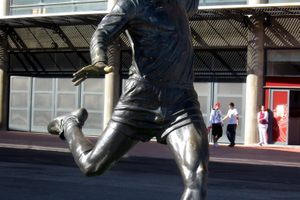
Benfica honored their greatest ever player with a statue outside their home ground, Estádio da Luz. The bronze statue depicts Eusébio in his trademark pose, readying to unleash his fearsome right-footed shot that brought so much joy to the fans of Benfica and the Portuguese national team, and which also secured his legacy as one of the beautiful game's greatest ever players.
Community Contributors

Added By
Published
August 7, 2026
Sources
- https://nationalmuseumpublications.co.za/eusebio-the-mozambican-who-became-portugals-legendary-soccer-star/
- https://www.theguardian.com/football/2014/jan/05/eusebio
- https://www.uefa.com/news-media/news/0211-0f8a35876e14-1dd0d4511a73-1000--eusebio-da-silva-ferreira-1942-2014/
- https://www.theguardian.com/football/2010/jun/06/eusebio-africa-world-cup
- https://www.bbc.co.uk/sport/football/25611509
- https://www.topendsports.com/athletes/football-soccer/eusebio.htm
- https://www.fifa.com/en/articles/100-great-world-cup-moments-qatar-2022-31-eusebio-portugal-star-1966