About
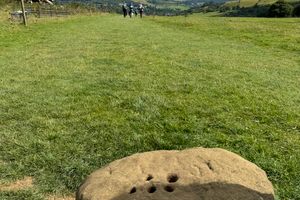
The Eyam Boundary Stone, found on the edge of Eyam village in Derbyshire, represents the village’s brave decision to quarantine itself during the Great Plague of 1665-1666. Eyam, often referred to as the "Plague Village," took remarkable steps to stop the disease from spreading beyond its limits. The Boundary Stone was key to this effort, serving as a place where villagers could leave money for food and supplies while keeping a safe distance from outsiders. To avoid spreading the plague through direct contact, they disinfected the coins by putting them in holes in the stone and soaking them in vinegar, which they believed would kill the plague germs.
The story of the Eyam Plague is one of great sacrifice. The plague came to the village in 1665 through a cloth infested with fleas sent from London, and it quickly began to take lives. The village rector, William Mompesson, along with his predecessor, Thomas Stanley, led the community in a bold decision to isolate themselves from the outside world. This quarantine lasted over a year and was meant to protect neighboring towns from the plague, even though it meant that the villagers were putting their own lives at risk. More than 260 villagers died during this time, but their selflessness helped prevent the disease from spreading further.
The Boundary Stone still stands today, about a mile from the village center on the way to Stoney Middleton. The holes for coins, known as "plague holes," can still be seen, and serve as a powerful reminder of the fear and challenges people faced back then as they tried to survive the threat of the plague.
Today, people visit the Eyam Boundary Stone to honor this remarkable part of history.
Know Before You Go
The Eyam Boundary Stone is located about a mile outside the village of Eyam. The village is easily accessible by car from nearby towns such as Bakewell and Sheffield. For those traveling by public transport, the nearest train station is in Grindleford, from where you can catch a bus or take a taxi.
The Boundary Stone can be visited year-round, though the best time to explore the village and its surroundings is during spring or early autumn, when the weather is pleasant for walking the trails around the village.
The Boundary Stone is on a public footpath, and the walk is relatively easy, though sturdy shoes are recommended due to uneven terrain in parts. While the stone itself is a modest marker, its historical significance makes it a must-visit for anyone exploring Eyam.
Do take the time to explore the village of Eyam in full, as there are several other plague-related sites worth visiting, such as the Riley Graves and the Eyam Museum. Don’t forget to be respectful of the area's history, as it is still a place of remembrance for the tragic events that took place.
Community Contributors

Added By
Published
June 19, 2026