About
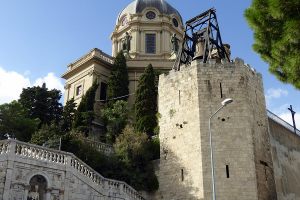
The Castellaccio is the oldest fort in the city of Messina. Around the middle of the 16th century, during the period that Sicily was ruled by Spain under Habsburg Emperor Charles V. He wanted to incorporate Sicily into Spain proper. He instructed his Viceroy, Juan de Vega, to improve fortifications, and he fortified the city by building very strong walls and four royal fortresses. Castellaccio and the other fortifications were designed by the Venetian military architect Antonio Ferramolino.
After a long period of abandonment, a new use for the fort was proposed in the mid-late 1940s. After WW2, control of the fort was granted to Father Nino Trovato, who transformed it into "Villa Pia", described as a “colony” for boys (essentially an orphanage). The priest took over a completely ruined fort (it had not been spared either by the 1908 Messina earthquake or by the wartime bombings). He began to build the dormitories, the kitchen, the canteen, the infirmary and then the school next to the old fort. That school was named after Monsignor Valdelli, one of the architects of the economic aid that came originally from the Americans, but was administered by the Pontifical Aid Organization. The fortress stands a short distance from Forte Gonzaga (also built by Juan de Vega and designed by Antonio Ferramolino).
The original structure has a quadrangular design, but the site is highly modified by the more modern buildings constructed by Travato, all now in a state of dereliction. More recently, after the Villa Pia colony closed, the Italian Scout and Guide Association tried to use the structure as a training centre for both leaders and young people. However, finances did not ultimately work out and the structure has been empty for some time.
The site is now best considered as a destination for urban explorers, but even if that is not your thing, the view from the fort towards the straits is well worth the visit. It is considered locally to be haunted by the ghosts of orphans and by the apparition of a nun.
Know Before You Go
The road up to the fort is described as being a restricted road, so it is probably best to walk up from the streets on the eastern side.
Community Contributors

Added By
Published
June 19, 2026