About
Being a child in Cambodia is likely to be rough. By many counts, the country is one of the poorest in Asia, leading to high rates of child abandonment and even orphaning. It is also one of the most heavily-landmined countries, a legacy of 20th-century conflicts like the Vietnam War and the Khmer Rouge regime, which means that many children will often have had an amputation or explosion-related incident. In this context, there are many types of institutions that offer services to care for children, on all-day or part-time bases. Some of these are known as orphanages, even if most of the children attending them actually have a living parent or even both. There are also boarding schools, day nurseries and activity centers that help keep children occupied for working parents and guardians.
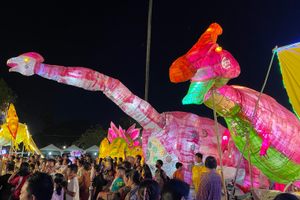
It is in this context that the Giant Puppet Project started in 2007. Similar to the origins of the Phare Circus , the Giant Puppet Project came about through an art therapy program aimed at children in vulnerable situations. The children make the puppets and participate in parading them through the streets of Siem Reap (Cambodia's main tourism hub), earning skills that could help them with future employment as artisans, allowing them to connect with knowledge of their culture and the wider world, and even just offering them a fun distraction to break from their routine. In this sense, the puppets not only benefit the children who participate in the parade, but also the very many who come to witness it.
The only hiatuses in the yearly activity since its inception were in 2020, 2021 and 2022, all because of the COVID-19 pandemic. Otherwise, the giant, themed lit-up paper puppets have paraded across Cambodia's main tourism hub on a single night every spring. Since the parade's return, it is estimated that 400-500 children participate in each edition.
Another similarity that this initiative shares with Phare is that both have activities divided between Siem Reap and Battambang, where the puppets are often designed before being built across both cities. Outside of the parade date, these workshops can often be visited throughout the year to see the puppets in the process of being brought to life.
Related Tags
Know Before You Go
The parade takes place one night a year, usually in late February or early March. It is recommended to check online for the date, starting time, route and theme for the year. Dinosaurs were the 2024 theme, with Khmer mythology in 2025, for example.
Missing the parade date doesn't necessarily mean you won't be able to see the puppets. These are often left on display around Siem Reap's tourist hotspots after the parade. The location on the map is for the parade's end point in 2024, and where the puppets were displayed afterward.
Workshops where they are built can also be visited in Siem Reap and Battambang. Please be wary, however, as "voluntourism" in Cambodia is often focused on children's centers, fueling a system that can ultimately be detrimental to them. It is strongly recommended to do extensive research before taking part in it.

Published
September 2, 2026
Sources
- https://hyperallergic.com/360210/the-gliding-glowing-giants-of-a-cambodian-puppet-festival/
- https://www.khmertimeskh.com/501247922/get-ready-for-giant-puppet-parade/
- https://pharecircus.org/siem-reap-giant-puppet-parade/
- https://www.worldbank.org/en/programs/sief-trust-fund/brief/increasing-early-childhood-care-and-development-through-community-preschools-in-cambodia-evaluating-the-impacts
- https://cambodianchildrenstrust.org/volunteer-in-cambodia/
- https://www.pbs.org/newshour/show/why-cambodian-orphanages-house-so-many-children-whose-parents-are-still-alive
- https://www.rfa.org/english/news/cambodia/landmines-casualties-04042024172953.html