About
Imber sits isolated in the middle of the chalk plateau of Salisbury Plain, several kilometers away from any other settlement. Resembling any other village in rural Wiltshire, it is only upon closer inspection that there is more, or arguably less, than meets the eye.
The first evidence of Imber's existence was recorded in 967 AD. It next appeared on the 1083 AD survey of England and Wales, better known as the Domesday Book, which listed the village's population at around 50 people. Continuing to exist as an agricultural community, it peaked at 450 residents on the 1851 survey, before shrinking back down to 150 by the early 1940s.
In the middle of World War II, on November 1, 1943, all villagers were summoned to a meeting at the school, and hastily given a 47-day notice of eviction. In advance of the Allied invasion of Europe, Imber was to be used as a training ground by American troops to practice street combat. Initially, residents were told that they could return 6 months later or when the war was won. This never happened.
In truth, the War Office had been purchasing much of the land around Imber for practicing military maneuvers since the late 19th century. Good prices offered to struggling farmers encouraged most to sell their land; the properties were then rented back to the villagers at low rates. Content with their new tenancy agreements, few gave any thought to potential evictions. By the outbreak of WWII, the few properties not owned by the War Office were the church, vicarage, chapel, schoolroom, and the Bell Inn pub.
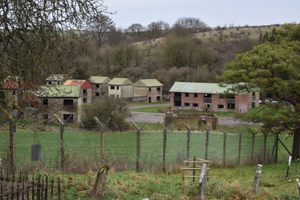
Post-war, the displaced inhabitants submitted petitions to return to Imber, but were continually rebuffed in favour of keeping the village uninhabited for military purposes, which it continues to be used for, to this very day. Many of the long-standing cottages fell into disrepair and were demolished, replaced by shell buildings in the 1970s. These aided British troops in preparation for the urban battle situations they would face in Northern Ireland during The Troubles.
Some of the pre-war buildings are still standing, such as Imber Court, Seagram's Farm, the Bell Inn, and the village's most distinctive landmark, St Giles Church. Built in the 12th century and Grade I heritage-listed, it is Imber's lone upkept structure. Maintained by the Diocese of Salisbury since 2002, it continues to perform an annual church service on St Giles’s Day (September 1st) each year.
The last known resident of Imber was laid to rest at St Giles in January 2023, very likely the churchyard's final funeral service. Sadly, it appears that unless the Ministry of Defence relents on its stance, Imber's buildings will continue to stand as empty, characterless husks, eerily bereft of homely features and human life.
Know Before You Go
Imber is open to the public for 50 days per year. The St Giles's Day service at the church is on a fixed open day and is the most popular date to visit the village.
The other public access days are negotiated with the Ministry of Defence, changing from year to year. For those interested in visiting Imber, the schedule for the open days is listed on the St Giles Church website.
On open days, it is possible to visit the church and to walk through the village along Imber Road, but the rest of the buildings are strictly off-limits.
Community Contributors

Added By
Published
August 7, 2026