About
The Kendall Band is a complicated three-piece musical sculpture installed in Kendall Station, not far from the MIT campus in Cambridge, Massachusetts. Created by Paul Matisse—the grandson of artist Henri Matisse and stepson of artist Marcel Duchamp—it brought some much-needed musicality to the otherwise rumbling subway station.
Back in the late-1970s, the Massachusetts Bay Transportation Authority (MBTA) launched its "Arts on the Line program, aimed at bringing art into the stations of the Boston subway (locally known as the "T"). Around 20 works were commissioned, among them Matisse's musical sculpture.
Unlike most of the other works, Matisse had proposed an ambitious project with numerous working parts, all of which could be operated by the public from either side of the tracks in Kendall Station, its ultimate destination.
Finally installed in 1987, the Kendall Band, as it is known, consists of three musical elements, named Pythagoras, Kepler, and Galileo. Pythagoras is the most complicated, with 16 perfectly tuned B minor musical bells suspended between the train tracks, with 14 long hammers hanging between them. By operating one of the levers located on either platform, members of the public can set the hammers in motion, striking the tubes and creating music.
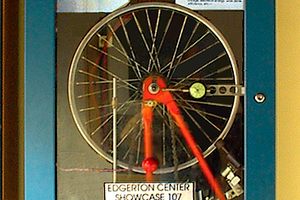
Kepler, meanwhile, hangs in an arch near between the tracks not far from the other two works. It features a machined-aluminum ring of 55-inches in diameter, which is struck by a hammer when a handle on the subway is pulled. It produces an F sharp note which complements the sound produced by Pythagoras.
Galileo is the third piece of the band. It’s basically a large sheet of stainless steel, about the size of a barn door, which functions as a thunder sheet, producing a powerful reverberation throughout the subway tunnel when struck. It too is operated by handles on either side of the platform.
In theory, once all three pieces were successfully installed, passengers waiting for trains on either platform could operate these musical sculptures, filling the station with music. But from almost the moment of its installation, the Kendall Band had issues.
Matisse had spent years calibrating the pieces before they were installed, but Pythagoras failed before Galileo and Kepler had even been put in place. The sculpture had to be dismantled, and a few weeks later Matisse taped an explanation to the station wall: “The problems all relate to my underestimation of the strength of humanity,’’ he wrote. “With any luck at all, we will make it last forever.’’
So began a tradition of sorts in which parts of the Kendall Band failed, followed by explanatory notes on the station walls. Some passengers encouraged the repair efforts, writing things like “Keep up the good work!’’ and “Thanks for the explanation!’’ on Matisse’s letters. Others were not so supportive. One anonymous missive stated: “If you spent my tax $ on this, then may you die slowly!!’’
Over the years, the Kendall Band has been beset by problems, most of them related to the operating system and the levers on each platform. Solutions were found for many of these issues, and improvements were made. Still, it was an ongoing battle to keep everything in working order.
Matisse kept on returning to the station in an attempt to keep things operational, but after nearly 20 years he finally grew tired of all the maintenance. In 2007, the then 74-year-old Matisse decided to leave the band to its fate, and the sculpture quickly fell into disrepair. Soon, out of the original six handles, four were removed, leaving only Galileo in a working state.
But as with many great bands, breakups are often overcome with the help of the fans. In 2010, one such fan, Seth G. Parker, decided to get the Kendall Band back on its feet. Parker, a principal at a Massachusetts based energy consulting firm, contacted the Massachusetts Institute of Technology, who in turn contacted Matisse to help plan the restoration (he had previously lost all the designs for the Kendall Band after a hard-drive crash).
A group of 20 or so students joined the project, collectively known as the Kendall Band Preservation Society. And since then, the society has labored, with varying degrees of success, to keep the musical sculpture functioning. Since 2010, they have dismantled, refurbished, and restored the Kendall Band, but it’s very much an ongoing project. So when you pass through the station, be sure to treat the levers gently, and keep an eye out for any explanatory handwritten letters posted on the walls.
Know Before You Go
The Kendall Band is located in Kendall Station (MIT Station) on Main Street at Broadway in Cambridge, Massachusetts, across the river from Boston. It’s part of the MBTA Red Line, which operates Monday to Saturday from approximately 5:15 a.m. to 1:20 a.m. and Sunday from 6 a.m. to 1:20 a.m.

Published
May 29, 2019
Sources
- http://www.paulmatisse.com/kendall-band
- http://archive.boston.com/news/local/massachusetts/articles/2010/05/09/fine_tuning_the_kendall_band_once_more/?page=full
- https://dspace.mit.edu/handle/1721.1/115453
- https://kendallband.wordpress.com/about/the-kendall-band/
- https://thetech.com/2018/02/01/restoration-of-kendall-band