About
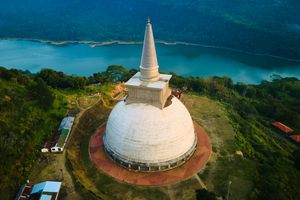
Completed in 2016 after a 33-year construction period, the Kotmale Mahaweli Maha Seya is an intriguing addition to the cultural landscape of Sri Lanka. With a height of 289 feet and a diameter of 200 feet, this stupa is the second largest in the country. The existence of this stupa is inextricably linked to the huge hydroelectric power station a few miles down the road.
In 1961, Sri Lanka embarked on the largest development project to date: the Mahaweli Development Program. The main purpose of this project was the construction of a dam along the Mahaweli River in order to generate hydroelectric power, regulate the flow of the river, increase farming output, and alleviate poverty in the region. Construction started in 1961, and the bulk of the program was completed by 1995. During this period, several phases of the project were implemented. One of these was the damming of the river, which took place in 1984 and caused the immediate upstream area to flood. In commemoration of all the people who lost their property and the fifty temples that were submerged, it was decided that a stupa should be built overlooking the dam.
The design of the Kotmale Mahaweli Maha Seya was assigned to Vidya-Jyothi Dr. A.N.S. Kulasinghe, a highly regarded Sri Lankan civil engineer that passed away before the construction was completed. Modelled after the traditional Anuradhapura's ancient stupas, the Kotmale Seya also incorporates classic Sri Lankan design elements in its pinnacle, where a finial crowns the dome. The entrances to the stupa also mirror those of ancient temples, featuring prominent carved moonstones, guard stones, and wing stones. However, unlike ancient stupas, Kotmale Mahaweli Maha Seya is hollow, and within its hemispherical interior, there is another quite sizable stupa. Around the smaller stupa are three concentric circumambulation platforms.
Due to the large hollow dome, sound reverberates and creates an intense echo. Whether this feature was intentional or accidental is not clear, but when pilgrims chant mantras around the smaller stupa, the booming echo is said to enhance a sense of spirituality and transcendence.
Community Contributors

Added By
Published
August 1, 2025