About
Namur is a city located an hour's drive southeast of Brussels. As you walk near the Pont des Ardennes bridge over the Meuse River, you may notice a strange grey-green sculpture standing on a tall concrete pedestal. This sculpture depicts a horse that seems to be leaping over the river with four figures on its back. Its futuristic appearance and multicoloured ceramic panels are somewhat disconcerting. The name 'Le Cheval Bayard' (the Bayard Horse) is known to all the locals, even if it is not very visible and there is no sign explaining it.
The story of this sculpture began in 1958 at the Brussels World's Fair, where sculptor Olivier Strebelle was chosen to create a piece to grace the Porte de l'Esplanade, one of the fair's entrances. An episode from the 'Chanson des quatre fils Aymon' (Song of the Four Sons of Aymon) was chosen for depiction. Dating from the 13th century, this chanson de geste tells the story of four brothers. They try to escape Charlemagne. They do so by fleeing on the back of a magical horse. This horse is capable of crossing the Meuse valley in a single leap. This medieval text was a great literary success and has enjoyed a resurgence of interest since the 19th century. Many different locations are being used for this, which is good, because it leaves traces in Belgium, Germany, France and the Grand Duchy of Luxembourg.
The artist chose to depict one of the horse's impressive leaps. The sculpture is made of bronze covered with ceramic tiles. However, on the last day before the opening of the World's Fair, when the artist returned from his lunch break, he discovered that the crates containing the final ceramic pieces had disappeared. They were never found, leaving the sculpture unfinished.
Following the World's Fair, the sculpture was stored in Namur and installed in 1961. It seems that we owe its current location to Roger Bastin, the architect of the nearby Ardennes Bridge, who wanted to adorn the structure with a work of art. Unfortunately, contrary to the wishes of the architect and the artist, the sculpture was installed too low — it is almost invisible from the bridge — and without night lighting. Additionally, the locals did not initially appreciate its modern appearance, and it took years for them to grow attached to it and recognise it as an iconic sculpture of the city. An example of this is that the Namur Francophone Film Festival (FIFF) chose the sculpture as its logo, and its awards are called the 'Bayards'.
At the time of writing in 2025, plans were in place for a major restoration project. There were also plans to raise its base to make it more visible. A fundraising campaign was about to be launched, but then a local brewery decided to fund the entire project itself! Had the campaign been launched, the people of Namur would probably have shown just as much enthusiasm. This anecdote demonstrates the population's enduring attachment to the sculpture.
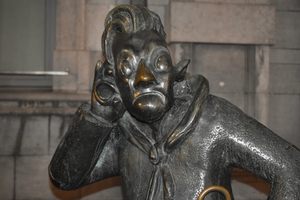
Despite the appearance of other emblematic sculptures, such as 'Djoseph et Françwès' on the Place d'Armes, the Cheval Bayard is undoubtedly the sculpture to which the inhabitants of Namur are most attached. Its upcoming restoration will restore its visibility.
Related Tags
Know Before You Go
The statue is surrounded by busy roads, so take extra care when crossing them. When you leave the statue, take a detour to the roundabout on Rue d'Harscamp, 250 metres upstream on the same quay. There, you can see the work « Bras Ouverts » (1999) by the same artist.
Community Contributors
Added By
Published
November 30, 2025