About
The Philadelphia Merchants’ Exchange Building is a prominent site in American history. Once the location of the nation’s first stock exchange, one of Philadelphia’s early post offices, and the headquarters of the Philadelphia Board of Trade, the marble building also served as a common space for civic and industry business.
Prior to the erection of the stately Greek Revival structure in the late 1890s, negotiations and transactions took place in coffee houses and taverns. But without widespread telephone adoption, this nodular setup made coordination and communication difficult.
In 1831, a group of citizens led by prominent banker and philanthropist Stephen Girard envisioned a civic space that would contain multitudes, cohering Philadelphia’s business processes—from contracting to commodities trading—in a single space. They tapped Philly architect William Strickland, who designed many of the city’s most notable buildings, for the job.
Strickland was apprentice to Thomas Jefferson’s architect of choice, which afforded him a strong reputation among early Philly’s movers and shakers. When he was appointed to the Merchants’ Exchange job, he was faced with the uncommon architectural challenge of designing a rectangular-footprinted building on a triangular plot of land. The back side of the Greek Revival structure demonstrates his solution: a semicircular façade that follows the curved line of Dock Street to the building’s rear.
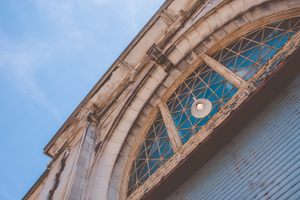
Today, the Merchants’ Exchange serves as headquarters of Independence Historical Park, a campus of historical sites and buildings in a federally protected historic district of Philly’s Old City. On a visit, check out architectural details like imported Carrera marble from Italy alongside local Pennsylvania blue marble, an ornate Corinthian portico inspired by Athenian architecture, and the cornerstone that was laid to commemorate the 100th anniversary of George Washington’s birth.
Know Before You Go
History buffs will want to stop by the small public exhibit in the building’s lobby which chronicles the physical and usage changes of the building since its construction in the 1830s.
Community Contributors

Added By
Published
November 17, 2025