

About
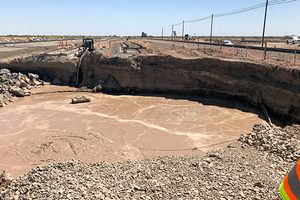
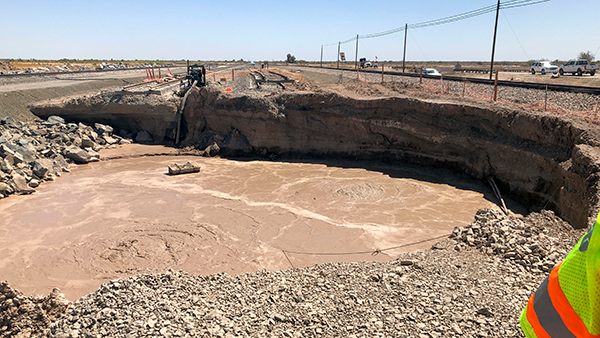
Around 1953, a mud pot later known to geologists as W9 formed in the Imperial Valley of California. Formed by rising carbon dioxide coming from tectonic rocks, such formations are unsurprising at the southern end of the notoriously active San Andreas Fault. This forces water to also rise to the surface, creating a muddy bottom similar to quicksand. The pool releases water and hydrogen sulfide, the latter of which gives off a distinctive rotten egg smell. Despite its nickname, the Niland Geyser is not a true geyser, and its waters are not heated to just 80°F.
The mud pot was not a serious issue until it began moving around 2015 or 2016, possibly because of seismic activity. Some believe that this is the only instance of a moving mud pot, and it is certainly the only known instance of one moving at such a noticeable rate. By 2017 it was spilling muddy water into drainage ditches, and in June 2018 Imperial County declared a state of emergency because of the threat to the nearby railroad, highway, pipeline, and fiber-optic cables. The former is particularly significant because it is one of the major transcontinental routes in the United States, important to international shipping.
Engineers first attempted to stop the pot's movement by digging wells to reduce its pressure. When that did not work, they also attempted to directly pump the water away and block the hole with rubble and steel sheets. None of these worked either, and the mud pot was soon directly under the railroad tracks. The railroad, highway, and other infrastructure were forced to be rerouted. Highway work alone cost the state of California around $20 million. As the highway was built to the west of the hole in its future path, it may be rerouted again back to its original route in the future.
The Niland Geyser, nicknamed "the Slow One," sped up over time from 20 feet per year in 2018 to 10 feet per month in 2020. By 2021 it had slowed down somewhat to 3 feet per month but was already eating away at the original highway's surface. There is no consensus on what makes this particular mud pot move and when it will stop moving. Geologists David K. Lynch and Travis Deane suggest that the pot's carbon dioxide is reaching the surface via a tilted route and will halt once it is directly over the gas's source. The good news is that there are no buildings in the pot's projected future path, which is towards the endorheic Salton Sea.
Know Before You Go
The Niland Geyser can be viewed from the rerouted Highway 111.
Community Contributors
Added By
Published
June 19, 2026