About
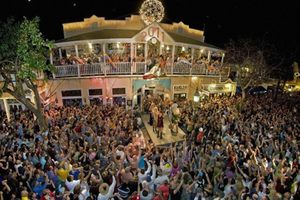
Marooned on a triangular intersection at the heart of New York City's busiest neighborhood sits One Times Square, the iconic setting for the annual New Year's Eve ball dropping ceremony, broadcasted worldwide and attracting hundreds of thousands of revelers each December 31.
Constructed in 1904 as the headquarters for the New York Times, it was the tallest building in the city when measured from basement level to roof deck. One Times Square's completion coincided with the opening of the city's first subway line in 1904 and was instrumental in the development of its surroundings into a thriving commercial area. In a brilliant publicity ploy, the paper's owner Adolph Ochs volunteered to hold the city's New Year's Eve celebration for the building's opening year. The festivities had previously been held at lower Manhattan's Trinity Church, but the raucous nature of the night was nerve-wracking for Trinity and the church was relieved to relinquish their role in the celebration. Ochs was intent on making December 31, 1904, a night to remember and spared no expense. An all-day festival in the streets culminated at midnight with fireworks raining down on over 200,000 guests and One Times Square was officially marked as the new setting for the city's annual New Year's Eve bash.
Within a couple of years the fireworks display was banned by the city because of the dangers of explosives showering debris down on attendees. Ochs was determined not to let the ban detract from the spectacular quality of the city's New Year's festivities and turned to the newspaper's chief electrician, Walter F. Palmer, to create an alternatively showy way to celebrate the arrival of 1908. Inspired by the downtown Western Union Telegraph building's clock tower, which dropped an iron ball at noon each day, Palmer hired a young Russian immigrant, Jacob Starr, to create a 700-pound ball made of iron and wood. The Times Square Ball was made that year, illuminated with one hundred 25-watt lightbulbs and ceremoniously lowered at midnight. The event was a massive success, and for most of the remainder of the 20th century, Starr, and later the sign-making company he founded, Artkraft Strauss, continued to be responsible for the yearly ball dropping ceremony as well as much of the design of the massive, luminous signage that has become indelibly associated with Times Square.
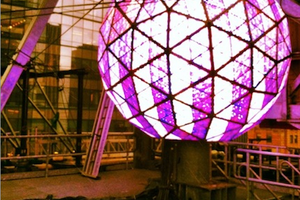
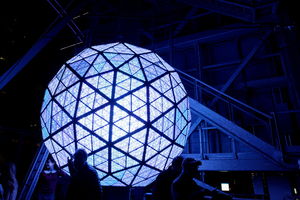
The Times Square Ball has since been redesigned and upgraded several times across the decades. The ball's current incarnation weighs in at 11,875 pounds and is 12 feet in diameter. The sphere is composed of 2,688 individual Waterford Crystal triangles, impressively illuminated by tens of thousands of Philips LEDs. It shimmers year-round from the roof deck of One Times Square, a glowing beacon overlooking the hustle and bustle of Manhattan. Hovering high above the city streets, the Times Square Ball patiently awaits December 31, when millions of spectators around the world will gather once again to breathlessly count down the symbolic sphere's glittery descent and the coming of a new year.
The ball is never taken down, if you can get in a skyscraper you will be able to see it any time of the year
Related Tags
Community Contributors

Added By


Edited By
- Martin profile photo Martin
-
dlc31723
-
brokengod001
-
Jaszmina Szendrey
-
 EricGrundhauser
-
 Michelle Cassidy
- MtnLady profile photo MtnLady
- LiamY profile photo LiamY
Published
January 1, 2016
Updated
December 23, 2025