About
Following the establishment of the Claretian order of Catholicism in 1849 by Father Antonio María Claret in Spain, its members would set out on missionary activities across the world. They arrived in Mexico in 1884, and by the 1920s they had established their first church dedicated to the Immaculate Heart of Mary. The current building was completed in 1954, not far from the location of the original church. As per a plaque dated 7 August 1960 near its entrance, several men were responsible for its building. Luis Olvera was the architect in charge of the crypt during its construction in the 1940s, Antonio Muñoz was the architect in charge of the rest of the building during the 1950s, with Miguel Rebolledo being in charge of stonemasonry and Pedro Cruz of painting. This plaque also mentions several Catholic authorities who have blessed the Parish, including José Garibi, Mexico's first cardinal.
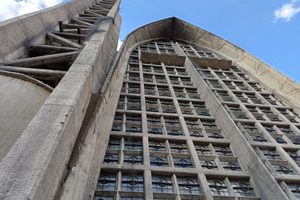
Its midcentury context is reflected in the architecture, as art deco is the main trend represented here. This Parish of the Immaculate Heart of Mary was once intended to be taller than Mexico City's Revolution Monument although this wasn't authorized by local authorities. Its current full height is 65 meters, the last 10 of which come from the monumental statue of the Virgin Mary topping its dome. Given the statue's position with arms outstretched, it is often mistaken for a figure of Jesus Christ, although among those in the know, she might be referred to as Nuestra Señora del Tránsito (Our Lady of Trafic), given that it is visible from several points in which the city traffic can come to a standstill.
The architectural modernist trends are also reflected in the parish's interior, specially its upper level, which features multi colored stained glass windows and murals. It is this section that was chosen as a key location in the 1996 film "William Shakespeare's Romeo + Juliet". The work by Australian director Baz Luhrmann featured Leonardo DiCaprio and Claire Danes in the title roles and several other Mexico City locations, including Chapultepec Castle as the Capulet mansion.
Know Before You Go
The building’s exterior is visible at all times and from several vantage points, specially the statue at the top (not in vain is it called Our Lady of Traffic). The interior is divided into two levels.
The cozy downstairs is open most often, from Monday to Friday, in two shifts. First from 9:30am to 1:30 pm and again from 4-7:30pm. On Saturdays it's only open for the morning shift, and closed on Sundays.
However, it's the upstairs area that opens on Sundays only. This is the airy interior that has most often been used as a location, including in "Romeo + Juliet".
Community Contributors

Added By
Published
December 4, 2025