About
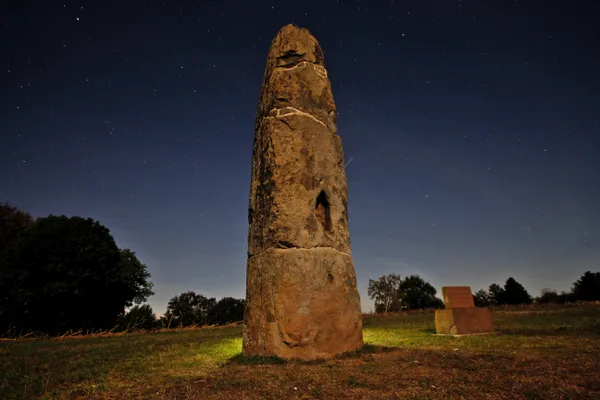
Like the National Mall in Washington, D.C., the Pattee Mall on Penn State’s University Park campus features its own prominent obelisk. Constructed in 1896 at what was then the Pennsylvania State College, the Obelisk (or “polylith”) stands 33 feet tall and contains 281 blocks sourced from 139 locations, primarily within Pennsylvania. It was constructed the same year that Penn State’s School of Mines (now the College of Earth and Mineral Sciences) was founded. The Obelisk stands next to the former site of the historic Armory building and is now between the modern Willard and Sackett buildings adjacent to Old Main.
The Obelisk was built to showcase the weathering of Pennsylvania building stones and their subsequent commercial value. Its stones are ordered sequentially from oldest on the bottom (pre-Cambrian) to newest on the top (Triassic). The stonemason for the project, Michael Womer, was local to State College. Certain stones are labeled visually, such as “AVONDALE MARBLE PENNA.” and “CHESTER, PA.”
According to Magnus C. Ihlseng, the professor responsible for the Obelisk's creation, "It exhibits many of the varieties of structural material with which Pennsylvania is endowed and reveals to the architect at a glance the possibilities of artistic combinations from our native products...Thus the column is not only picturesque but exceedingly valuable to student, visitor, and artisan."
Know Before You Go
Know Before You Go
The Obelisk is free to visit on Penn State’s University Park campus. While it is searchable on Google Maps as “Obelisk Garden”, visitors using alternative maps services may need to use the address of the adjacent Old Main and find the Obelisk nearby. Parking is available on campus at the nearby Nittany Parking Deck or Hub Parking Deck, as well as in downtown State College.
Community Contributors
Added By
Published
January 25, 2026