Places Foods Stories Newsletters
Loading...
Loading...
Loading...

No search results found for
“”

Make sure words are spelled correctly.

Try searching for a travel destination.

Places near me Random place

Popular Destinations

  • Paris
  • London
  • New York
  • Berlin
  • Rome
  • Los Angeles
Places Foods Stories Newsletters
Sign In Join
Places near me Random place
All Greece Athens Philopappou Hill Pathways

Philopappou Hill Pathways

Rest stops along this pathway offer some of the best views of the Acropolis of Athens.

Athens, Greece

gus619USA profile photo
Added By
gus kontopuls
Email
Been Here
Want to go
Added to list
CAPTION
View form the summit of the Parthenon   gus619USA / Atlas Obscura User
Pathway masonry   gus619USA / Atlas Obscura User
Philappos Monument   gus619USA / Atlas Obscura User
Pathway masonry   gus619USA / Atlas Obscura User
View of Acropolis halfway to the summit   gus619USA / Atlas Obscura User
Pathway masonry   gus619USA / Atlas Obscura User
View from the summit of the Aegean Sea   gus619USA / Atlas Obscura User
Sign to the Monument   gus619USA / Atlas Obscura User
Lower rest area   gus619USA / Atlas Obscura User
Wooden bridge over gulch   gus619USA / Atlas Obscura User
Pathway masonry   gus619USA / Atlas Obscura User
View of the Acropolis from the lower rest area   gus619USA / Atlas Obscura User
Pathway masonry   gus619USA / Atlas Obscura User
Been Here
Want to go
Added to list

About

Philopappou Hill takes its name from Prince Gaius Julius Antiochus Epiphanes Philopappos. Philopappos came to Greece in the 1st century A.D.E. from the Kingdom of Commagene after it was assimilated into the Roman Empire. Philopappos was extremely wealthy and was known for his philanthropy, funding many projects in the city. When Philopappos died in 116 AD his sister built his tomb as a monument directly southwest of the Acropolis atop what was then known as the Hill of the Muses. The Philopappos' monument was a magnificent, two-story structure, built with solid Pentelic and Hymettian marble. The monument remained intact until at 15th century, when portions were stripped by the occupying Ottomans for various uses. The remains of the monument sat on Philopappos Hill in that condition for the next 500+ years.

In 1951 the Greek government developed a plan to beautify and make the area south of the Acropolis more accessible to the citizens of Athens. The project included pedestrian paths that led to the summit of Philopappos Hill. Local architect Dimitris Pikionis was selected to oversee the project. Pikionis was born in Piraeus, Greece in 1887. He was interested in building design as a youth and eventually enrolled at the National Technical University of Athens to study civil engineering. He graduated in 1908 and left Greece to continue his studies in France and Germany. He returned to Greece in 1912 and began focusing his studies on modern Greek architecture. In 1921 he accepted a position as a lecturer at the National Technical University of Athens and in 1925 accepted a position as a full professor. He worked on various projects throughout the city while teaching, and in 1951 he was selected by the Greek government to lead the efforts to implement the project.

The project began in 1954. Pikionis collaborated with his colleagues, students and local stonemasons and together they developed a plan that was mostly reliant upon impromptu on-site decisions. The approach did not involve detailed written plans, nor was there a need for approval from the Greek government.

At the time Philopappou Hill was a mostly barren, rocky hill with narrow dirt paths leading to the summit. Pikionis’ vision for the hill was to reforest it with a large number of pine and olive trees, insert steps, pave the paths, and install numerous seating areas with views of the nearby Acropolis.

A collage of ancient ruins, cut marble, salvaged stone pieces from demolished neoclassical buildings, and ceramic shards found in the area were then gathered and organized. The students and workers then shaped the objects with chisels and carefully cemented them in a collage into the numerous paths leading to rest areas and the summit. The merging of all these objects created what many considered an amazing piece of art.

The project was completed with little fanfare in February 1958 and included the pedestrian walkway leading to the Propylaea and the area surrounding the Church of Agios Dimitrios Loumbardiaris. Despite the low-key approach, this project was recognized as part of the Acropolis of Athens when it was added to the UNESCO World Heritage List in 1987. This project is considered by many to be one of the most significant landscape architecture works in the 20th-century.

Places

Discover your next amazing Atlas Place.

Get more unusual and extraordinary places each week with the Atlas Obscura Places newsletter.

Your newsletter subscriptions with us are subject to Atlas Obscura's Privacy Policy and Terms of Use.

Related Tags

Architecture Ruins Ancient Greece

Know Before You Go

Philopappou Hill is open 24/7 with no gates. The climb up requires a moderate physical output. Care should be taken on hot days. If one if climbing up to enjoy the amazing sunset views a flashlight for the trip down is advisable. If one is visiting late at night, they should be cautious and aware of their surroundings as the area has occasional crime.

The easiest way to hike to the summit is to start on one of the paths near the top of Rovertou Galli Street, or off the fire road leading towards the Church of Agios Dimitrios Loumbardiaris (which also has amazing displays of Pikonias work). For a more challenging experience start on the east face of the hill off Garavaldi Street or Epitanous Street. If you hike up from the northeast you will not see much of Pikionias’ work on the way up, as this area is part of the protected ancient Koile Road to Piraeus.

There are many wild land tortoises on Philopappou Hill. They are interesting to watch, but are legally protected by both Greek national laws and European community regulations and should not be fed, removed or harassed.

Community Contributors

gus619USA profile photo

Added By

gus619USA

Published

March 26, 2026

Edit this listing

Make an Edit
Add Photos
Philopappou Hill Pathways
41 Filopappou
Athens, 117 41
Greece
37.967119, 23.721575
Get Directions

Nearby Places

Caves of Filopappou Hill

Athens, Greece

miles away

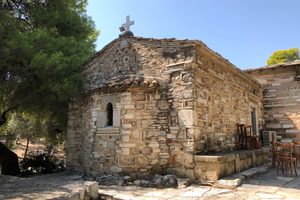
Church of Agios Dimitrios Loumbardiaris (Saint Demetrius the Bombardier)

Athens, Greece

miles away

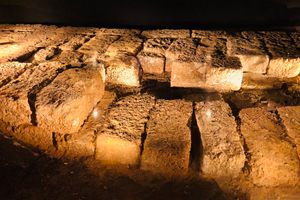
Divani Palace Acropolis Fortification Wall

Athens, Greece

miles away

Explore the Destination Guide

Photo of Athens

Athens

Greece

Places 87
Stories 4

Nearby Places

Caves of Filopappou Hill

Athens, Greece

miles away

Church of Agios Dimitrios Loumbardiaris (Saint Demetrius the Bombardier)

Athens, Greece

miles away

Divani Palace Acropolis Fortification Wall

Athens, Greece

miles away

Explore the Destination Guide

Photo of Athens

Athens

Greece

Places 87
Stories 4

Related Places

  • The river bed of Eridanos at Monastiraki train station on November 7, 2019

    Athens, Greece

    Archaeological Site Inside Monastiraki Metro Station

    View the ancient remains of buildings and the ancient "River of Hades" before hopping on a train.

  • First Ancient Theatre of Larissa

    Larisa, Greece

    First Ancient Theatre of Larissa

    Dedicated to the god Dionysus, this theatre was used for both musical and theatrical performances.

  • Lower level view 3

    Athens, Greece

    Valerian Wall at Niche Hotel

    The ruins of an ancient fortification wall sit in front of and underneath this boutique hotel.

  • P-1 Level 1.

    Athens, Greece

    Klafthmonos Square Parking Structure Fortification Walls

    Preserved portions of Athens's ancient defenses are on display in a subterranean parking garage.

  • Capo Colonna

    Crotone, Italy

    Capo Colonna

    A single column facing the sea is all that's left of one of the most important temples of Magna Graecia.

  • Bay-Eva Castle columns.

    Arlington, Virginia

    The Bay-Eva Castle Site Historical Marker

    Two columns and a path leading into the woods at Fort Bennett Park are all that remain of a custom-built, Bavarian-inspired castle

  • Roman villa of Echternach.

    Echternach, Luxembourg

    Roman villa of Echternach

    The ruins of one of the most important Roman villas north of the Alps.

  • Ancient City of Histria

    Istria, Romania

    Ancient City of Histria

    Once a thriving Greek port, now a windswept ruin lost to time.

Aerial image of Vietnam, displaying the picturesque rice terraces, characterized by their layered, verdant fields.
Atlas Obscura Membership

Become an Atlas Obscura Member


Join our community of curious explorers.

Become a Member

Get Our Email Newsletter

Follow Us

Facebook YouTube TikTok Instagram Pinterest RSS Feed

Get the app

Download the App
Download on the Apple App Store Get it on Google Play
  • All Places
  • Latest Places
  • Most Popular
  • Places to Eat
  • Random
  • Nearby
  • Add a Place
  • Stories
  • Food & Drink
  • Itineraries
  • Lists
  • Video
  • Podcast
  • Newsletters
  • All Trips
  • Membership
  • Feedback & Ideas
  • Community Guidelines
  • Product Blog
  • Unique Gifts
  • Work With Us
  • About
  • FAQ
  • Advertise With Us
  • Advertising Guidelines
  • Privacy Policy
  • Cookie Policy
  • Terms of Use
Atlas Obscura

© 2026 Atlas Obscura. All Rights Reserved.