About
It’s one of the most iconic and recognizable images in US history. A poster of Uncle Sam, the personification of the federal government, dressed in patriotic colors, looking sternly and pointing at the viewer, with the caption, “I WANT YOU FOR THE U.S. ARMY.” The poster was created by James Montgomery Flagg in 1917 to increase recruitment following the US entry into World War I. Although this may be the most well-known image of Uncle Sam, the symbol has been around much longer and, according to legend, is based on a meat packer who was born in Massachusetts.
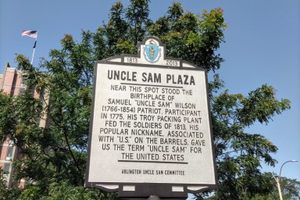
Samuel Wilson was born in Menotomy, Massachusetts (present-day Arlington), in 1766. In 1781, at age 14, he enlisted in the Continental Army and performed various support duties such as protecting livestock, repairing fences, and preparing animals for slaughter. In 1789, he and his brother Ebenezer moved to Troy, New York, where they set up a meatpacking business named E&S Wilson along the Hudson River. Wilson was a very active member of the community and earned the nickname “Uncle Sam” from people around town. During the War of 1812, his meatpacking company received a contract to provide rations to troops. The barrels filled with meat were marked “U.S.” and troops from Troy, who were familiar with Wilson, quickly noted that his nickname and the United States shared the same initials. A local newspaper, the Troy Post , picked up on the story, and over time Uncle Sam became the personified symbol of the federal government and the United States.
Some historians have cast doubt on the story, asserting that the symbol of Uncle Sam came from elsewhere or that Wilson simply popularized a mascot that already existed. Regardless, by the end of the 19th century, Uncle Sam had been firmly established as a national symbol and, in 1961, Congress officially recognized Samuel Wilson as the origin of Uncle Sam. Although the history may be unclear, Uncle Sam has come to represent the US for over a century, and the statue is worth taking a quick look at if you have an interest in the subject.
Community Contributors

Added By
Published
August 7, 2026