About
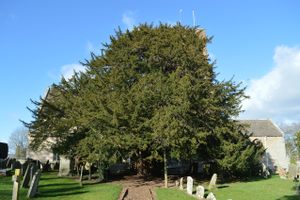
Built around 1130 by Hugh de Lacy, a powerful Norman lord, St. Mary’s Church was likely created to honor his father, Walter de Lacy, who played an important role in the Battle of Hastings in 1066 alongside William the Conqueror. The church is located on land that was originally owned by the de Lacy family, who were influential in the region known as the Welsh Marches during the late 11th and early 12th centuries. This strong connection to one of the wealthiest Norman families in England likely explains the impressive decoration inside the church.
The standout feature of St. Mary’s is the collection of early 12th-century wall paintings in the chancel, which are rare examples from a time when churches were adorned with artistic biblical scenes. These frescoes are especially important because they are the most complete set of Romanesque paintings in northern Europe, showcasing a vision of Christ from the Apocalypse. This vivid image of heaven, with Christ at the center, would have deeply moved the churchgoers and helped them grasp spiritual stories, especially as many of them were probably unable to read or understand the Latin spoken during services.
In the main area of the church, the paintings shift focus to more everyday themes, illustrating moral lessons and Christian teachings meant to guide locals in their daily lives. Created using both fresco (painting on wet plaster) and secco (painting on dry plaster) methods, these artworks reveal a great deal of skill and artistry for the time. The artists painted directly on the stone walls, crafting images that not only educated but also evoked feelings among the community. Unfortunately, these paintings were covered over with whitewash during the Reformation, when religious art became less popular, and it wasn't until 1872 that they were rediscovered.
Another notable aspect of St. Mary’s is its ancient Norman roof, recognized as the oldest wooden roof in England. Tree-ring analysis from the 1990s showed that the wood used for the roof was sourced in the early 12th century, and the structure has mostly remained intact. Unlike later roofs from the medieval period, this one uses a system of collars and struts, presenting an earlier style of construction. The roof, which was hidden behind a later ceiling for centuries, further adds to the church's remarkable preservation.
Know Before You Go
The church is generally open to visitors, but it is advisable to check in advance, especially if you want a guided tour or special access to study the wall paintings in detail.
Kempley lies near the Forest of Dean and the Wye Valley, both of which are known for their natural beauty. Visitors can combine a trip to the church with a walk through the Dymock Daffodil Walks in the spring, or a tour of other historical sites in the region.
While photography is generally allowed, be respectful of the fragile frescoes. The church is relatively small, so plan for a quiet, reflective visit, taking time to appreciate the intricate details of both the paintings and the architecture.
The church is accessible by road, with parking available nearby. It is a short drive from larger towns like Newent and Ross-on-Wye.
Community Contributors

Added By
Published
June 19, 2026