About
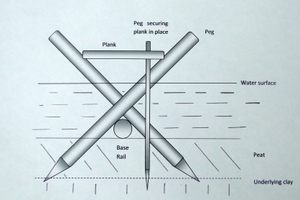
What is today the low-lying Somerset Levels in England's West Country was once a vast marshland interspersed with areas of habitable high ground. Neolithic Britons were able to cross the marsh using ingenious narrow wooden trackways often stretching over a mile in length, today believed to be some of the world's oldest purpose-built roads. The Sweet Track, which has been precisely dated to 3807 BCE using dendrochronology, once connected the Polden Hills to an island at what is now Westhay. The 1.1-mile path was constructed from 440,000 lbs of timber. The planks on top were made primarily of oak, supported by pegs of lime and ash wood and base rails of alder and hazel.
The track was only used for around ten years, likely being flooded by rising sea levels. However, the area's peat ended up preserving the track until it was rediscovered in 1970. However, the wood is extremely soft and fragile, and as such most of it remains buried in the interest of its future protection. Those parts which have been excavated and removed are kept in strict climatic conditions and have only occasionally been put on view. Instead, visitors to Shapwick Heath can enjoy a replica trackway partially constructed along the rough alignment of the original.
Community Contributors
Added By
Published
June 19, 2026