About
Tarō Okamoto was originally educated as a yōga (western-style painting) artist. As a young man, he studied oil painting, taking after his father, who was also an artist. After continuing his studies in Paris, he became influenced by the contemporary avant-garde scene and became involved in surrealist art groups and exhibitions. After World War II, he established himself as one of the leading avant-garde artists in Japan in what was seen as a reset of Japanese culture.
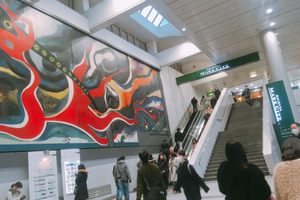
His output was informed by his theory of polarism, emphasizing that opposite principles in art could contrast within the same work rather than be synthesized. Okamoto was also influenced by prehistoric Japanese art of the Jōmon period and the traditions of Okinawa, which he sought to utilize in new ways. Among his largest and most notable public works are the Myth of Tomorrow mural in Shibuya Station and the 70-meter-tall Tower of the Sun built for Expo '70.
Okamoto's family had long lived at this site, which was destroyed during World War II. His house was rebuilt in 1954 with a design by his friend Junzo Sakakura, a student of Le Corbusier. Its unique convex lens shape was developed at Okamoto's own request. He lived there until his death in 1996, devising many of his most famous artworks and writings on art within the house. A second building next door has since been constructed as an addition to the now-museum.
Visitors are greeted on the street by an appropriately surreal self-portrait of Okamoto. Inside, the first floor showcases his living room and workshop, complete with a wax figure of the artist himself. The second floor is devoted to more of his works and a library. In front of the museum is a small sculpture garden where one can sit in one of his dome-shaped "chairs that refuse to be seated" with faces.
Know Before You Go
The museum is just an eight minute walk from Omote-sando Station. One can also walk 20 minutes from Shibuya Station.

Published
July 18, 2025