About
The Great Central Railway (renamed from the Manchester, Sheffield & Lincolnshire Railway(MS&LR) in 1897) was the last main line railway to be built in Britain (apart from very recent projects such as HS1 between London and the channel tunnel) Running south from Sheffield and linking to the earlier tracks between Manchester and the East coast it was, from Sheffield southwards, the straightest and fastest rail line to London, often reported as being built with a continental loading gauge in the 19th century anticipation of a channel tunnel, which was not completed until 1994 (this proposal is nowadays disputed). The mantra, "Rapid Travel in Luxury" became USP of the company and a non-stop service from London to Sheffield in 3 hours, unknown at the time, was regularly achieved even if it meant using slip coaches (https://railwaywondersoftheworld.com/slip-coaches.html), detached from the rear of the moving train, to allow passengers to get off at Leicester or Nottingham (in N America this would be called a "flying switch").
When UK railways were statutorily regrouped in 1923 the great Central became part of the LNER. In, what still remains, a controversial decision the Beeching report of 1963 condemned most of the former Great Central main line to closure. It is ironic that initial plans for the UK's newest high speed line, HS2 followed closely the GCR route and , in parts, ran along existing track beds. The cancellation of the Eastern arm of HS2 may become as controversial as the falling of Beeching's axe in the 1960s.
The line served Marylebone Station in London (with several miles on the outskirts of the capital run along lines jointly operated with the Metropolitan Railway). An "alternative route" was later constructed from Aylesbury (via Harrow on the Hill) to reduce the load on the Metropolitan Railway lines and this section is is still very much in operation being run by Chiltern Railways. They also run on the original shared lines route from Princess Risborough into Marylebone, for example the route from Birmingham via Warwick Parkway joins the old GCR line there.
The line north of Nottingham to Sheffield closed in 1966, as did the line between Rugby and Aylesbury. Between Rugby and Nottingham the line was kept open to passengers (DMU services) until 1969 The original, MS&LR, line from Sheffield to Manchester (https://www.atlasobscura.com/places/thurgoland-tunnel) , the first fully electrified line (1500V DC) in the UK (known as the Woodhead Line) closed in 1970 (trains (diesel) are still running as far as Penistone from Sheffield).
Two sections of lines from the Great Central Main Line have been preserved as magnificent heritage lines, both offering something slightly different. One section was preserved through the efforts of a group of individuals (formed as the Main Line Preservation Group) who campaigned for the line from 1969 onwards. This line currently runs from Leicester North station (100m south of the site of the former Belgrave and Birstall station, destroyed by vandalism and arson in the 1970s) to Loughborough Central (originally built 1898, closed 1969 then reopened by the heritage railway as their HQ in 1974). The track length is about 8 miles. It is the only UK heritage railway operating a main line double track which it has done so since the double track was reinstated in 2000.
The other line was originally kept open to serve both gypsum transportation, a bi-product from the FGD plant at a coal fired power station in N Leicestershire, and a ministry of defence ordnance depot at Ruddington. Because of this a link was also kept open to the Midland Main Line (connecting near Loughborough). This line, called the Great Central Railway (Nottingham) was temporarily called the "Nottingham Heritage Railway" (reverting back to the original name, after 2 years, in 2023). This line runs from Ruddington station close to Nottingham ,south towards Loughborough central but the GCR (Nottingham) activity stops close to the A60 close to Stanford viaduct (there is a branch line to Ruddington Fields Station which is the site of the old MOD depot). Altogether there is about 10 miles of track on this heritage line (including branch lines). Reunification with its southerly neighbour has been the aim of this organization since its inception.
The southerly limit of Great Central Railway (Nottingham) is approximately 500 metres from the northern limit of the older Great Central Railway heritage line at Loughborough. Both heritage railways have developed into excellent tourist attractions and both are recognised icons of the railway heritage. Both organisations agree that bridging the 500m separation of the two lengths of track is something that would bring great benefits if it could be achieved. The gap was created in the 1980s with the removal of several embankments and bridges and, critically, a bridge over the Midland main line (4 tracks wide) which, when replaced, required sufficient height to allow the installation of an electrical catenary at some point in the future. This is a step which has been achieved in the form of , what has become known as, The Reunification Bridge.
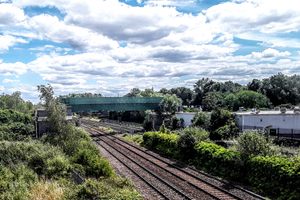
The new bridge over the Midland main line is the first piece of the jigsaw of crossing the "Gap" to be built (at a cost of £2.5,million). The bridge deck was lifted into position in 2017. In 2026, it can be seen, from the road bridge next to Loughborough midland main line station as appears currently as a bridge from nowhere to nowhere across one of the busiest rail lines in the country. It sits there as a symbol of intent and determination to raise the many millions of pounds required to finish the reunification.
The route along the "Gap" also involves crossing the Grand Union Canal (the bridge has recently been refurbished), a minor local road in Loughborough, a factory parking lot and the A60, a major road. The engine maintenance shed of the southern heritage line, at Loughborough north station. also sits across the line of progression and will have to be relocated if the Gap is to be filled. The bridge over the A60 was replaced and partially completed in 2024. The remaining works includes replacing the former embankments but in some places it has been determined to be better to use concrete viaducts, both cheaper and causing less interference with post-closure developments. In an overheard conversation between GCR staff/volunteers in June 2026 the time frame for completion, and putting reunification bridge into use, may be between 3 and 12 years.
Community Contributors

Added By
Published
June 24, 2026