About
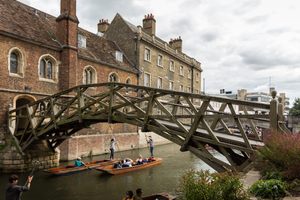
Officially known as, simply, the "Wooden Bridge", the "Mathematical Bridge" of the University of Cambridge, England, is the popularly used name of this fascinating wooden footbridge just to the southwest of the centre of Cambridge.
It spans the famous River Cam, connecting two parts of Queens College (it is sometime referred to as "Queens' Bridge"). Although the bridge looks like a curved arch, it is constructed entirely from straight timbers. It is built to a sophisticated engineering design looking like it is straight out of a geometry textbook, hence the popular name. This bridge though is not the original version. The original "Mathematical Bridge" was another bridge of a, near enough, identical design, which once crossed the Cam between Trinity and Trinity Hall colleges
The bridges were originally designed by William Etherage and both were built by James Essex, the one at the current site in 1749. Even this bridge, because of limited lifespan of timbers exposed to agents of attack has been rebuilt twice, in 1866 and in 1905, in both cases keeping the same overall design.
The arrangement of timbers is such that the arc is created by a series of tangents. Radial members are used to tie the tangents together and produce a strong, triangulated, self-supporting structure, in which all the tangential timbers are under tension whilst the radial components are in compression. Thus none of the timbers are exposed to significant bending loads. This efficient use of timber, for maximum strength, is technically termed tangent and radial trussing. In the past it was used to produce temporary supporting arches used for building stone and brick bridges including most of the 19th century masonry railway viaducts in the UK.
A popular tale about this bridge is that it was designed and built by Sir Isaac Newton and that he managed it without the use of bolts. Stories tell of how in the past either students or fellows of the University attempted to take the bridge apart and put it back together, but were unable to work out how to hold the structure together, and had to add the nuts and bolts. However the equivalent of bolts were a requisite part of the original design but when first built, large nails or iron spikes would have been driven into the joints from the outer side, where they could not be seen from the inside of the parapets. This was why bolts were thought to be an addition to the original but it is simply a factor of improved construction materials. It is highly unlikely (but actually not impossible) that Newton had anything to do with the bridge design since he died in 1727, twenty-two years before it was constructed.
A larger, triple arch, bridge built on the same principle was also designed by Etherage and spanned the Thames at Walton on Thames. Built in 1750 it stood for 33 years and was painted in a superb picture by Canaletto in 1754 (https://commons.wikimedia.org/wiki/File:Canaletto-waltonbridge.jpg ).
Community Contributors

Added By
Published
September 12, 2017