About
This former horse-drawn industrial tramway or plateway connected the brick works, lime quarries and lime-burning works (lime yards) of the village of Ticknall in Derbyshire to the Ashby Canal at Willesley, now in Leicestershire but at the time in Derbyshire. It also had branches to the quarries and lime works at Cloud Hill and to two nearby collieries (Smoile and Lount). The main route was 12.5 miles long and operated on a 4 ft 2-inch gauge. It is now a popular dual-use cycleway and footpath. One of the most interesting features is the 138-yard-long tunnel that was produced by cut-and-cover techniques to prevent interference with the carriage drive of the Calke Abbey Mansion (https://www.atlasobscura.com/places/calke-abbey) and to relieve the Harpur family from having to see industrial waggons crossing their land. Several other tunnels (one still accessible) were present on the tramway. There is also, in Ticknall village, a very un-railway-like bridge over Main Street. Rail bridges always maintain a flat profile to the tracks but this one is arched with a distinctive hump in the track bed. It must have posed quite a challenge to the horses and would never have been suitable for an adhesion-type steam locomotive. This may be the oldest rail bridge in the world.
The tramway operated between 1802 and 1913. It was built by Benjamin Outram (the track was often referred to as “Outram Way”) but financed by the Ashby Canal Company (who decided a tramway would be better than a branch of the canal).
It is referred to as a plateway because it had L-shaped cast-iron rails (cast in Benjamin Outram's foundry of the famous Butterley Iron Works) allowing the use of waggons with flangeless wheels (which were hauled by horses). The rails were 3 feet long and were mounted onto stone sleeper blocks or setts, which weighed about 150 lb each. Although all the tracks are long gone, the setts can be seen at several points. For several years after the tramway ceased to be used, a solitary waggon and single horse would traverse the tramway every six months to maintain the right of way (in normal times a train of 3+ waggons and several horses would be controlled by one man). Some late-19th-century horse water troughs can be seen on the route.
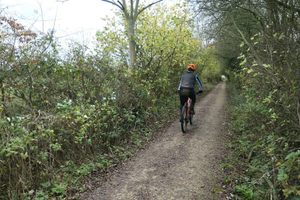
About half of the full length of the former track bed is available to walkers and cyclists and the tramway also forms part of a circular trail (the Tramway Trail) which has been set out by the National Trust, who own the nearby Calke Abbey. Some of the branches of the route were converted to standard gauge steam loco-hauled railways in the late 19th century (including Old Parks Tunnel, which was re-profiled). The routes take the walker or cyclist through some amazing countryside filled with fascinating early railway history.
Know Before You Go
There is a public car park at Ticknall Village Hall where there is also a memorial to Sgt John Smith VC, born in Ticknall in 1814.
Community Contributors

Added By
Published
June 19, 2026