About
The region of Dacia, now comprising modern-day Romania and parts of Serbia and Hungary, was the last territory to be successfully conquered and retained by the Roman Empire in 106 AD. The Emperor Trajan entered the region in order to subdue the Dacian people who kept threatening the empire. Doing so was a daunting undertaking, as the wide and turbulent Danube River proved a major obstacle. As such, to move troops efficiently across the river, Trajan ordered the Greek architect Apollodorus of Damascus to construct his namesake bridge.
At 1,135 meters long, Trajan's Bridge was at the time the longest arch bridge in the world. With twenty 50-meter wooden and stone spans, it also had the longest bridge spans in the world. The bridge was destroyed by the Emperor Aurelian in the 3rd Century AD in order to prevent enemy armies from using it to reach Rome, but tale of its monumental size lived on - no bridge would exceed its records for over 1,000 years. It was such a monumental feat that it was commemorated on Trajan's own monumental column in Rome.
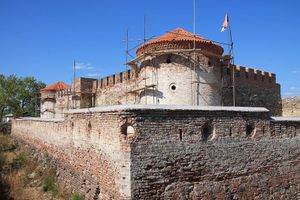
After the bridge was demolished, its stone pillars remained underwater. They re-appeared in the 19th century during a drought which lowered the Danube's water level. Today, many have been swept away or were destroyed, however the entrance piers are still visible on either side of the Danube. They are surrounded by concrete walls to keep out the river's dammed waters. Both are accompanied by forts built to protect the bridge's approaches and to facilitate the river's navigation.
Related Tags
Know Before You Go
Ruins can be seen on both the Serbian side and the Romanian side of the Danube.
Community Contributors
Added By
Published
October 22, 2025