About
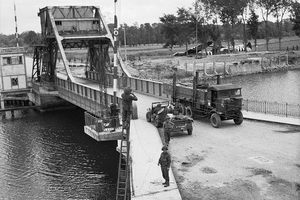
Next to the village of Cambercourt in northern France is a, relocated and reused, historic remnant of the Mulberry harbour from Aromanches which still does what it was intended to do, carrying traffic over water. The Mulberry Harbour was connected to the shore by two long pontoon bridges constructed by linking together numerous 80ft long bridging units, known as "Whales".
The old bridge (known then as Les Bordeaux Bridge) where the D265A crosses the Noireau river ( on the border between the Departments of Calvados and Orne) was destroyed by the French resistance on 29th June 1944 in support of the invasion by allied forces which started on the 6th June.
During 1945, as Normandy was recovering from the destruction of both German Occupation and Liberation, Les Bordeaux bridge was considered for repair because the road was then a useful link between Caen and the south for Allied troops.
The span of the old bridge was conveniently just over 80ft and an unusual solution was suggested by to British army engineers who sent word up to Arromanches where Mulberry B harbour was being decommissioned. They sent for one of the bridge sections which linked the harbour to the shore, coincidentally the right length. This section was known as a "Whale" because of its distinctive shape.
Several examples of "Whale" bridges were constructed in France, as far away as the German border, but over time n most have now been replaced by permanent bridges of modern design. Some remain as isolated examples for heritage purposes but few still carry traffic.
Community Contributors

Added By
Published
December 17, 2024