About
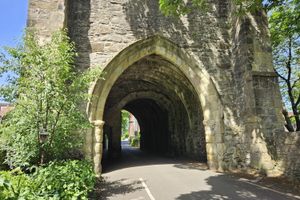
Whalley Abbey was a monastery established by the Cistercian monks in Northwest England during the Middle Ages, with construction on the monastery starting in 1296. The abbey’s two-story gatehouse was one of the first buildings erected. The lower floor has a vaulted ceiling and two doorways, one of which would have been used for horses and carts and the other of which would have been used for pedestrians. The upper floor featured a single large room that likely would have been used as a chapel for guests. As the main point at which the monastery connected to the outside world, the gatehouse would have been the place where monks would have provided assistance and food to beggars and travelers visiting the monastery.
During the reign of Henry VIII, the monastery in Whalley Abbey was dissolved, and the lands were seized by the king. In 1553, the property was sold to Richard Assheton, who turned the property into a private estate, and the former monastic grounds would stay in private ownership until 1923, when the Catholic Church and the Anglican Diocese of Manchester bought separate parts of the property. During this entire time, the gatehouse continued to stand in place over what became one of the roads leading west from the village of Whalley, and it was eventually acquired by English Heritage, a British organization focused on the preservation of historic sites in England.
While the gatehouse has been designated as both a Grade I Listed Building and a Scheduled Ancient Monument, the medieval building is now, to some degree, treated as part of the everyday village landscape. Local residents routinely drive through or walk through the gateway to get between the center of Whalley and the residential area on the west side, but very few tourists ever stop in Whalley to marvel at this centuries-old structure.
Know Before You Go
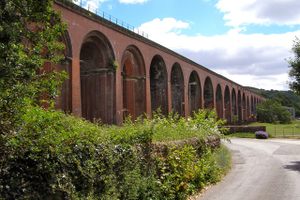
The gatehouse, which is part of a public right of way and which can therefore be accessed at any time of day, can be approached from the center of Whalley via Church Lane and the street called The Sands, or it can be approached from the rail station to the north via Broad Land and Ridding Lane (which passes under the Whalley Viaduct). Cars driving through the gatehouse should slow down to safely navigate around pedestrians as well as the arches within the structure (which do not line up in a straight line but which are instead slightly offset from each other), while pedestrians should stay aware of oncoming vehicles and move to the side of the road if necessary.
Also note that a small door on the north side of the gatehouse leads to a small enclosure with additional views of the Whalley Viaduct.
Community Contributors

Added By
Published
July 17, 2026