Damanhur and the Mysterious Underground Temple
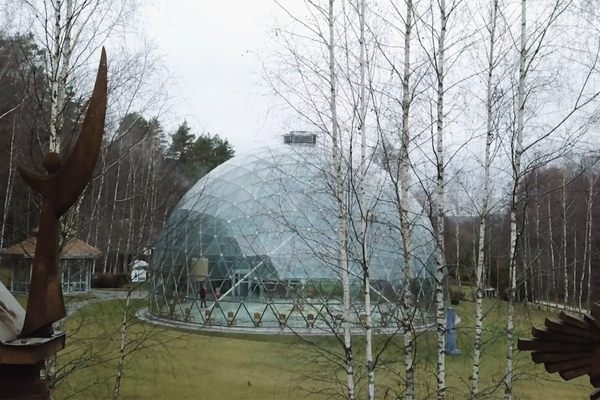
A complex of psychedelic underground temples—beneath a suburban home in northern Italy.


Listen and subscribe on Apple Podcasts, Spotify, and all major podcast apps.
Dylan Thuras: In 2001, travel writer Lisa Alpine was on a trip to Northern Italy. She was meeting up with other writers, even teaching a dance workshop. But after a few days of wine and pasta and tiramisu, hmm, Italy, Lisa was craving a more spiritual experience. And she’d heard about this place nearby, this place called Damanhur. It was a sort of self-contained, eco-spiritual, artistic community/commune, outside of Turin. So she thought she’d check it out.
Lisa Alpine: I took a train from Bologna and then a taxi from the small town nearby to Damanhur, and I get to the front reception desk, and this man introduces himself. He goes, “Hello, my name is Platypus.” And I was wondering, “What? What did he just call himself?” I said, “Could you please repeat that?” “Platypus.”
Dylan: As it turned out, everyone in Damanhur gives themself a new name, plant or animal, to help symbolize their oneness with the natural world.
Lisa: So that was just my introduction to how very unusual this place was. And they have their own currency. So Platypus then instructed me at the front desk to use my ATM card in their ATM machine, which would give me Damanhurian coins.
Dylan: Platypus gave Lisa the keys to her room. But before she could see it in person, Platypus looked out the window and saw a tour bus idling outside. “Quick,” he said, “go join them!” So Lisa climbed on the bus.
Lisa: And they were all British psychics, older women in lavender and little flowery hats. And I just got thrown into their tour.
Dylan: And as the British psychics told Lisa, she had not, in fact, joined their tour. She had joined their initiation into Damanhur.
Lisa: I’m going, “What initiation are we talking about here?”
I’m Dylan Thuras, but you can call me Squid Eucalyptus. And this is Atlas Obscura, a celebration of the world’s strange, incredible and wondrous places. And oh boy, do we have a strange, incredible and wondrous place for you today. We’re going to Damanhur. It is this mysterious religious community founded by an insurance agent who was reborn as a spiritual leader. We’re going to try and uncover our past lives. We’re going to dance blindfolded in the moonlight, baby. We’re going to visit a five-story underground temple that the Damanhurians dug in secret and illegally over the course of 15 years.
This is an edited transcript of the Atlas Obscura Podcast: a celebration of the world’s strange, incredible, and wondrous places. Find the show on Apple Podcasts, Spotify, and all major podcast apps.
Dylan: Maybe finding out from a busload of British psychics that you were getting roped into some kind of spiritual initiation might have scared some people off, but Lisa was not one of them. Lisa was interested in writing about Damanhur and getting as full of an experience as she could. So she rolled with it.
The first stop on the journey was about an hour’s drive away in Turin, specifically in Turin’s Egyptian Museum, which is kind of randomly the largest collection of Egyptian artifacts outside of Cairo.
Lisa: The museum director who led it, he had a very big, deep voice, beautiful Italian accent, dressed immaculately. And he sort of whispered. And it was all a big secret going into the Hall of Memory.
Dylan: In the Hall of Memory were 21 statues of the same Egyptian goddess, Sekhmet. Sekhmet is the lion-headed goddess of war, medicine, and plague, and the desert. And as the director told them …
Lisa: “We will be walking past 21 statues of Sekhmet, and you’re to stand in front of her, stare at her for a few minutes, and then go to the next statue in silence.”
Dylan: This was a practice, the director explained, that started with the founder of Damanhur, Falco. That’s falcon in Italian. Falco was born Oberto Airaudi in 1950 outside of Turin. And according to his official Damanhurian biography, or the website of the Damanhur Foundation, Airaudi was this exceptional kid having, quote, visions and wonders.
Lisa: He had his awakening when he was 13 years old at that Egyptian museum. He had this awakening to this vision of a community of people living in harmony with the earth and also remembering all their past lives. In this whole Damanhurian experience, they really believe in past life memory and how it dictates what you do in this life.
Dylan: When he was 19 years old, Oberto got a really pretty boring job as an insurance agent. But throughout the 1970s, he was crafting and refining his ideas about a spiritual community, a place where, and again, I’m consulting the official Damanhurian biography here, people could, quote, experiment with a new balance between human beings, divine forces, and natural force.
In 1977, Damanhur was born. As the story goes, Oberto, now going by Falco, was driving around with some friends about an hour north of Turin in a rural area where not that many people lived anymore. And they came to the bottom of this hill overgrown with brambles.
Falco got out of the car, started walking up the hill, and an old man greeted him at the top and said, “What took you so long?” The next year, 1978, Falco and a small group of followers, fellow spiritual travelers, started building, in secret, underground, what would become their ultimate masterpiece: the Temple of Humankind. But we’re getting ahead of ourselves here. We’re only on the first step of the initiation.
Dylan: Back in the Hall of Memory, Lisa faced the statues.
Lisa: I stood in front of each Sekhmet and stared in her face. And I didn’t have any past life memories, but I really wanted to eat pizza after I got out of there. I was like, “Oh, I’m getting hungry. I need some pizza.” The next day, the British women woke me up. Knock, knock, knock, “Get up, dearie, it’s time to dance!”
Dylan: Lisa’s initiation was not over. Before she could go and see the masterpiece, the Temple of Humankind, she had some more work to do.
Lisa: So we went into this dark room and the man, I think his name was Jaraffa, he said, “You’re going to be dancing for two hours. Here’s your blindfold.” In the dark.
Dylan: Jaraffa led them into a huge dark room, big enough for them to dance without bumping into each other. Lisa was pretty excited about this part. She’s a dancer after all, and a dance teacher. She said the idea was kind of like aligning your energies with the earth. There was no instruction. They were just really supposed to do their own thing.
Lisa: We were on our own and there was no talking, there was no sound. Maybe I heard some people breathing and that was it. The music was excellent. It was very danceable music.
Dylan: So Lisa danced, blindfolded, for two hours.
Lisa: I gotta say, I really, I’d never done anything like that before. In all my years of experimental dancing, that was a first. It was a gift to be able to dance that long uninterrupted, realizing that nobody was looking, not even yourself. It was very yummy. It was like eating a really great meal, a dance meal. And then that night, they had a ceremony for the members of the community, a full moon ceremony that we were invited to watch.
Dylan: Today, around 600 people live in the Damanhur community full time. They have their own constitution, school, farms, and as Lisa had already found out, a system of money. Some are even second generation members who were born into the community.
And if you’re wondering what exactly it is they believe, if you look online, it’s a little bit vague, but there’s a lot of emphasis on a harmony between the community and nature. As one BBC article put it, in their early years, they were very interested in the idea of time travel and believed that Falco may have come from the future.
And we should point out that it’s not all sunshine and roses. They have definitely been criticized by some former members who say that the group controls and even brainwashes its members, that it is, you know, a cult. In response, the Damanhur blog said, “Well, maybe we’re an ethical cult.” Make of that what you will.
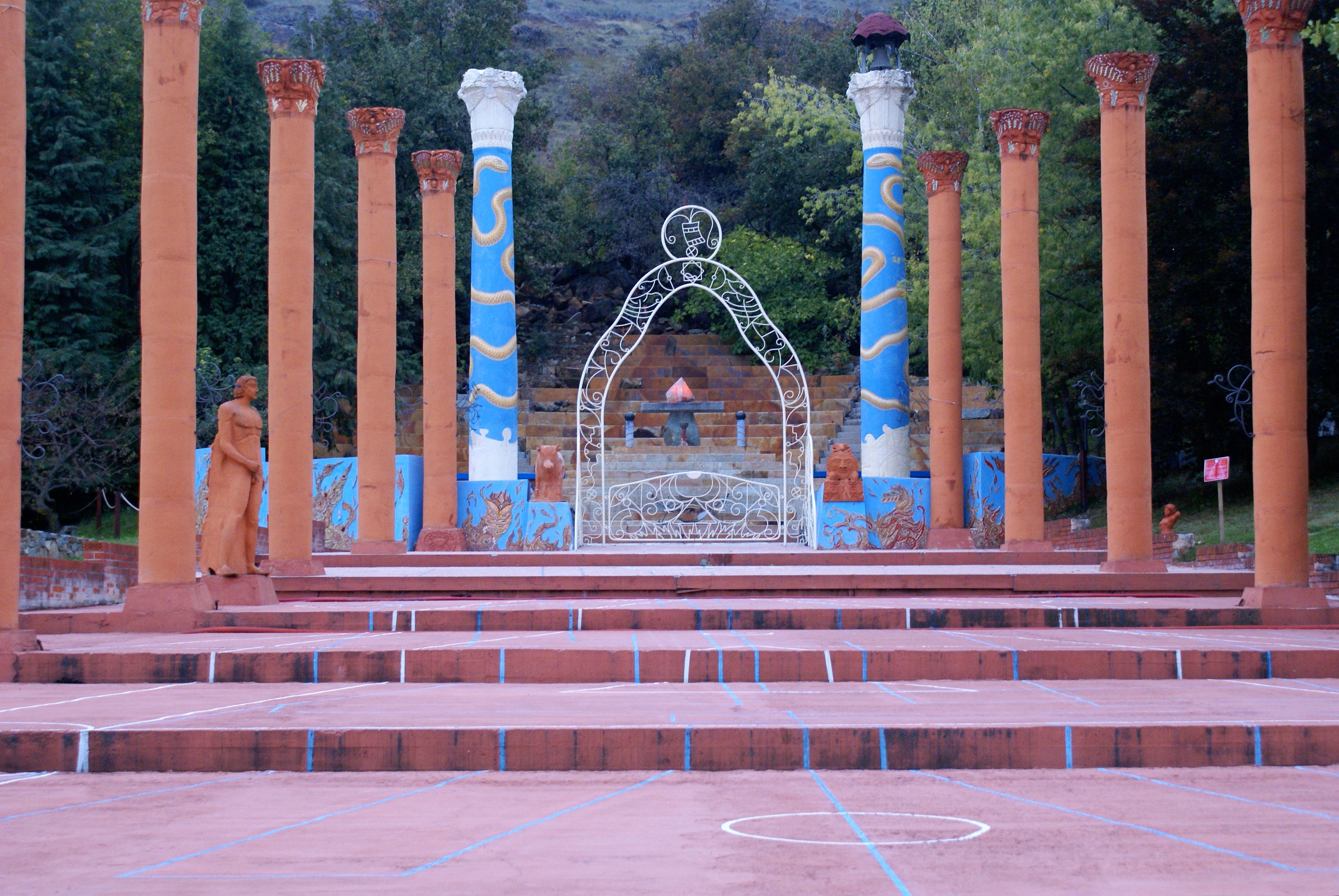
But some say the community has opened up a bit since Falco died in 2013. In contrast to some other esoteric spiritual communities, Damanhur welcomes the public for visits and special events, things like the full moon ceremony. There, Lisa saw a group of Damanhurians wearing these long pastel colored robes. They were circulating in silence around these freestanding columns outdoors under a beautiful shining full moon.
Lisa: And then they have these movements they’re doing, geometric movements that have to do with the position of the moon at that time of the year. And I have no idea what they were trying to invoke, but it was very, very beautiful. It was like being in a Druid experience long ago. Oh, it was—it was mesmerizing.
Dylan: But before Lisa could see the very famous temple of humankind, this great underground the jewel of the Damanhurian crown, there was still one step left to prepare her.
Lisa: The last piece before I was led into the temple of mankind was to walk a labyrinth, a stone labyrinth that gave you a very specific focus to have while you’re walking the labyrinth. I think mine had a lot to do with my dance, my own dance as a healing art form.
Dylan: And finally, it was time. Lisa met up with her guide named Elefante and was escorted to the entrance of the Temple of Humankind.
Lisa: The door, it looks like what I imagined the door in The Hobbit, Bilbo Baggins door would look like, the wooden arch door, very rustic.
Dylan: Elefante explained that back in 1978, Falco and his followers had begun digging deep into the hills by hand, carving this temple out of the rock. They dug in secret. And since none of them had architectural training, it was totally illegal to build some giant temple underground.
But they were on a mission and they kept going, going down five stories into the earth, 150 feet deep. If anybody from outside the community got anywhere near it, they would play loud music to hide the sounds of construction. And they kept this project secret for over 15 years.
Then in the ’90s, the authorities finally found out about it and they were tipped off by a disgruntled former Damanhur member, no less.
Lisa: Local officials got all upset and panties in a twist and tried to stop them. But then the Italian arts community said, hey, this is a piece of art.
Dylan: The Italian courts eventually ruled that the temple was okay. Just Damanhur would have to pay some back taxes on it. Back on the tour, Elefante took Lisa down an elevator, down five stories, into the bowels of the temple. This enormous room with a giant sculpted tree root going up to the ceiling.
Lisa: And there you are starting at the bottom with the tree and the air going—the water going up into the root systems and growing. It was like being inside a cathedral that was like the Garden of Eden.
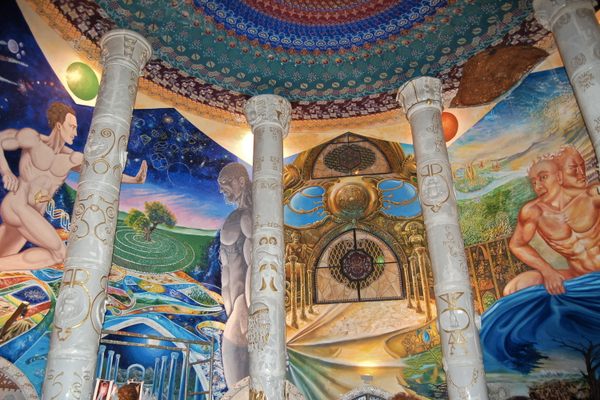
Dylan: That was just the first room. The temple has five stories of these spaces, all decorated with these really intricate paintings and mosaics and crazy trippy colors, images inspired by Roman and Greek and Egyptian mythology.
Lisa: It’s pretty overwhelming. It’s pretty overwhelming.
Dylan: Lisa’s favorite space was the Hall of Water, which is dedicated to femininity and is also home to the largest stained glass Tiffany dome in the world.
Lisa: You get out of the elevator at that stage and oh my goodness, there’s this blue, blue, blue, beautiful stained glass, gigantic ceiling of Tiffany glass, circular above you that is just shedding this very soft, lovely light on everything. It was gorgeous. I could feel those colors influencing me and calming me down and making me think slightly differently or move slightly differently. It had impact on me.
Dylan: But then it was back to reality. Elefante led them back upstairs. Lisa’s trip to Damanhur had come to a close. Interestingly, she said that no one ever really preached to them or pushed brochures into their hands. No one tried to get them to join the community, although in Lisa’s case, it probably wouldn’t have worked.
Lisa: I’m not a lavender type person, so for me to wander around singing songs in lavender robes and … no way. So I never felt like, “Oh, I could live here.” But for three days, it was a dream. It was like being in a dream.
Dylan: It seems though that maybe she brought a little bit of Damanhur home with her. About a week after she got home in California, she went hiking in Marin County with a friend of hers. And they were up on this trail, relaxing under the shade of some redwood trees when her friend suddenly sat upright.
Lisa: And he reaches under where he’s sitting, something’s poking him in the rear end, and he pulls out this plastic statue. And it’s Sekhmet. He goes, “Did you bring this?” I said, “No, I’ve never seen it before.” Yeah, he still has the statue, periodically sends me notes about it and sends me little photos of it. “She’s still here!” He took it home with him. So who knows? Who knows? I do believe in mysteries, I do.
Dylan: Lisa ended up writing about her trip to Damanhur, and you can find her essay in her book and on her website, and we’ll link to both in the episode description. If you want to learn more about Damanhur and visiting the Temple of Humankind, you can check out their website.
It seems like you can opt for a four-hour tour if you don’t want to do the more immersive initiation experience. It’ll run you about 85 bucks. Of course, if you do go, you know, just keep in mind the cult stuff and ask yourself if you want to permanently don a lavender robe. Maybe you do. Maybe I do.
Listen and subscribe on Apple Podcasts, Spotify, and all major podcast apps.
Our podcast is a co-production of Atlas Obscura and Stitcher Studios. This episode was produced by Amanda McGowan. The production team includes Doug Baldinger, Chris Naka, Kameel Stanley, Manolo Morales, Baudelaire, Gabby Gladney, Johanna Mayer. Our technical director is Casey Holford. This episode was mixed by Luz Fleming, and our theme and end credit music is by Sam Tyndall.
This story originally ran in 2024; it has been updated for 2025.



Follow us on Twitter to get the latest on the world's hidden wonders.
Like us on Facebook to get the latest on the world's hidden wonders.
Follow us on Twitter Like us on Facebook