Hell or High Water: How an Odd Amphibian Became a Symbol of Resilience in North Carolina
The eastern hellbender has thrived in clear Appalachian rivers and streams for more than 100 million years.


Listen and subscribe on Apple Podcasts, Spotify, and all major podcast apps.
Kelly McEvers: If you ever find yourself camping in western North Carolina, don’t forget your snorkel gear. Yes, I said snorkel gear, not for the ocean obviously, but for the many rivers and streams that snake through the mountains. Put your head under the water and you will see all kinds of trout, crawfish, river otters, and if you’re lucky, you might even spot a modern day dinosaur. This is a creature called a hellbender.
Will Harlan: When I locked eyes with my very first hellbender, it was an awe-inspiring moment that I’ll never forget. To imagine these leviathans lurking on the bottoms of rivers hiding beneath boulders was both thrilling and a little bit terrifying. Where you’re laying on top of the water with snorkel gear and wetsuits, it’s like looking for hidden treasure on the bottom of a river.
Seeing all these different crayfish and fish and snails, just the water was alive and electric and beautiful. And then along the way, peeking under one of the largest boulders in the stream and seeing these little tiny eyes and this wrinkled body curled around a rock underneath the river. It was just incredible.
He was a den master, which is a word describing male hellbenders who guard their nests. And he wasn’t going anywhere, and I wasn’t about to mess with him either, but it was great to see him in his wild state protecting the next generation of hellbenders. It was a beautiful moment.
Kelly: I’m Kelly McEvers, and this is Atlas Obscura, a celebration of the world’s strange, incredible, and wondrous places. This episode is brought to you in partnership with Visit North Carolina. And today, we are meeting the eastern hellbender. It’s a giant salamander that has been lurking in the rivers and streams of Appalachia for more than 100 million years. And in just the last few years, after surviving one of the worst hurricanes in decades, they’ve become a local symbol of pride.
This is an edited transcript of the Atlas Obscura Podcast: a celebration of the world’s strange, incredible, and wondrous places. Find the show on Apple Podcasts, Spotify, and all major podcast apps.
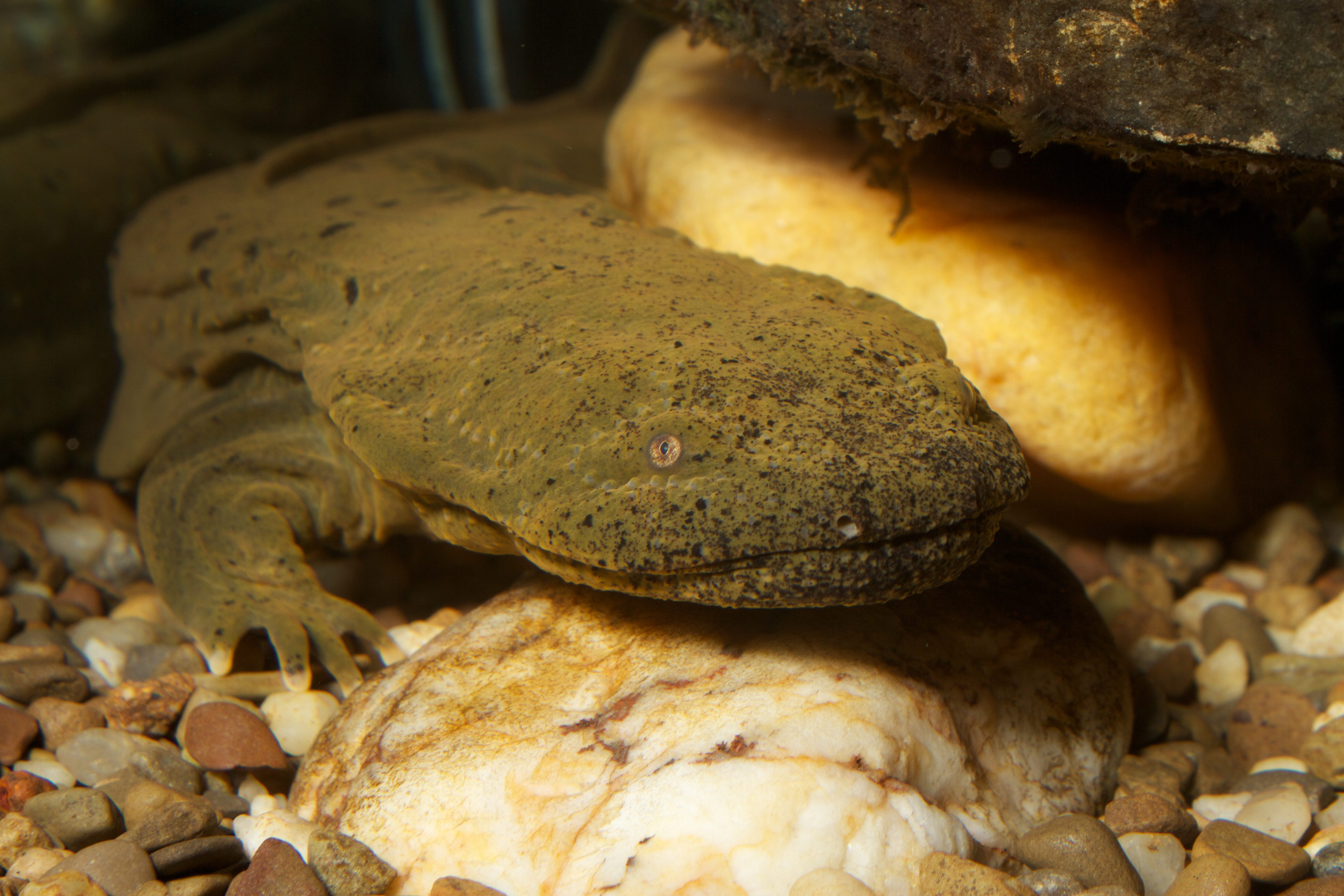
Kelly: Okay, I have to admit, when I first heard the term hellbenders, I thought we’d be talking about some kind of motorcycle crew. Sounds like the kind of thing you’d see on the back of a Harley-Davidson jacket. But no. Hellbenders are the name given to the largest salamander species in North America. How they got this name is a little unclear, but there are theories.
Will: When colonists first came to the United States, they didn’t know what to make of this creature. They thought it was some beast that had come up from the depths of hell. But that was kind of the colonial mindset.
Kelly: This is Will Harlan. He’s the Southeast Director of the Center for Biological Diversity. It’s a wildlife conservation group. He’s been studying hellbenders for decades. He’s often snorkeling to look for them, both for work and for fun.
Will: It’s got all these cool characteristics and attributes and even some really amazing nicknames like “snot otter” and “lasagna sides” and “Allegheny alligator.”
Kelly: Just to be clear, he said “snot otter,” “lasagna sides,” and “Allegheny alligator.” Some other nicknames we found: “water dog,” “devil dog,” “mud devil,” and “walking catfish.” Maybe a bit of a picture is coming together from these nicknames. These are very large salamanders.
They can grow to over two feet long and live for 30 years. They’re slimy with brown mottled skin to blend in with river rocks—that’s where the “snot otter” comes from. And they do kind of look like alligators with a big flat head, short little legs, and a powerful tail.
Will: They have this wrinkled skin that’s actually really important for their survival. That wrinkled, folded skin is actually helping them exchange oxygen with the water. They breathe through their skin.
Kelly: That’s where the name “lasagna sides” comes in, since their wrinkles kind of look like lasagna noodles. Hellbenders have been around for a long time, somewhere between 130 and 160 million years. And over that time, they have adapted to life in swift moving river water.
Most of their time is spent hunkering down underneath rocks, waiting for a tasty crawfish or a frog to swim by. Then they leap out from their dens, open up their very large mouths, and snap up their dinner.
Will: We usually talk about survival of the fittest and you’ve got to be strong and fast. Hellbenders took a different approach, and it’s worked for them for 130 million years, which is: slow down, chill, take it easy, wait for the food to come to you. And that works just as well. They are big and beautiful and distinct, a little bit scary, a little bit edgy, but totally harmless. I think above all, I think hellbenders are badass.
Kelly: But even a badass mud devil needs help sometimes. The eastern hellbender can be found as far north as New York State and as far south as Alabama and Georgia. But the biggest concentrations are in western North Carolina and eastern Tennessee. There’s also a separate subspecies of hellbender, the Ozark hellbender, found exclusively in Missouri and Arkansas. But today, these creatures are struggling. Their numbers have shrunk to a fraction of what they once were.
The Fish and Wildlife Service estimates that of 626 historic populations, only about 60 percent remain today. And of those, only 12 percent are stable. The big limiting factor here is clean, fresh water, which hellbenders need to survive.
Will: They’re only found in places where there’s clean, cool, well-oxygenated water. They can’t survive in muddy, murky rivers that have a lot of sediment. If the stream is too clouded with sediments, they can’t eat and they can’t survive. They also can’t breathe because that sediment will clog their skin and make them unable to pull oxygen out of the water. So where there are hellbenders, there’s clean water.
Kelly: A lot of damage to waterways has come from human activity. Deforestation, mining, and land development can clog rivers with sediment and make them inhospitable places for hellbenders to live. That’s why hellbenders have thrived in areas like western North Carolina, which is home to lots of protected forest land.
Will: One of the last strongholds was in western North Carolina and eastern Tennessee because there wasn’t as much coal mining. There wasn’t quite as much development pressure. Waters were still mostly protected. But then Hurricane Helene came along and knocked back populations here.
Kelly: Hurricane Helene made landfall in September 2024 and became one of the deadliest storms in the U.S. in decades. Flooding devastated inland North Carolina, and it hit hellbender habitats hard. Storms ripped out trees and vegetation, which filter water. Flooding washed away the heavy rocks that hellbenders use as dens. And rivers got filled with sediment, debris, and runoff containing pollutants like fertilizers.
One conservationist we talked to for the story said after the storm, hellbenders were found washed up on riverbanks. Sometimes they even ended up in church basements or swimming across flooded highways. So when he went out for his first hellbender surveys after Helene, Will says he was not optimistic.
Will: But I brought my oldest son with me because he was really curious too. And to our amazement, we found juvenile hellbenders. Somehow this species figured out a way to survive one of the largest hurricanes in our recent memory. It had survived, and even a young one had made it through. It was really magical and really powerful. They’re going to find a way to survive even hurricanes if we can just keep their water clean and clear.
Kelly: In August 2025, after Hurricane Helene, the town of Spruce Pine held a festival celebrating its recovery from the storm. And they named it the Hellbender Festival.
Organizer Spencer Bost said they were inspired by reports of hellbenders being found in surveys after the storm. As he told local news channel WLOS, quote, “They’re still here. And kind of the idea we have is … If these squishy, weird amphibians are still here and able to survive, well, we can do it too.”
And it’s not just in Spruce Pine. The city of Boone, home to Appalachian State University, unveiled a giant hellbender mural in 2024. Will’s group, the Center for Biological Diversity, was one of the partners on that project. At the local Booneshine Brewing Company, you can order an Electric Hellbender IPA.
There’s also efforts to get more protections for hellbenders. The Fish and Wildlife Service has proposed listing them officially as an endangered species. Communities like Boone and Buncombe County have passed local resolutions in support.
Will: There’s a lot of folks that are proud that these creatures are still around in our waters after 150 million years, and they’re still protecting our waterways. They’re still guarding their eggs. Those den masters are still out there. I think we take a lot of pride in having these hellbenders around in our rivers and streams.
Kelly: If you’re ready to snorkel for an elusive hellbender, Will recommends the Blue Ridge Snorkel Trail. It’s a list curated by state experts identifying biodiversity hotspots. Just make sure not to disturb the rocks too much. Don’t move them or stack them into cairns because hellbenders got to live there. A big shout out to Andy Hill from MountainTrue for sharing his expertise on this story.
Listen and subscribe on Apple Podcasts, Spotify, and all major podcast apps.
Our podcast is a co-production of Atlas Obscura and Sirius XM Podcasts. This episode was produced by Amanda McGowan. The production team for this episode includes Dylan Thuras, Doug Baldinger, Kameel Stanley, Johanna Mayer, Manolo Morales, Jerome Campbell, Amanda McGowan, Alexa Lim, Casey Holford, and Luz Fleming. Our theme music is by Sam Tyndall.
For Real, Visit North Carolina.








Follow us on Twitter to get the latest on the world's hidden wonders.
Like us on Facebook to get the latest on the world's hidden wonders.
Follow us on Twitter Like us on Facebook