Saving the Sacred Upton Stone Chamber
This ceremonial stone chamber dates back to before the colonies—and its owner tried to build a cell tower over it.


Listen and subscribe on Apple Podcasts, Spotify, and all major podcast apps.
Cathy Weaver Taylor: Do you want to hold a flashlight, Doug?
Doug Harris: I’d be happy to do that. If you hear a big splash behind you, it’s only me.
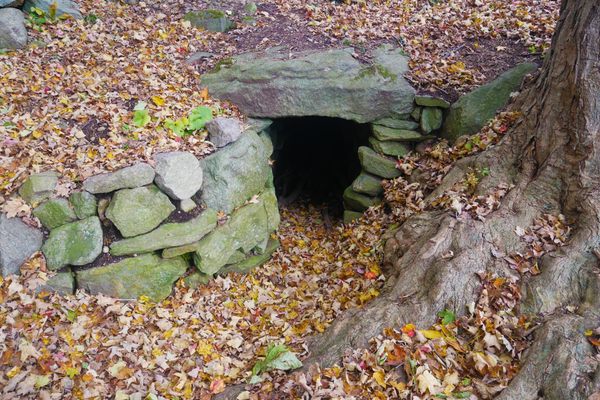
Abbey Perreault: Doug Harris and Cathy Weaver Taylor are standing in tall muck boots in front of what looks like a shrunken stone door frame built into the side of a hill.
Cathy: Going in.
Abbey: Cathy crouches a little, careful not to hit her head, and steps inside. Doug and I follow behind.
Doug: Anything swim around down in here?
Cathy: I haven’t seen anything today.
Abbey: We make our way through a narrow hallway, our feet sinking into a couple of inches of water pooled at the bottom.
Cathy: You’re almost there.
Doug: Ta-da!
Abbey: The hallway opens into a big stone dome, stretching over 10 feet in diameter. And except for the light beaming from Doug and Cathy’s flashlights and a little bit of sunlight coming in through the entrance, it’s completely dark.
Doug: This is not a cave, it’s not natural. It has been prepared. In tribal tradition, these are known not as caves or chambers, but known as hasunak.
I’m Abbey Perreault, and this is Atlas Obscura, a daily celebration of the world’s strange, incredible, and wondrous places. Today, we’re heading to what’s now known as Upton, Massachusetts, to visit this hasunak, or ceremonial stone chamber that was built hundreds of years ago. When we come back, we’re going to hear from the people working to protect its future in order to understand more about the past.
This is an edited transcript of the Atlas Obscura Podcast: a celebration of the world’s strange, incredible, and wondrous places. Find the show on Apple Podcasts, Spotify, and all major podcast apps.

Abbey: Unless you know what you’re looking for, the chamber is a little hard to find. It’s in a wooded part of what is today a largely residential area. Doug and Cathy have been leading educational walks into the chamber for over a decade, Doug as the Historic Preservation Officer for the Narragansett Nation, and Cathy as a member of the Upton Historical Commission.
A couple years ago, the town hired a geologist to try to figure out when the chamber was built. She sampled over 600 grains of quartz, and used this dating method that basically looks at when those bits of quartz last saw the sun. Nearly all of the grains sampled predated the time of colonization of the area.
But for well over a century, there have been all sorts of theories floating around about the chamber’s origin. There’s been the long-standing claim it was a colonial root cellar, or that it was built as a leather tannery. There was a theory that involved ancient aliens, and another tracing its origins to 8th century Irish monks.
Doug: And the presumption was that it must have been those people. It couldn’t have been Indigenous local people who were doing this kind of stonework. It had to have been someone else from somewhere else.
Abbey: The chamber is located on land ancestral to the Nipmuc Nation, and falls along an important Indigenous trade route connecting present-day Boston with present-day Hartford, Connecticut.
Several tribal nations in the area have identified connections to the chamber, including the Narragansett Nation, the Mashpee Wampanoag Nation, and the Wampanoag Nation of Gay Head Aquinnah. But for a long time, none of those cultural ties were acknowledged by those outside of those tribal nations.
Doug: The colonists, in order to occupy these lands, had to declare them not properly being used by the Indigenous people who were here. So the sociologists, the archaeologists, took up the stance of the cultural forebears who could only claim this land with a clear conscience if they had a good reason, like “it wasn’t being used properly.”
Abbey: There are over 300 other stone chambers that haven’t been properly researched, scattered across New England. And countless others have been destroyed or have disappeared. That’s part of why preservation is a big priority for some of the region’s tribal nations right now.
Cheryl Andrews-Maltais: My name is Cheryl Andrews-Maltais, and I’m currently the chairwoman of the Wampanoag Tribe of Gay Head Aquinnah on the island of Nopi, known as Martha’s Vineyard.
Abbey: Cheryl has worked in historic preservation for the majority of her career. And long before it was her career, it was a big part of her life.
Cheryl: My entire life essentially has been part of historic preservation and protections. You know, just growing up and being mentored by medicine people, tribal leaders and spiritual leaders from not only our local tribes, but also from tribes that were from other parts of the region.
Abbey: So back in the early 2000s, Cheryl gets called to check out this chamber in Upton. And when she gets there, she says it feels like pieces of a puzzle just start coming together.
Cheryl: It’s that antenna that comes up. It’s almost like an antenna that the ancestors are speaking to us. You know, and literally, the hair rises almost on the back of my neck, and on my arms, and it’s like, oh my goodness.
Abbey: The chairwoman knew that what she was looking at was something significant.
Cheryl: Our houses of worship are not four walls. You know, they might be a vista, they might be a butte, they might be a point somewhere or other. Some chambers are for different purposes. Some are for viewing sunrise, some are viewing sunset, some are for viewing solstice, some are for viewing celestial events.
Abbey: This chamber has a view. Standing at the very back of the dome and looking out through the narrow entrance, you can see the summer solstice sun setting. So, many think it might have also been a calendar, a way to track the passage of time. And this stone landscape extends beyond just the chamber itself.
Bettina Washington: They told you how the whole thing started with a cell tower, correct?
Abbey: That’s Bettina Washington, who currently heads up the Historic Preservation Office for the Wampanoag Nation of Gay Hatoquinna. She was working with Cheryl at the time. And she got notified that a cell company was going to be building a tower at the top of a hill really close to the chamber, a hill called Pratt Hill.
Bettina: And we went up there and we found all these stone features.
Abbey: Huge base stones with hundreds of smaller stones placed on top of them.
Cheryl: So we went up to see it, it’s like, oh my goodness. Certainly this was the first time we had seen one of that size and volume. And then as we dispersed ourselves up, we found more and more and more. So we’re like, “Oh no, oh no. Pause!”
Abbey: So, a few historic preservation officers from different local tribal nations, including Doug, Cheryl, Bettina, they all got together to collectively try to prevent the cell tower from being built on that hill, under the protection of the National Historic Preservation Act.
Doug: We knew that there was a relationship between the mouth of this chamber and the stones on Pratt Hill, but we couldn’t prove it.
Abbey: To prove it, they set out to survey the area in the middle of the winter. Doug says it was snowing the whole time. And working with an archaeologist, they had to map out where these stone mounds were in relation to the chamber to see if they might be part of one cohesive landscape. But in the meantime, the site’s owner got impatient. The chairwoman says he stood to make money from having that cell tower on his land.
Cheryl: He was insistent that these were nothing. He took a bulldozer and he started to bulldoze some of the less impressive ones just to clear them out.
Doug: I mean, to this day, that’s a prime example of just not understanding how devastating and what a loss it is to everyone. It’s a loss to everyone. And, you know, that’s one of the things that I just worry about is the destruction.
Abbey: Ultimately, the stone groupings were found to fall directly within the view of the chamber. The cell tower was moved to a different spot. And the landscape was federally recognized as a historic place.
Shortly after, the Narragansett Nation purchased the land on the hill to try to keep the remaining stone mounds safe. So, the chamber and the stone mounds that hadn’t been destroyed were protected. But it’s one site. The chairwoman says it’s a scramble to save countless others.
Cheryl: So, it’s almost like once it’s saved, all right, it’s saved. Got that one. On to the next one or on to the next 10. The National Historic Preservation Act, it finally afforded us the legal right to revisit and attempt to protect and preserve ceremonial places and sacred sites, which we have not been allowed to even see or experience for centuries. You know, so ours is always a challenge in a race against time and development.
Abbey: The chairwoman says tribal nations don’t have enough resources to save all the historic structures and landscapes in time, which is one of the reasons why tribes are pooling resources and working with town governments and agencies. Cathy from the Upton Historical Commission says we need to rethink which histories we’re putting all of these resources into preserving.
Cathy: We could, you know, maybe just do a little pause on historical houses. We have a lot of historical houses, a lot of them. And, you know, I’d like to see some more finances put behind identification and preservation of things older than the colonies.
Abbey: At the same time, preserving these sites can draw attention to them. For some citizens of tribal nations, that raises questions around whether going to these lengths to protect historical and cultural sites is worth the risk of sharing them with the wider public.
Doug: Tribes are split in terms of wanting to share and not wanting to share. But what has become obvious is that if, in fact, towns and tribes can’t get together and agree that they will mutually protect sites, then sites will be destroyed. The protection of what is ancient there belongs to all of us. And so that’s what we have to be about teaching and getting our future generations to be sensitive to that need for historic preservation to protect the ancient history of what’s on the land.
Bettina: In the end, yeah, it’s worth it. Because if we can’t do this and there won’t be any, you know, then it’ll be lost. And it’s not just a loss for affiliated nations, but I believe it’s all of the Americas. There’s a greater story that’s sitting there.
Abbey: Outside of the chamber, it’s starting to get dark. Before we go, Doug says a few words in Narragansett.
Doug: Well, we’re giving thanks for all things. Now do we depart?
Abbey: A really special thank you to Chairwoman Cheryl Andrews-Maltase and Bettina Washington for taking the time to talk to me, and to Doug Harris and Cathy Weaver Taylor for taking me inside of the chamber.
Listen and subscribe on Apple Podcasts, Spotify, and all major podcast apps.
Our podcast is a co-production of Atlas Obscura and Witness Docs. The production team includes Doug Baldinger, Chris Naka, Kameel Stanley, Willis Ryder Arnold, Sarah Wyman, Manolo Morales, Gianna Palmer, Tracy Samuelson, John DeLore, Peter Clowney. Our technical director is Casey Holford. This episode was mixed by Luz Fleming.
This story originally ran in 2022; it has been updated for 2025.




Follow us on Twitter to get the latest on the world's hidden wonders.
Like us on Facebook to get the latest on the world's hidden wonders.
Follow us on Twitter Like us on Facebook