
I've walked into a hospital and found myself surrounded by the disembodied hands of surgeons, athletes, and international peacemakers. I haven't wandered into some secret chamber; it's actually right near the entrance of Baylor University Medical Center in Dallas.
The Adrian E. Flatt hand collection.
Nurses walk past me carrying their lunches up the spiral staircase and out to the courtyard despite summer heat. I stand transfixed before a horseshoe of glass cases.
Slim, gnarled,
lanky, flat,
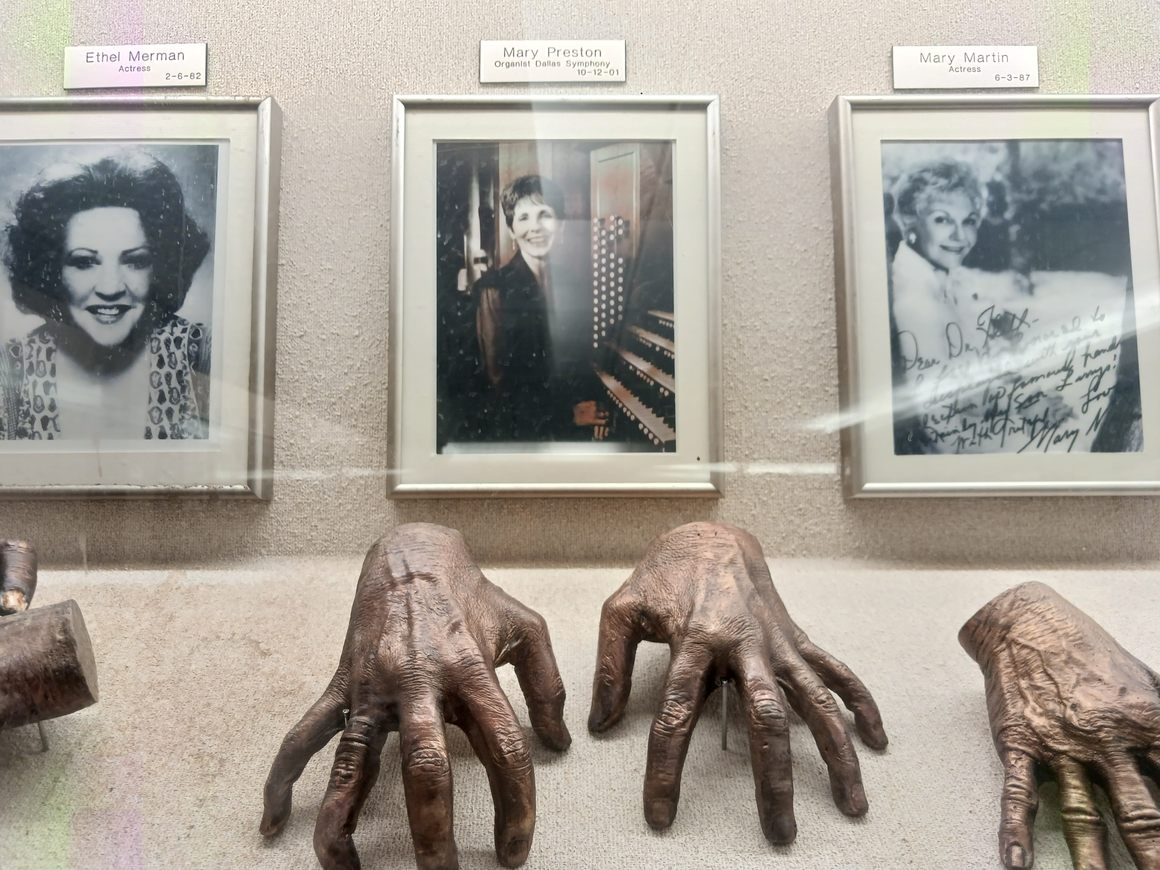
swollen pairs of hands sit inside.
Without the black and white portraits behind each bronze cast, there's almost no way you'd be able to guess at the owners' occupations.
Exceptions include Andre the Giant's (paws, basically) and Mary Preston, organist, whose hands sit poised to strike the keys.
Some remarkable hands, such as the hands of the first surgeon to transplant a heart or those of the illusionist David Copperfield, look pretty ordinary.
Bummer.
Both performed modern miracles.
Some hands, like the wizened hands of evangelist Billy Graham, look lonely without a bible beneath them.
And Roger Staubach's crooked pinkies ache for some form of orthopedic setting.
Morbid curiosity and excitement seem inherently linked to medicine.
The cartoon scientist with jars of formaldehyde and cases of pickled body parts.
The operating theatre!
My cousin in school to become a Physician's Assistant shows me the motion she has to practice for prostate exams.
My friend's brother, an ER intern, holds out his phone displaying the picture of an unidentifiable meatball-like tumor removed from a patient.
Grotesque.
Educational?
The symbolism of the hand is significant to many, apparently.
One case holds hand-shaped trinkets and dishes. Artifacts across time and continents. Good luck charms from Brazil (Figa) and Hamsa pendants from the Middle East/North Africa.
But beyond the obvious reach across cultures and the literal translation of what these hands have done,
operated a space shuttle,
summited Everest,
held Olympic gold,
prayed over or cut open hundreds of people,
why are hands so significant?
Why do we trust them to stave off evil?
They are just agents of the mind, the body.
They realize our thoughts and sentiments.
And they will perform a mixture of boring and extraordinary things throughout our lives.
We are not celebrating our hands when they press the buttons on the microwave to heat up a vegetarian enchilada.
We are celebrating the lifesaving, peacemaking, record-breaking clenches.
Hands are boring? Hands are extraordinary?
I can't choose.
It is a bizarre and curious museum.
There are dozens of hands spectacularly frozen in these glass cases and millions more outside, doing the daily tasks.


