About
Most memorial museums stay put in the house of the person they remember. This one moved out.
It was founded in 1968 in the Tashkent house where Abdulla Avloni (1878–1934) had lived with his family from 1910 until his death. Avloni was one of the Jadids, the Muslim reformers who believed Central Asia could be renewed through new-method schools, newspapers and the theatre. He opened schools, wrote their textbooks, published the newspaper Shuhrat and, in 1913, gathered the Turon theatre troupe.
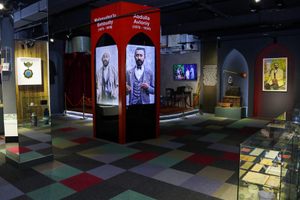
In 1993 the museum left the house for the institute that carries Avloni's name, where teachers from all over Uzbekistan now come to brush up their skills. Without its original walls, it relies on things to bring him close: his desk, typewriter and candlestick, his bookcase and wardrobe, even his clothes, arranged in a reconstruction of his study.
Around them are early twentieth-century books and newspapers in Arabic script, printed in Tashkent, Kazan, Orenburg, Baku and Istanbul, and a small stage that recalls the Turon troupe. The most surprising corner is a tall red display in the middle of the hall, where Avloni and fellow reformers such as Mahmudkhoja Behbudi, brought to life with artificial intelligence, look out at visitors and present passages from their writings. Walk around to the back and there is a mirror with the words "Zamonamiz jadidi", "a Jadid of our time". Whoever looks into it becomes, for a moment, the newest member of the movement.
The museum is also the only one from Uzbekistan in the UMAC Worldwide Database of University Museums and Collections.
Know Before You Go
The museum is on the first floor of the institute building at 6 Ziyo Street, Olmazor District, Tashkent. It is open Monday to Friday, 9:00 to 18:00, and admission is free. Groups can book a guided tour through the museum's website, avloniymuseum.uz, which also offers a 360° virtual tour of the hall.
Community Contributors
Added By
Published
November 19, 2026