

About
In 1949, West Germany was debating the location for its provisional government. After lengthy back-and-forth—the mayor of Frankfurt, Walter Kolb, had even pre-recorded a victory speech—the choice came to Bonn. A university town known as little more than the birthplace of Beethoven, Bonn had seen little wartime damage, had few ties to the Third Reich, and lacked the gravitas that a larger city might have commanded to keep the government upon reunification. Yet while Bonn offered the fledgling Federal Republic a fresh start, it lacked the culinary infrastructure to satiate hungry politicians.
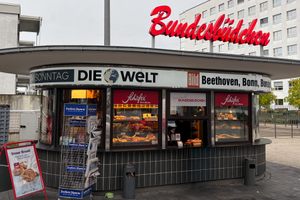
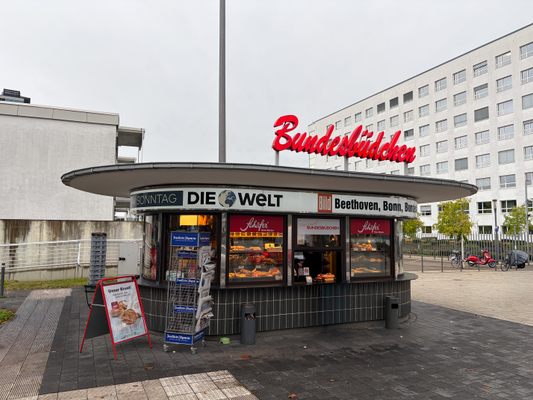
Enter the Bundesbüdchen. Erected in 1957 by the family of Christel Rausch, the “federal kiosk” served sausages, sandwiches, and pastries to the builders of the Bonn Republic. Every day, politicians, diplomats, and reporters drifted in and out of the Bundestag and associated offices nearby to break at the Büdchen for a quick bite or to catch up on gossip or news. As West Germany grew, the Büdchen evolved into a symbol of postwar democracy. Joschka Fischer, member of the Bundestag and eventual Vice Chancellor and foreign minister, supposedly loved to buy Asterix comics, and Vice Chancellor Hans Dietrich Genscher loved to pick up gummy bears for business trips. Former Labor Minister Norbert Blüm claimed the kiosk stood for Bonn itself; “That’s just how Bonn was like. Not pompous. A lovable republic.”
In 1990 came reunification, and nine years later, the Bundestag moved to Berlin. The United Nations and various businesses (Deutsche Welle, Deutsche Telekom) moved into or nearby the former government facilities along the Rhine. The Bundeshaus, the former parliament building, became the World Conference Center Bonn. In 2006, when the UN Campus was inaugurated, the kiosk was stripped of its colorful advertisements and moved to a storage facility.
But the Bonners persisted. With owner Jürgen Rausch, a group of stalwarts founded the Förderverein historischer Verkaufspavillon Görresstraße e.V., a society dedicated to preserving the historic structure. In 2018, they secured a city council resolution and a €55,000 grant from the Nordrhein Westfalen Foundation to re-establish the Büdchen within view of its original spot. In May 2020, it was wheeled from storage through the streets of Bonn to Heussallee and given a face-lift to restore its Cold War-era grandeur. Today, visitors to the UN Campus and World Conference Center—or anyone nostalgic for a whiff of the Fifties—can stop in for a quick bite or to peruse the headlines. With many of the buildings from the Bonn Republic now occupied, the Bundesbüdchen remains one of the most accessible, living pieces of the era.
And its history isn’t lost on the current seat of power. In 2025, a Bundesbüdchen restaurant opened at Hannovrische Strasse 2 in Berlin, a twenty-five minute walk from the Bundestag. While its Michelin-trained chef and menu featuring oxtail and filets represents a leap from the casual kiosk, the restaurant’s bar replicates the original Büdchen in Bonn.

Discover your next hidden gem with the Gastro Obscura
Newsletter—your guide to extraordinary food and drink.
Know Before You Go
The Bundesbüdchen is open from 7:00 a.m. through 6:00 p.m. Monday through Friday, and is closed on weekends. It is two blocks from the Heussallee/Museumsmeile subway stop and the Haus der Geschichte Museum.
Community Contributors

Added By
Published
November 10, 2026