Trips Places Foods Stories Newsletters

Take your next trip with Atlas Obscura!

Our small-group adventures are inspired by our Atlas of the world's most fascinating places, the stories behind them, and the people who bring them to life.

Visit Adventures
Trips Highlight
View all trips
Top Destinations
Latest Places
Most Popular Places Random Place Lists Itineraries
Add a Place
Download the App
Top Destinations
View All Destinations »

Countries

  • Australia
  • Canada
  • China
  • France
  • Germany
  • India
  • Italy
  • Japan

Cities

  • Amsterdam
  • Barcelona
  • Beijing
  • Berlin
  • Boston
  • Budapest
  • Chicago
  • London
  • Los Angeles
  • Mexico City
  • Montreal
  • Moscow
  • New Orleans
  • New York City
  • Paris
  • Philadelphia
  • Rome
  • San Francisco
  • Seattle
  • Stockholm
  • Tokyo
  • Toronto
  • Vienna
  • Washington, D.C.
Latest Places
View All Places »
Faro Francesco Crispi
Lighthouse "Francesco Crispi"
Smöjen kalkbrottsbad
Smöjen Kalkbrottsbad
Naruto Strait and its famed whirlpools
Naruto Whirlpools
SpaceX Falcon 9 Booster Rocket
Latest Places to Eat & Drink
View All Places to Eat »
Art at the VCC
Vintage Cocktail Club
The Buckhorn Saloon exterior
The Buckhorn Saloon and Opera House
The cozy interiors of Monozuki Cafe
Monozuki Cafe
Inside Mothership at the Bar
Mothership
Pagoda at Yamashiro
Yamashiro
Recent Stories
All Stories Video Podcast
Most Recent Stories
View All Stories »
The robotic instrument at the center of Moving Monuments incorporates found objects from across the city.
This Musical Robot Celebrates Toronto’s Vibrant Rhythms
The SS Edmund Fitzgerald was the largest freighter on the Great Lakes when it was built.
Why Is TikTok Obsessed With a 50-Year-Old Shipwreck?
Why Does the Salish Sea Glow in the Dark?
Repurposed finds, robotic elements and recorded vocals create a symphonic ode to Toronto.
Capturing Toronto’s Vibrant Rhythms in Sculpture

No search results found for
“”

Make sure words are spelled correctly.

Try searching for a travel destination.

Places near me Random place

Popular Destinations

  • Paris
  • London
  • New York
  • Berlin
  • Rome
  • Los Angeles
Trips Places Foods Stories Newsletters
Sign In Join
Places near me Random place
All Italy Rome Cloaca Maxima

Cloaca Maxima

The "Great Sewer" of ancient Rome is one of the oldest sewer systems in the world, and is still in use.

Rome, Italy

Added By
Kavya Ram Mohan
Email
Been Here
Want to go
Added to list
CAPTION
A view of the Cloaca Maxima in 1814, as rendered by artist Christoffer Wilhelm Eckersberg   Christoffer Wilhelm Eckersberg/CC BY-SA 4.0
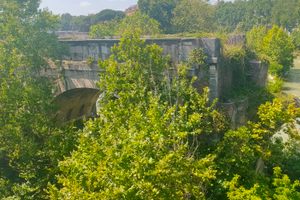
Cloaca Maxima’s outfall is near the Ponte Rotto bridge.   Lalupa
There is also an entrance to the system near the Basilica Julia in the Roman Forum.   Pedro Cambra/CC BY 2.0
The Cloaca Maxima, Rome, Italy, engraving by Lemaitre from Italie Ancienne, first part, by Duruy, Filon, Lacroix and Yanoski, L’Univers pittoresque, published by Firmin Didot Freres, Paris, 1850.   Getty via DE AGOSTINI PICTURE LIBRARY / Contributor
Very overgrown in June 2023   rbenn250 / Atlas Obscura User
  Collector of Experiences / Atlas Obscura User
  ahoy / Atlas Obscura User
  Collector of Experiences / Atlas Obscura User
From Ponte Palatino   katielou106 / Atlas Obscura User
  Collector of Experiences / Atlas Obscura User
2017- view from Ponte Rossi is obscured by vegetation.   Dr Alan P Newman / Atlas Obscura User
About 100m upstream this, more recent, storm water overflow, is from the sounds one can hear, !inked to the Cloaca Maxima.   Dr Alan P Newman / Atlas Obscura User
2017- unfortunately the out fall is getting overgrown and has suffered greatly from graffiti.   Dr Alan P Newman / Atlas Obscura User
Been Here
Want to go
Added to list

About

When the Romans built the Cloaca Maxima in the 6th century BC, they were very pleased with themselves for coming up with such an effective water drainage system. They were so pleased, they named it the "Great Sewer," which is what Cloaca Maxima translates to. It is one of the oldest monuments in Rome, albeit lacking the glamor of the Colosseum or the Pantheon.

The sewer was constructed as an open drainage system during the reign of Tarquinius Priscus, and was originally used to empty the marshlands and carry stormwater from the central Forum section of the city to the river Tiber. Much later, around the 3rd century BC, the open drain was covered, and waste from latrines and public baths were directed through the system.

Later still, in the 1st century, during the rule of Augustus Caesar and under the stewardship of his trusted lieutenant Agrippa, the ancient sewer system received a thorough cleaning and was expanded to include the flow from 11 aqueducts.

The Roman philosopher Pliny the Elder, writing 700 years after the system’s construction, was amazed by the sturdiness of the sewers. He wrote, “Sometimes water from the Tiber flows backwards and makes its way up the sewers. Then the powerful flood-waters clash head-on in the confined space, but the unyielding structure holds firm.”

Although it remained in continuous use, the underground structure suffered damage and neglect under the Byzantines, along with other parts of the ancient city. Parts of it were revived during the Renaissance and later excavations partially restored it. In 2012, a powerful Archeorobot was sent through the tunnels to check its condition and found that it was extremely fragile and needed extensive maintenance, which was then begun.

Today, a small trickle of water flows through the "great sewer," with its outfall running near the Ponte Rotto bridge. It can also be accessed near the Basilica Julia at the Roman Forum, where a door leads to the sewer, and its noises, and odors, can be experienced. 

Related Tags

History Underground Sewers Tunnels Roman Cities Ancient Infrastructure Subterranean Sites

Community Contributors

Added By

Kavya Ram Mohan

Edited By

Dr Alan P Newman, Collector of Experiences, rbenn250, katielou106...

  • Dr Alan P Newman
  • Collector of Experiences
  • rbenn250
  • katielou106
  • ahoy

Published

April 11, 2017

Edit this listing

Make an Edit
Add Photos
Sources
  • http://www.thehistoryblog.com/archives/21511
  • http://penelope.uchicago.edu/Thayer/E/Gazetteer/Places/Europe/Italy/Lazio/Roma/Rome/_Texts/PLATOP*/Cloaca_Maxima.html
  • http://www.livius.org/articles/place/rome/rome-photos/rome-cloaca-maxima/
  • http://www.museumofthecity.org/project/a-brief-history-of-urban-waste-management/
Cloaca Maxima
Piazza della Bocca della Verità
Rome
Italy
41.888886, 12.48026
Get Directions

Nearby Places

Temple of Hercules Victor

Rome, Italy

miles away

Temple of Portunus

Rome, Italy

miles away

Pons Aemilius

Rome, Italy

miles away

Explore the Destination Guide

Photo of Rome

Rome

Italy

Places 154
Stories 26

Nearby Places

Temple of Hercules Victor

Rome, Italy

miles away

Temple of Portunus

Rome, Italy

miles away

Pons Aemilius

Rome, Italy

miles away

Explore the Destination Guide

Photo of Rome

Rome

Italy

Places 154
Stories 26

Related Stories and Lists

13 Places to Wade Into the Wondrous History of Sewers

List

By Jessica Leigh Hester

10 Places to Explore the Dark Underbelly of Rome

List

By Kerry Wolfe

39 Places That Will Warp Your Perspective of Time

List

By Molly McBride Jacobson

Modern Cities Owe Their Cleanliness to These Innovative Old Sewers

engineering

By Kavya Ram Mohan

Related Places

  • A staircase excavated from the tuff leads to a depth of 120 feet (40 meters).

    Naples, Italy

    Naples Underground

    A labyrinth of ancient tunnels hidden below the city holds the ruins of 2,500 years of history.

  • Gea de Albarracín, Spain

    Albarracín-Cella Roman Aqueduct

    This ancient tunnel is one of the most important examples of Roman hydraulic engineering in Spain.

  • Roman circus of Tarragona.

    Tarragona, Spain

    Roman Circus and Praetorian Tower

    Long tunnels run under the ancient chariot racing circuit to the tower.

  • Clean Rivers Tunnel.

    Washington, D.C.

    Clean Rivers Tunnel

    An 18-mile-long tunnel for sewage waste will soon wind within the bowels of Washington, D.C.

  • Part of an medieval aqueduct

    Nice, France

    La Crypte Archéologique de Nice

    The construction of a tram line unveiled hidden remnants of the old medieval city.

  • The Western Wall Tunnel.

    East Jerusalem, Israel

    Western Wall Tunnel

    Descend 2,030 years into the past in an ancient tunnel built to support Jerusalem's most famous wall.

  • In the Barcelona sewer system.

    Barcelona, Spain

    Sewers of Barcelona

    Barcelona's historic 19th-century sewers, whose foundations were laid in medieval times, are open to the public for exploring.

  • A view from inside the tunnel. (Photo:

    East Jerusalem, Israel

    Siloam Tunnel

    An ancient tunnel in Jerusalem built to redirect water in the event of a siege is one of history’s great architectural innovations.

Aerial image of Vietnam, displaying the picturesque rice terraces, characterized by their layered, verdant fields.
Atlas Obscura Membership

Become an Atlas Obscura Member


Join our community of curious explorers.

Become a Member

Get Our Email Newsletter

Follow Us

Facebook YouTube TikTok Instagram Pinterest RSS Feed

Get the app

Download the App
Download on the Apple App Store Get it on Google Play
  • All Places
  • Latest Places
  • Most Popular
  • Places to Eat
  • Random
  • Nearby
  • Add a Place
  • Stories
  • Food & Drink
  • Itineraries
  • Lists
  • Video
  • Podcast
  • Newsletters
  • All Trips
  • History & Culture
  • Wildlife & Nature
  • FAQ
  • Membership
  • Feedback & Ideas
  • Community Guidelines
  • Product Blog
  • Unique Gifts
  • Work With Us
  • About
  • FAQ
  • Advertise With Us
  • Advertising Guidelines
  • Privacy Policy
  • Cookie Policy
  • Terms of Use
Atlas Obscura

© 2025 Atlas Obscura. All Rights Reserved.