About
Bergen derives its name from the seven mountains surrounding the city, of which Mount Fløyen is the most iconic, bar none. That’s in large part thanks to this funicular railway, which offers passengers a sweeping panoramic view of the city and its surrounding fjords without breaking a sweat.
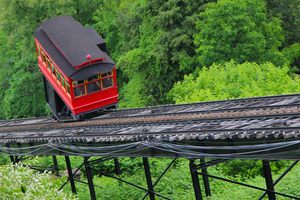
First proposed in 1895, the construction of Fløibanen started in 1914 and operation commenced on January 15, 1918. Carrying passengers from Bergen city center to the peak of Fløyen (with three additional station stops in between), the fully electric funicular ascends 300 meters (984 feet) over a total track length of 850 meters (2789 feet). Aside from one passing loop located between the third and fourth stations, the cars run along the same single track for the duration of the climb.
The two counterbalanced cars—known to locals as “Blue Man” and “Little Red Riding Hood”—each accommodate approximately 80 passengers and take roughly seven minutes to traverse the length of the track.
Fløyen’s summit provides visitors with not only picturesque vistas but also ample hiking opportunities, including trails leading to Bergen’s other six mountains. A favorite among local hikers is “Vidden,” which runs 8.3 miles from Fløyen to the gondola station atop Bergen’s tallest mountain, Ulriken. There is also a restaurant, cafeteria, souvenir shop, and a play area.
Unlike many tourist attractions, Fløibanen is a fixture of daily life for Bergen locals, many of whom purchase annual passes and use the summit as a starting point for hiking and trail running. Some even incorporate it into their daily commutes to work or school, or to get to soccer practice at the athletic complex near the Skansemyren station.
Attentive readers may have noticed that the funicular’s name, Fløibanen, differs in spelling from its namesake mountain. This idiosyncracy derives from a change to Norwegian spelling conventions in 1938 that renamed the mountain while the railway operator decided to keep its original name.
Most everything else has been overhauled since then, however. The cars and machinery were fully replaced in 2002, and (in admirably forward-looking Nordic fashion) are slated to be renewed again in 2030.
Know Before You Go
Fløibanen runs from 7:30 a.m. to midnight on weekdays and 8 a.m. to midnight on weekends and holidays. Trains typically depart every 30 minutes, but run continuously during peak hours.
Community Contributors

Added By
 Traveldug profile photo
Edited By
- tpaulus profile photo tpaulus
- movesbrit profile photo movesbrit
-
Bearded Zombie
- Traveldug profile photo Traveldug
- besko6A profile photo besko6A
Published
July 9, 2016
Updated
September 9, 2026