About
In 1458, following the conquest of Athens, Ottoman rule prioritized establishing stability in the region. Alongside administrative reforms, optics played a vital role in cementing Ottoman authority. The Islamization of the newly acquired lands led to the emergence of unseen architectural designs, fundamentally altering the everyday experiences of the local Greek population. At the core of this evolution was the development of mosques.
The city's main mosque was strategically positioned atop the Acropolis, repurposing the Parthenon, while several smaller mosques were constructed nearby. The only Mosque outside central Athens was built seven miles north in the settlement of Kifisias, which was popular in the Ottoman era as a retreat.
Although the precise construction date of the Kifisias Mosque remains debated, historical records indicate its existence in 1667. Back then, Kifisia was a quaint village boasting three hundred houses, with a diverse population split evenly between Muslims and Christians. This mosque, on a site that was previously a Christian church honoring Saint Pareskevi, stood prominently near the settlement's fountain and several small Christian chapels.
In the heart of the mosque stood a square prayer hall, crowned by a small dome, while a sheltered portico adorned the northwestern side with its small hemispherical vaults. A minaret graced the western corner, the mihrab at the focal point of the southwestern wall, and to its right stood the pulpit.
Following the Ottoman defeat by the Greeks in 1824, the mosque fell victim to pillage at the hands of the rebellious Greeks. Subsequently, the mosque transitioned into the possession of the modern Greek state, finding new purpose as a gendarmerie and barracks. In the 1890s, the mosque met its demise, being demolished along with all other Ottoman structures in the area.
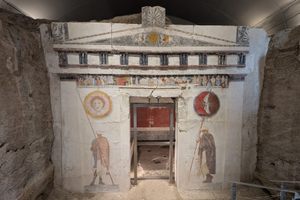
In 2022, restoration works were conducted by the Ephorate of Antiquities of East Attika to preserve the remaining structure. Today, only a small section of the southwestern wall and the base of the minaret are still intact. Additionally, a barracks wall, situated between the minaret base and the adjacent building, remains standing, offering a glimpse into the past and showcasing a nearby Roman grave monument.
Know Before You Go
The ruins are viewable 24/7. They sit behind security fencing and are well lit at night. Several families of cats live safely behind the secure fencing.
Community Contributors

Added By
Published
November 3, 2025