About
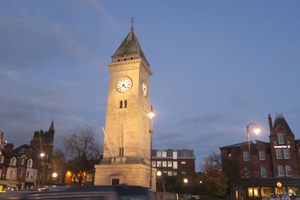
"The Monument" is one of the locally used names for this war memorial in the form of a clocktower in Leek, Staffordshire, UK. It is also known as The Nicholson Memorial, named for the person who originally paid for its construction after WW1, but the locals commonly refer to it, affectionately, as "Sir Arthur's wristwatch".
It was inaugurated in 1925, constructed for the sum of around £16k in memory of the inhabitants of Leek who fell in the Great War, but particularly in memory of Lt. Basil Lee Nicholson who was the son of Sir Arthur Nicholson and who was killed in 1915.
At about 90 feet high, it is one of the tallest war memorials in the UK and, within provincial towns, one of the most impressive. The tower was built in brick and clad in white Portland stone with a pyramidal roof.
It has four 6.8 ft diameter, illuminated clock faces. There are decorative wrought iron and bronze gates and lamp standards. The architects were the firm of Thomas Worthington and Sons of Manchester with memorial tablets designed by The Birmingham Guild of Artists. The original clock mechanism and the five bells, weighing over a tonne in total, were made by Gents (of Leicester).
Around the top of the tower are the names of battles involving the 46th (North Midland) Division of the British Army, which included three reserve units, Old Leek Battery (a reserve artillery unit) and the 1/5th and 1/6th reserve battalions of the North and South Staffordshire Regiments. Both regiments would commonly recruit men from Leek, both regulars and reservists.
Sir Arthur's youngest son, Basil Lee, was killed quite early in the war during fighting at Ypres in July 1915, some 5 months after arriving in France. He was a forward observation officer and was shot by a sniper whilst observing the fall of shot. Although, from Sir Arthur's point of view, the memorial was to his son, it was officially dedicated to all of the WW1 dead from Leek. The memorial was added to after WW2. It now has plaques naming 535 Leek and district fallen from WW1 and WW2.
Following an award of £178k from the National Lottery Heritage Fund, the tower was restored in 2012, including a new clock mechanism, and, after many years, the tower was re-opened for public tours. It is protected as a Grade 2 listed building.
Community Contributors

Added By
Published
June 19, 2026