About
Joshua Nicholson was the owner of a number of silk mills in Leek, Staffordshire, UK, in the 19th and early 20th century. He wanted to give the people of Leek the chance to both learn valuable employment skills and expand their cultural horizons. He funded the construction of an amazing building which he used as the basis for an amazing social enterprise. The Institute he fuonded is still used for its original purpose (very rare for 19th century public libraries). It currently houses a museum, an art gallery, a public library and a Tourist Information Centre and it also has an extension, opened in 1900, to create a 'Silk and General Technical School'. It is currently part of Buxton and Leek College (part of the University of Derby group of colleges). Initially the public library was only free to those who lived within 6 miles of the building but it has now been taken over by the local authority and is available to anyone within its jurisdiction. The local museum and art gallery is very small with a, rather eclectic, permanent collection but this is supplemented by temporary exhibitions, both historical and artistic.
Notable, within the permanent collection, are a framed display of silk worms and moths, illustrating the source of the town's main economic activity at the time, and taxidermy, in the form of one of the population of Wallabies that have established on the, nearby , Staffordshire Moorlands near Doxey Pool (https://www.atlasobscura.com/places/doxey-pool). Whilst non-local visitors to the building will probably be aiming for the museum and art gallery on the top floor it is probably the building itself which impresses most of all, both interior and exterior.
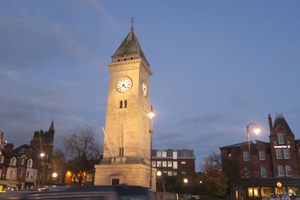
The building has an impressive tower with a copper domed roof and an ornately decorated frontage. The 1900 extension has some amazing low-relief plasterwork tympana above the windows illustrating the various subjects originally taught in the college (artist A Broadbent). Internally the Institute has loads of original features including some amazing frescoes on the staircase (best to see these on a very sunny day as the stairwell lighting is not the best).
Despite its typically Victorian "out there" appearance, the Institute is tucked away behind a beautiful 17th century stone-built house called Greystones and it is said that Nicholson deliberately avoided obstructing the view of the historic building partly because of its association with William Morris. It currently carries a plaque that records that ‘William Morris and Leek founder members of The Society for the Protection of Ancient Buildings saved this building in 1884’.
The Institute and library was built between 1882 and 1884. The architects were William and William Larner Sugden (father and son) who were also responsible for the 1900 college extension and for the adjacent William Carr Gymnasium which still serves as a sports centre for the college.
Know Before You Go
Closest parking lot is the Stockwell Street Car Park just uphill and to the west of the building. It is rather small and gets full quickly. There is another parking lot quite near, opposite the St Edward the Confessor Church. on Church Street
Community Contributors

Added By
Published
December 3, 2024
Sources
- http://news.bbc.co.uk/local/stoke/hi/people_and_places/history/newsid_9052000/9052486.stm
- https://www.pressreader.com/uk/leek-post-times/20200715/281874415708041
- https://www.thornber.net/staffs/html/leek3.html
- https://historicengland.org.uk/listing/the-list/list-entry/1268544?section=official-list-entry
- https://britishlistedbuildings.co.uk/101268544-nicholson-institute-and-leek-college-of-further-education-leek
- https://www.enjoystaffordshire.com/whats-on/open-art-staffordshire-moorlands-exhibition-p1859091