Podcast: Exploring the Unexpected in Alberta
This province’s diverse history makes it a rich territory for writers like Will Ferguson, from a deeply rooted Japanese settlement to a legendary Gold Rush figure.

Listen and subscribe on Apple Podcasts, Spotify, and all major podcast apps.
Will Ferguson: If you drive east from Calgary, instead of going towards Banff and the mountains, if you go the other way, the landscape will suddenly fall away and you’ll find yourself in the Badlands. But before you hit that valley, before you make that descent, if you turn off the main road, you will come to a small hidden valley full of wild roses.
In that little valley, you will find a small and improbable town—a town that should not exist. It’s at the very edge of these rolling canola fields, roses, a little valley. And it certainly should not be a major theater hub by any stretch of the imagination, but it is. And Rosebud is a town that kind of defies logic.
Kelly McEvers: I’m Kelly McEvers, and this is Atlas Obscura, a celebration of the world’s strange, incredible, and wondrous places. This episode was produced in partnership with Travel Alberta. Explore Canada’s Wild Side.
This month, we’re talking to writers and artists who find inspiration in their home province of Alberta. Today, we’re talking to travel writer and novelist Will Ferguson. He’s lived in South America and Japan, where he taught English for five years. But his work is inspired by his home country.
Will has published over 20 books. Many of them cover Canadian identity and history. And today, he is taking us on a tour of the province of Alberta to tell us about the places that have inspired his work. from that improbable town he was just describing, to a Japanese garden, to a town that tells the story behind a 12 foot statue of a fur trader. Will Ferguson, welcome to the show!
Will: Thanks for having me.
This is an edited transcript of the Atlas Obscura Podcast: a celebration of the world’s strange, incredible, and wondrous places. Find the show on Apple Podcasts, Spotify, and all major podcast apps.
Kelly: For this conversation, of course, we asked you to tell us about three defining places for you in Alberta, places that have influenced your work. And before we get to those, I just want to talk a little bit about your upbringing there, if you don’t mind. Let’s just talk about growing up in Alberta. Where’s your family from? What was it like there?
Will: Well, I grew up in northern Alberta in a town, the teeming metropolis of Fort Vermilion, population 749, I believe.
Kelly: Wow.
Will: So I grew up there. That town is closer to the Arctic Circle than the American border, just by a nutshell. And I don’t know why we were proud of that. That was like a real point of pride that we were like just past the halfway point. So I always feel growing up there that I kind of emigrated to Canada. The weirdest thing is Canada, as we knew it from the radio signals and the television signals, was a southern country.
So for me, Canada was to the south. That’s how I thought of it, as a southern country with shopping malls and paved roads and traffic lights.
Kelly: Wow. That is so interesting. What an interesting way to grow up, to think of yourself from this northern land that was somehow separate from the country that you were actually in.
Will: Yes.
Kelly: I love that. When did you know you were a writer?
Will: Well, I always liked writing. I originally went to study filmmaking. I wanted to be a documentary travel filmmaker. I wanted to travel the world with these big, giant, clunky cameras people had back then. Actually, physical film. This is back in the ’80s, the late ’80s.
But I wanted to carry a tripod and a camera case and travel the world. And so I went to York University to study film production. And I learned two things at film school. One is I did not want to make films. I did not enjoy it. The second is that I like the screenwriting. I like that aspect of it, the storytelling. I always enjoyed writing. Like it was something that seemed very natural to do.
Kelly: Let’s talk about the three places you chose. Three defining places for you in Alberta. And the first one is Nikka Yuko Gardens. Tell me about that.
Will: Nikka Yuko is in southern Alberta. And southern Alberta is big sky country, is what they call it. And this is where the red-coated, you know, the mounted police, that image everyone has of the Mounties riding their horses. That’s where they first arrived. And in Southern Alberta, the reason they went there is because Southern Alberta was kind of lawless. There were these American whiskey traders coming up from Montana, causing all kinds of grief and havoc and violence among the First Nations.
So with Lethbridge, with its whiskey smuggling, Mountie police, big sky, dry plains area, it’s the last place you would ever expect to find a Zen garden, right? You never expect to find Japanese aesthetics. It’s kind of almost the opposite of what you’d expect. And there’s a history there, which I find really fascinating. That area was settled by Japanese farmers in the early 1900s. Some of them from Okinawa, which I feel so bad. I feel guilty because Okinawa is this beautiful tropical paradise where it never snows.
I don’t know who gulled them, who tricked them into coming, but they arrived in areas where the winters hit 40 below. Japanese fishermen became farmers, but they settled in there, in that area around the early 1900s.
They struggled at first, then they thrived, like it became a very Japanese area. And then in World War II, when Canada expelled Japanese citizens from the West Coast and sent them inland, often into internment camps, but not always, there was a second wave of Japanese. So there’s kind of two big waves of Japanese people in Lethbridge, in the community. So it has a long, long history and it’s still very much, there’s still very like third, fourth generation Japanese in Lethbridge. I’m only second generation Canadian. The Japanese in Lethbridge have longer roots than I have.
To commemorate this Japanese community and their history, in the 1960s, they built a beautiful Japanese garden. And I, I, want to emphasize, a real Japanese garden, like an authentic Japanese garden. They built the garden structures in Japan by master craftsmen. The tea pavilion, the bell tower, there’s wooden bridges, the cast iron Buddhist bell itself, those were brought over and assembled in Lethbridge. But the gardens themselves, like the flora, the trees, the materials, were taken from the prairies from Southern Alberta. So it’s really this perfect blend of the two.
You’ve got these Alberta skies and flora and trees and the Japanese aesthetics. So for example, they used crabapple trees for spring flowers rather than sakura. They used Canadian maples for autumn colors. They gathered stones from the Old Man River. And Nikka Yuko, it’s derived, the kanji comes from Japan-Canada friendship. Canada and Alberta is founded by so many different communities. But what I love about it is it’s such a blend of Alberta landscape and Japanese aesthetics. And my wife’s Japanese, so we go to Nikka Yuko often, whenever we can, whenever she gets homesick.
Kelly: And this place influenced your novel, Officer Shimada and the Disappearing Girl. It came out this year, in 2026. How did the place inspire the book?
Will: The population of Lethbridge has a heavy Okinawa influence. And my wife is from southern Japan, so we went down to Okinawa. And we went to this little island, the southernmost island in Japan called Hataruma, the very end of Okinawa. You can’t go any further. That’s the end of Japan. It’s maybe six kilometers across, maybe 400 people live on it. And when I was there, we walked by and there was a police station of this island with one police officer.
So I just thought, what does he do if crime comes to Hataruma? Because in front of this little tiny police station, there was a billboard with Japan’s most wanted, and these Yakuza toughs with scars on their faces. So I started to think, what is it about Okinawans that there’s something adventurous? They used to be their own kingdom. They had their own language, their own religion. They were caught between Ming China and Japan. They were their own kingdom, their own culture, but now they’re part of Japan. But they were really pulled back and forth. And I think that’s a lot of the reasons why they were open to leaving, to going across the world, to Alberta. So I believe that the roots of Okinawa’s diaspora come from being caught between two opposing empires. And Canada, of course, is in the shadow of an empire.
So I think all that stuff just kind of resonated with me and came together and came up with a novel about this officer named Shimada. on this tiny island in Okinawa who has to solve an impossible crime. So that’s kind of how it all started. It kind of starts with Nikka Yuko Gardens.
Kelly: Okay, so the next place you chose is called Rosebud. Where in Alberta is this place and what is it?
Will: Rosebud is in central Alberta. If you drive east from Calgary, Instead of going towards Banff and the mountains, if you go the other way, the landscape will suddenly fall away and you’ll find yourself in the Badlands. But just before you hit that valley, before you make that descent, if you turn off the main road, you will come to a small hidden valley full of wild roses. In that little valley, you will find a small and improbable town, a town that should not exist.
It’s at the very edge of these rolling canola fields, roses, a little valley. And it certainly should not be a major theater hub, by any stretch of the imagination, but it is. And Rosebud, is a town that kind of defies logic. So Rosebud was a prosperous little place in its day. You know, one of those classic, it was a farming and coal mining town. You know, they had homes and shops and a school, but the mine shut down, the school closed. And by the 1970s, it was a ghost town. It was essentially a ghost town. There were nine people still there, living there.
Kelly: Wow.
Will: The beauty of being almost a ghost town, the benefit of being almost empty is that there’s lots of buildings and space available. So there was a Calgary church decided to have their summer camp. And they knew someone who knew there’s all these places available in Rosebud. So they took kids out there and they had a summer camp. And among them, they also did a theater program. They put on a play for local farmers in the area. It was largely improvised. It was the ’70s, man. So it was like a theater dell’arte.
Am I saying that right? You know, like the kind of improvised 1970s style. I imagine they all had bell-bottom pants on. I could just imagine, and long hair. You know, they put on this play, and then it was such word-of-mouth spread. So it became an annual summer camp that included the arts, which included acting and theater for teens. And it grew. They grew from a summer camp to an actual theater schoo. Then it got a professional stage. And today Rosebud has a program. It runs all year. There’s three stages. One of them is outdoors. The town now has a population of about 150, but it can welcome up to 40,000 people every year.
Kelly: Wow.
Will: They have people drive out to this theater town. It’s got a beautiful bed and breakfast. There’s a hotel, a very high-end hotel. And there’s also a very cozy B&B. And there’s little antique shops. And there’s a cafe. And they’ve got some of the old town. It’s a very small little hidden valley. And my wife went to a Catholic school in Japan. And her favorite nun, the nun that she loved, was Sister Logina, who loved “Sound of Music.” So my wife grew up learning “Sound of Music.”
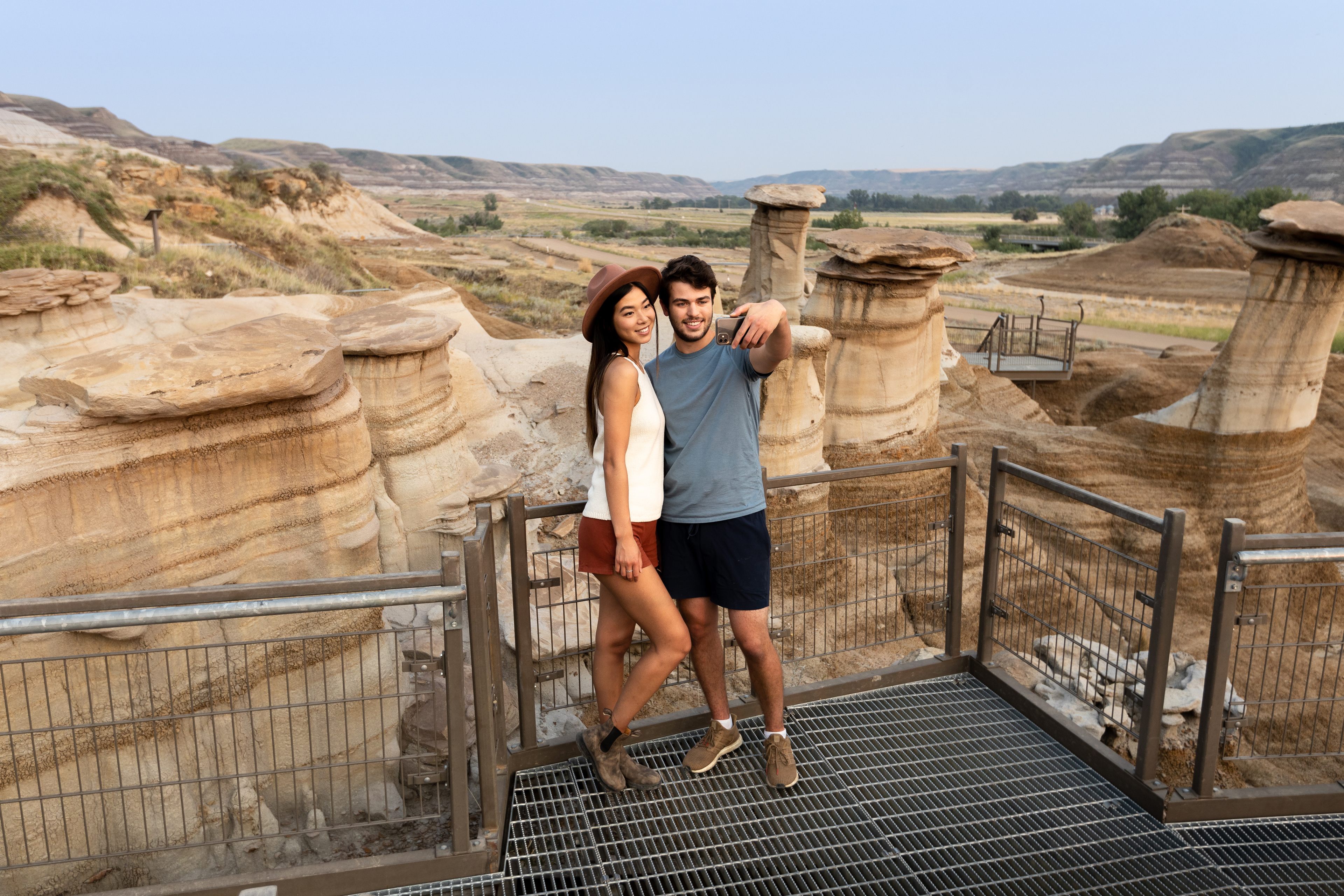
So we heard that they were putting on a few years ago “The Sound of Music” in Rosebud. So we drove out, stayed overnight, loved it. And what I like about Rosebud is, is you feel like you’ve discovered it. Of course you haven’t, but you feel like you’ve discovered something whenever you drive in that little valley. And it dovetails really nicely with a trip to the Badlands, to Drumheller, it’s like maybe 20 minutes away. So you can get this, it’s the contrast between these rolling canola fields that are deep green in the spring and golden yellow in the fall, and the theater. And then you drive down the hill and you’re suddenly among dinosaurs and rocky hoodoo formations and fossilized remains.
That 20-25 minute drive between the two is just remarkable. And I love the fact that there’s these little communities that reinvent themselves. Because the west was always where you went to reinvent yourself. That was one of the appeals of going west. Go west, young man. Go west, young woman, west to reinvent yourself. And Rosebud kind of personifies that.
Kelly: Nice. And we should say, you feature it in your book “Meanwhile, Back in Nokomis,” which is part of your travel collection, right?
Will: Yeah, so it’s a travel collection, “Meanwhile, Back in Nokomis,” which is another small town. So it’s in there, the story of Rosebud, is in that book. And it’s a collection of the kind of, I really favor eclectic, eccentric little towns. So when you read my travel books, you’re not going to get a guide to Banff or to downtown Toronto or to Niagara Falls necessarily. But you will find out about Rosebud and Nokomis. So there you go.
Kelly: Okay, so the third place, it features in another of your travel books, “Beauty Tips from Moose Jaw.” I say place, but it’s really a statue, the 12-foot Davis statue. Talk about that.
Will: Yes. So a travel book I wrote called “Beauty Tips from Moose Jaw.” I did go to Moose Jaw. I did get beauty tips in Moose Jaw at the spa. But this is a town on the Peace River, which is a massively wide river. And the name Peace River, it sounds very calming, but it actually refers to these very bloody kind of battles between two First Nations, the Cree who pushed up and then the Beaver who fought them back.
And the Peace River became kind of the demarcation line between the two nations. So that’s where the name comes from. The gateway to northern Alberta is the town of Peace River, which is about, I think around 7,000 people. A after Peace River, you really plunge headlong into these endless forests.
But in Peace River, you will find a very iconic wooden statue of a woodsman. He’s kind of wearing what looks like a Davy Crockett-style raccoon hat. But he’s not Davy Crockett, and it’s far away from the Alamo. But it’s actually a statue of a man called 12-Foot Davis, who is real, and he was very short and stocky. Visitors sometimes think that he’s like a Paul Bunyan statue, character, that type of character. But no, he was real. He wasn’t 12 feet tall, of course.
His name was Henry Davis. And the name, how he got the name was during the Caribou Gold Rush in the 1860s up in northern Canada and BC. And he arrived too late. All the good land had been staked. But he noticed that in the rush to stake these gold claims, people were a little bit sloppy.
You’re only allowed so much space, like so many feet for a claim. And he walked through it and measured and measured, and he realized that two miners had overstaked their claim by six feet each. They’d done the math wrong, but they’d each over-claimed by six feet. So he staked a claim on 12 feet on this narrow strip of land, and he reaped a fortune in gold on those 12 feet. He made what in today would be over $200,000. So from that’s where the name 12-foot Davis, he made his fortune on this thin strip of land because he thought to check.
And he used that money and he came to the Peace River to become a fur trader. He set up his own very successful fur trading, independent fur trading fort. And he was, you know, he’s very popular in the area and friendly by all accounts.
It’s always said that he always left the door of his cabin open, which I think explains why he was robbed so often. But I’m kidding. No, he wasn’t robbed. But he did leave his cabin door open. So the idea is that if it’s windy or cold, you could always go in.
He was what’s called a free trader. So he wasn’t aligned with the big companies, the Northwest Company or the Hudson’s Bay Company. So for almost 40 years, he clashed and rankled and fought with the Hudson’s Bay Company, which wanted and claimed a monopoly on the fur trade.
So when he died, he asked to be buried. The statue is in the town, but his grave is up the hill. And he asked, and it’s a beautiful view. You get this kind of epic panorama of the Peace River and the Smoky River. It’s a very striking area. And he asked to be buried on the hill, looking down on the valley. Now, in the north, where we grew up, it was known that the reason he asked to be buried there was so that he could piss on the Hudson’s Bay Company below.
But the official reason, the official story was that you read in the tourist books is that he wanted to be buried there so that he could gaze out one last time upon the landscape that inspired and moved his heart. So again, whichever story you decide to take, it’s still 12-foot Davis country. Like it belongs to the short, stocky, very astute fur trader.
Kelly: I love it. Oh, my gosh. You know, you’ve written obviously so much about Canada and about being Canadian. And, you know, you said earlier that growing up, you almost kind of grew up looking at Canada as an outsider because you lived so far north. And you obviously still live in Canada. What does it mean to you today to, you know, be Canadian?
Will: Well, what I what I like about Canada, what I enjoy the most, it’s is that it’s, do I have time? Can I tell you a very quick story about South America? Do I have time? I don’t know how podcasts work.
When I was a teenager, I went to South America with Canada World Youth. I mentioned it’s like the Peace Corps. And every Canada World Youth group was chosen to represent Canada as a whole. Like the same ratio of French to English, rural to urban, east to west.
We were like these little miniature Canadas, these groups. And they sent my group to South America. And wherever we went, the Ecuadorians would ask us to do a Canadian dance. Now we don’t have a Canadian dance. So we made one up this kind of weird square dance where we would stomp and holler and move around in circles. Um, and the Ecuadorians would be very puzzled by it.
And I’ve watched them watching this travesty of a dance we pretended was our national, and, uh, I think that in Canada, there is no homogenous attempt at a melting pot. There is no unifying Canadian culture that kind of dilutes the eclectic nature of the country. I don’t think that’s a weakness. I think that’s a strength. And I think it’s a selling point. The fact that we don’t have a Canadian dance, that it’s a very eclectic, eccentric, far-flung country. with French and English, Acadian, East, West, a wide variety.
But the key is they’re joined in this project called Canada, and there’s a civility to it. No matter what your difference is, you try your best to be civil and to be respectful. That’s it. It’s not a difficult formula. It’s not an obscure formula. It’s just we live in this very far-flung, eclectic, eccentric place. We’re only going to get along if we respect that in each other.
Kelly: Will Ferguson, thank you so much for this. This has been wonderful. You are selling me so hard on Alberta and Canada. Like, I’m in.
Will: Well, I’ll see you. I’ll be here waiting for you with a gift basket when you arrive.
Kelly: Awesome. And we’ll go to Rosebud and the Badlands and the North. All of it. Yeah. Thank you so much.
Will: Thank you.
Sponsored by Travel Alberta. Explore Canada’s Wild Side.


Follow us on Twitter to get the latest on the world's hidden wonders.
Like us on Facebook to get the latest on the world's hidden wonders.
Follow us on Twitter Like us on Facebook