Podcast: Exploring Alberta’s Rich History in Fiction
The novelist Esi Edugyan was born in Calgary, and her work frequently explores some of the lesser-known aspects of the province’s history in a blend of literary fiction and adventurous storytelling.

Listen and subscribe on Apple Podcasts, Spotify, and all major podcast apps.
In this episode of The Atlas Obscura Podcast, we’re exploring the surprising side of Alberta with the Canadian novelist Esi Edugyan.
Our podcast is an audio guide to the world’s wondrous, awe-inspiring, strange places. In under 15 minutes, we’ll take you to an incredible site, and along the way you’ll meet some fascinating people and hear their stories. Join us daily, Monday through Thursday, to explore a new wonder with host Kelly McEvers and guests.
This is an edited transcript of the Atlas Obscura Podcast: a celebration of the world’s strange, incredible, and wondrous places. Find the show on Apple Podcasts, Spotify, and all major podcast apps.
Esi Edugyan: I remember coming across this image of these Black homesteaders in Central and Northern Alberta kind of working the land. I hadn’t had a sense of there being any Black presence or Black history in Alberta, and I thought, “Oh my gosh, who are these people?”
Kelly McEvers: I’m Kelly McEvers, and this is Atlas Obscura, a celebration of the world’s strange, incredible, and wondrous places. This episode was produced in partnership with Travel Alberta: Explore Canada’s Wild Side. This month we are talking to writers and artists who find inspiration in their home province of Alberta.
And today we’re talking to novelist Esi Edugyan. She grew up in Calgary, Alberta, and her novels are part literary fiction, part adventure, traveling across continents and through different time periods. They’re also based on her extensive historical research. She says she’s inspired by what she calls the footnotes of history, these moments and stories that most of us have never heard of, in particular stories and histories of Black communities.
And today she is taking us on a tour of the places in Alberta that have shaped her life and work, from a prehistoric buffalo jump to the ghost towns of Black homesteaders. Esi Edugyan, thank you so much for being here today.
Edugyan: Delighted to be here.
McEvers: Okay, so for people who are not familiar with Calgary or Alberta, how would you describe it?
Edugyan: You know, it’s, it’s so funny. I realize my Alberta is like a remembered Alberta. Love that. It’s like an Alberta of the imagination, simply because I haven’t really lived there since 1995. For me, Alberta is like, we used to call it Big Sky country, like enormous open skies.
I think parts of it are, obviously when you get kind of outside of the cities, probably still that way. Rolling fields of wheat and farms and wonderful air. You know, I’m from Calgary. In the times that I’ve been returning it’s very much like a city for foodies now, like excellent restaurants.
It’s always had a very interesting kind of cultural landscape in terms of acts it’s been able to attract, in terms of music, excellent art exhibits. So it’s this kind of curious and interesting mix of, I guess, the rural and the urban. It’s a very interesting place. Very interesting place.
McEvers: You grew up there in the ’80s, right? What was your community like then in Calgary?
Edugyan: Definitely I was a child of the ’80s, running around Calgary. I was born and raised in the southwest in a little neighborhood called Glamorgan. I grew up in a series of townhouses that were just off, like, Sarcee Trail. And as a child, I could just throw open the door, go outside, stand on my front stoop and just turn my head to the right and look out, and I could see the Rockies very clearly.
This is like one of the, the central images of my childhood is this very crisp, very pristine view of the Rocky Mountains. By the time I was a teenager, you could not see the Rocky Mountains from my stoop. But that just tells you just how quickly change happens within Calgary and the province in general, and that it came from having a very sort of austere, almost removed kind of sense of things.
Like I remember tumbleweed would be rolling through our streets as a child, and if I think of that now, that seems so weird. But yeah, we had actual like large balls of tumbleweed that would just go flowing through and you really felt that like Western …
McEvers: And your parents came from Ghana, right?
Edugyan: Yeah. So in terms of community, like you were asking earlier, we were very much part of this web of, I guess, African immigrants and expatriates, but also just, like, a larger immigrant community. We knew people from everywhere, newcomers who would… You know, my father’s, one of his best friends was this man from Poland, and then he had another best friend who was from England, and it was very interesting, a lovely kind of mix.
But, you know, I also felt myself, having been born and raised there, to just sort of be part of, I guess, this community of Canadian kids who were all kind of running around.
McEvers: So you said you left Calgary in 1995, and you now live on Vancouver Island. But thinking about Alberta and growing up there, what are some of your favorite places there?
Edugyan: I guess, my favorite places in Alberta, from when I was a child were… I think first and foremost, the things you remember are the places that you went to on, like, school field trips.
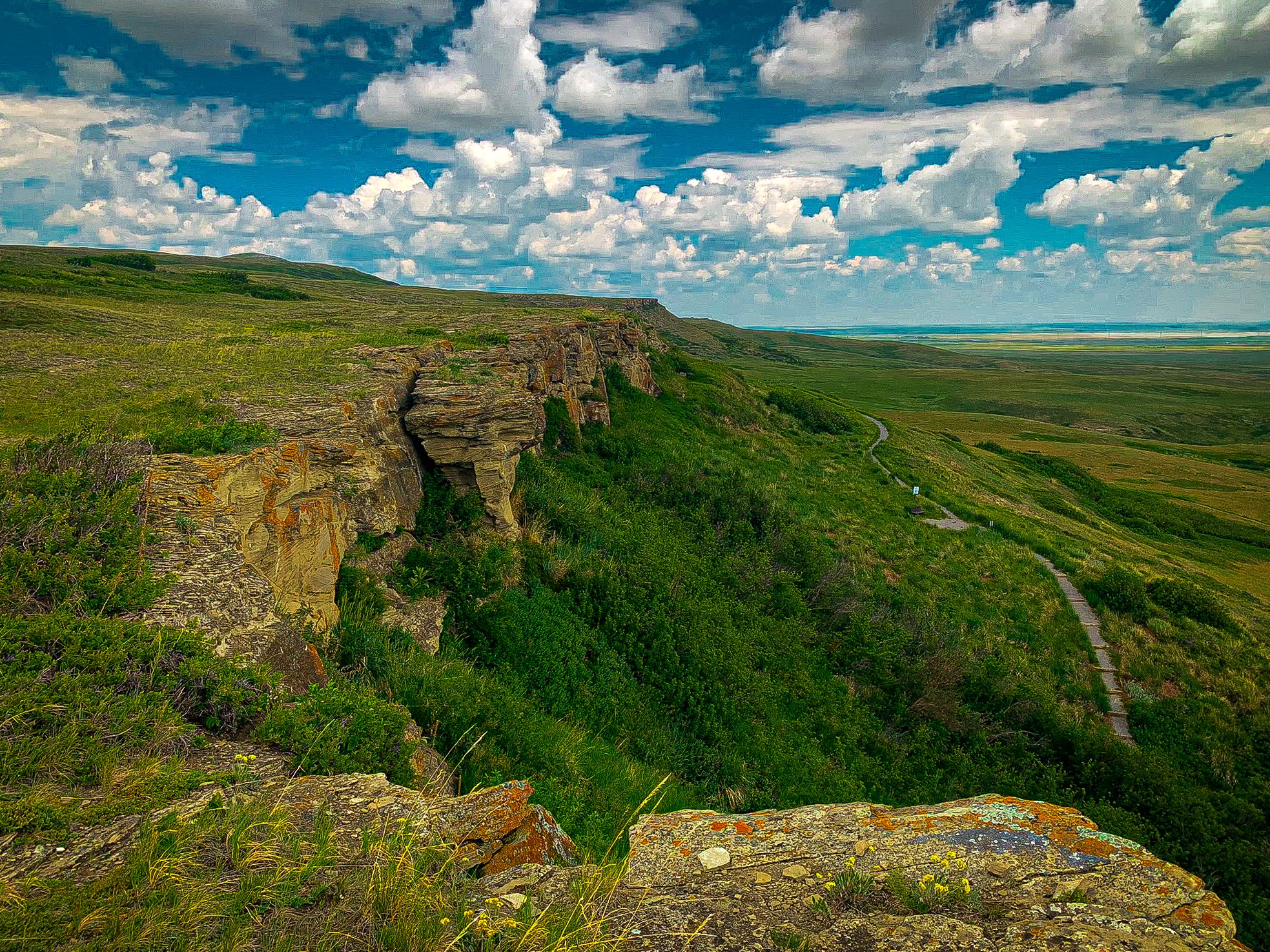
You know, I remember going to Head-Smashed-In Buffalo Jump. I think it’s about 15 minutes from Fort Macleod, so south of Calgary. And this is a very old site, like 6,000 years old, so very, very prehistoric, where the Blackfoot would, I guess, round up the buffalo, and they would run them one route that the buffalo could take because it’s going to lead them off the cliff.
And this was a very efficient way of hunting. And so right up until, I think, the mid-1800s, this was the main way that the buffalo were hunted on the plains. And now it is, I believe it’s like a UNESCO World Heritage site.
It just feels like a very special place, and you know, I haven’t been there since I was a child, but I can distinctly remember the feel of it, that sense of standing on the precipice of the main run and looking out onto this vast landscape of grasses and that great big sky, and just feeling this kind of, like, haunted feeling.
This is one of those memorable places that I think everybody should see.
McEvers: Yeah. Yeah, definitely. Others that sort of stick out for you?
Edugyan: Yeah, I mean, just a lot of things within Calgary itself. There’s the Globe Cinema, which is one of those institutions that’s been around since, like, the early to mid-’90s, where you could always go and watch, you know, art-house films.
I just remember my first experience of watching, like, a David Cronenberg film at that theater, and it just making such an impression, and attracted to, I don’t know, this very kind of easily accessed art.
McEvers: Esi eventually moved to the States for graduate school at Johns Hopkins in Baltimore. Her partner was three hours away studying at the University of Virginia. And it was there in the library that she would find a historical footnote that would inspire her first novel, “The Second Life of Samuel Tyne.”
Edugyan: And I remember visiting him one weekend and just going through the stacks at the library at the University of Virginia, which is quite an incredible library. But, like, coming across a history book about Alberta, and I think when you’re a kid living in Alberta, like, that’s the last thing you want to pick up is a history book on Alberta.
You know, as somebody who was living away and maybe, um — not homesick, but just kind of had a thought like, “Oh, like, like I don’t…” You know, we did learn some Albertan history, but I didn’t feel like I had extensive knowledge or anything like that. And, uh, also, you know, you’re casting around, I think with your first novel, this is not for the case for everybody, but I think with first novels, you can have the sense of wanting to kind of like stake your ground or like, “This is what I’m going to write about.”
And also you want write maybe from your experience and it’s like, “Okay, I’m an Albertan, uh, so what’s in this history of Alberta?” And, I remember like by page maybe like 30 or something, coming across this image of these Black homesteaders in Central and Northern Alberta kind of working the land.
I hadn’t had a sense of there being any kind of a Black presence or Black history in Alberta. And I thought, “Oh my gosh, who are these people?”
McEvers: After the break, Esi tells us who these Black homesteaders were and how they got to Northern Alberta, and how this inspired her first novel.
And we’re back. I’m Kelly McEvers, your host. Esi, before the break, you talked about coming across these Black Albertan homesteaders in a history book, and you’d never heard of their story growing up. What did you find out about them?
Edugyan: So I ended up doing some research and just being completely floored to understand that there had been these small Black townships kind of scattered throughout Alberta and Saskatchewan in which freedmen, like people who’d been previously enslaved, come up from Oklahoma mainly, but also from Texas, and come and settle some of the land up north.
And why they did this, or how they ended up doing this, was because, I guess, the turn of the 20th century, the Albertan government put in place a campaign called the Last Best West, in which they were trying to encourage American farmers and ranchers to come and settle parts of the west. And so they had people actually going down, I guess, emissaries with advertisements and, like, holding talks about why this was sort of the best place for, for these people from Oklahoma and Texas.
And a lot of these freedmen thought this sounded like, you know, a great idea because since the abolition of slavery in the South, you know, they had had just the worst time trying to establish lives for themselves. They were completely disenfranchised. They were denied the vote. It was very difficult to purchase property.
There were just all sorts of restrictions in place. And so I think very slowly you had, uh, maybe it was, like, between probably about 1908 and maybe 1911, you had people coming up and kind of claiming their parcels of land. But some people did not regard these newcomers as welcome, and so there was a lot of sort of protest.
And I guess added to this, that kind of difficulty, was the fact that so much of what… For instance, if you were a farmer in Oklahoma, the crops that you would have grown were not the same crops that you would find in Alberta, so where the land is just much different. So I think it was quite difficult. And also the government, I believe, sort of dissuaded, uh, more immigration.
And so these communities were maybe capped around 1,000 people.
McEvers: At its height, Amber Valley was a thriving Black community with log cabins, a school, and fields of crops. In the book, “The Second Life of Samuel Tyne,” Esi sets the story in a fictionalized version of Amber Valley, imagining it as a still functioning community in the 1960s.
The title character, Samuel, is an immigrant from Ghana who moves his family to the crumbling buildings of the original settlement, hoping to start over and reinvent himself.
Edugyan: And, you know, they had several hundred people living there. They had kind of their own community established. They even had their own fearsome baseball team that would go and compete against other communities.
And they existed for many decades, right up until the 1950s, when their descendants decided that it would probably be easier to make a living in the cities. And so many people traveled down to Edmonton and Calgary. And so now I believe Amber Valley is like a bit of a ghost town, but you can still kind of go and, and see a few of the, the old buildings that existed.
McEvers: What is it, what was it about these settlers and their story that, you know, compelled you, that made you think, “People have to know about this,” right? Like, “I need to make this into a book.”
Edugyan: I think for me, the fact that I could grow up my whole life in Alberta, born and raised, and not once in any of my time there did I ever hear even the briefest sort of whiff of this history.
Like, I had no sense at all that, that these communities had existed, and I thought, “What a shame that we don’t have a sense of, yeah, of this presence.”
McEvers: Did you visit Amber Valley when you were doing research?
Edugyan: I did. We were visiting my father in Calgary, and then we hopped in the car and drove for several hours, uh, up to Amber Valley and just walked around some of the old buildings and saw the old baseball diamond, uh, where they used to play.
And we spoke to some of the locals in a nearby town who said… Actually, there’s one man who, you know, he’s ancient now, but he’s been, he’s sort of one of the last, I guess, settlers from that community. And they said, “You can go speak to him, but he’s very grumpy, and if you ring his doorbell, he may be very unhappy.”
And we didn’t want to disturb him and disturb his peace, and so we kind of left it to our impressions of the landscape.
McEvers: And the main character is a immigrant from Ghana who’s living in Amber Valley in a much later time. What made you wanna have this location be the backdrop to his story?
Edugyan: What I sort of felt maybe in writing “Samuel Tyne” that here was a man who felt completely, like, blindsided by the direction that his life had taken, just totally blown off course and looking for a sense of connection and community.
And so he is in some ways trying to reclaim this sense of a Black community for himself because he feels so totally divorced from his life in Calgary and any of the people in it. He feels like it’s going to be a kind of a homecoming. And in the book, there’s still an existing town. It’s not like it was, he was returning to a ghost town only to do this.
McEvers: So your other novels, “Washington Black” and “Half-Blood Blues,” take place outside of Alberta, and I was wondering, do you see a connection between the journeys of the characters that you’ve created and these real-life settlers of Amber Valley?
Edugyan: I think maybe the thing that connects all of those stories is this idea of a character, usually a character from the African diaspora, searching for a sense of place or a sense of home like, looking to see themselves within the setting or the landscape that they’re in.
Like, looking for some sense of continuity or looking to locate themselves within a history, but also looking to see if that history isn’t there, to see how it is that they can create their own sense of home.
McEvers: Yeah. I love that throughline. You also wrote a collection of essays called “Out of the Sun,” where you talk about Blackness and identity and how that’s been represented in art and culture.
And one thing you discuss are ghost stories in Canada. Why do you think ghost stories are an important part of understanding a place?
Edugyan: Yeah, I feel like ghost stories are kind of like the cult history of a place, so like the pop culture history. You know, they’re not just like the lore of a place, but they’re actually telling us in a way that they’re, first of all, conceived, and second of all, how they kind of change throughout, you know, in the telling, throughout various decades, you know, various years.
They’re expressing, I think, certain anxieties that existed in the culture at that time. You know, they’re really reflective of what it is that’s sort of most concerned us.
McEvers: Ah yes. Of course. What are we afraid of?
Edugyan: Yeah, what are we afraid of?
McEvers: What we’re afraid of tells us so much about who we are, doesn’t it?
Edugyan: Exactly. I sort of do argue that what we’re afraid of, I think, really, um, really a reflection of what it is we value now. And it’s always constantly changing. It’s like, like a secret history of place.
McEvers: Yeah. I would love to talk about one example. One story you talk about is a friend’s experience on a farm in Northern Alberta. Like, what made you think that was a ghost story that could kinda connect us?
Edugyan: Yeah, so that was, um, I had a friend whose, I don’t know if his parents are still living there.
This kind of wonderfully strange, really large tract of land in Northern Alberta. They bought this home kind of on a nearby farm, and every time they left for, like, a long period of time, they’d come back and something would have happened. They returned to find their furniture being shifted a little bit.
And so I think his parents were able to kind of explain so many of these things away until it got to the point where they’d return and the light bulbs have all been taken out of the lights and piled in the center of the rug.
You know, his mother was was convinced that this was a haunting, and so she started really becoming obsessed with, who were some of the peoples who had been on that land before her. She did, of course, touch upon indigenous histories, but she didn’t go too thoroughly into them to find out exactly what the stories of those particular people, you know, might be that would’ve created the circumstances for a haunting.
And I also thought it was interesting that this, this homestead was very close to the townships of places like Amber Valley. And, you know, she didn’t really sort of look at those either. So I thought that was very interesting, the way that when we sort of look back into history, we’re, we’re looking for sometimes those who are are like us.
McEvers: In the essay collection “Out of the Sun,” you write that, “Slavery is not one of the ghost stories of our nations, but it should be. Its history does not haunt us, even though today I’d argue the average Canadian knows persistently little about it.”
It’s almost like you’re saying it should haunt us. What are the consequences when we don’t listen to the ghosts, when the ghost stories are silenced?
Edugyan: Well, I think just very generally speaking, we don’t have the fullest sense of our collective history, that we’re sort of seeing maybe a third of the picture here.
I think that there are so many viewpoints and frames of reference for looking at, at what we would think of as a known history that even that, like, it’s just so contentious.
But to look at the entire fabric, like, so to look at indigenous histories, to look at Black histories, to look at, uh, histories of Asian settlers. Like, just to look at the whole picture is to know ourselves, you know, in the fullest, uh, way possible and to have a full sense of who we are as, as a nation.
McEvers: Thank you so much for being one of the people who is bringing those stories to us. Thanks so much for being here today. We really, really, really appreciate it very much.
Edugyan: No, thank you. It’s been lovely.
Sponsored by Travel Alberta. Explore Canada’s Wild Side.


Follow us on Twitter to get the latest on the world's hidden wonders.
Like us on Facebook to get the latest on the world's hidden wonders.
Follow us on Twitter Like us on Facebook