About
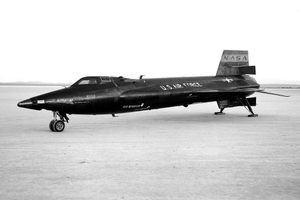
The X-15 rocket plane program is barely remembered today, but it was the first venture by crewed craft to the edge of space. The rocket plane, carrying a human pilot, would be carried to high altitude under the wing of a modified B-52. The plane would then be released, and the pilot would initiate a flight plan, firing the rocket engine and commonly flying up to the edge of space. A number of the pilots even later received astronaut wings, and some altitude and speed records from the X-15 still stand today.
Air Force Major Michael Adams, the 12th and final X-15 pilot, was first selected for the Manned Orbiting Laboratory (MOL), a proposed Air Force space station. As it became clear that that program was unlikely to be funded, however, he applied to join the X-15 program, being accepted on 14 July 1966. He then flew 6 successful and reasonably uneventful missions.
His 7th and final mission was on 15 November 1967. After his craft was deployed, a motor malfunctioned on one of the scientific instruments and started arcing. By the time the X-15 climbed through 100,000 feet, the arc was producing a coronal discharge that disrupted the electrical system in the craft. (It was later determined that the failing motor had not been tested for performance in the near-vacuum of the flight.) The in-flight computer began to reset continually, and evidently the instruments were also malfunctioning, such that Adams was unaware of the attitude of the aircraft. At 230,000 feet, on its descent, it was flying backwards along its flight path. The craft then entered a hypersonic spin, rotating three times over the next 43 seconds as it fell another 100,000 feet. Adams was able to stop the spin by engaging the automatic ballistic control systems, which used thrusters to correct the plane's motion. However, he evidently was unable to raise the nose of the aircraft as it was plunging toward the ground at Mach 4.7 at 120,000 feet.
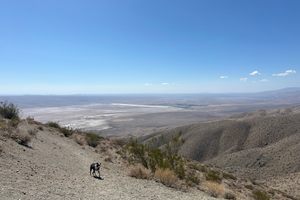
Adams is thought to have made one last attempt to engage the ballistic control system at around 80,000 feet, as the aircraft began to disintegrate due to aerodynamic stresses while still traveling at nearly Mach 4. Finally, all telemetry was lost as the aircraft finally broke up around 62,000 feet. Debris from the aircraft was scattered over several miles of desert between Ridgecrest and Johannesburg.
Major Adams is now regarded as the first in-flight fatality of the US Space Program. Up to this point the X-15 program had had a near-perfect safety record, which was especially remarkable considering the extreme conditions of its operations.
Major Adams' doomed flight did not lead directly to the cancellation of the X-15 program, but it certainly didn't help. A whole series of follow-on "X" programs had been planned, but were now canceled as much due to budget pressures as anything. The moon-landing program was in full swing, and in addition the Vietnam War was soaking up additional resources.
The memorial is erected at the point where the forward part of the fuselage was found. Only in 2004 was the monument built, as part of an Eagle Scout project. It is now a protected historical site.
Know Before You Go
Major Adams' monument is in the desert about 25 miles south of Ridgecrest and 4 miles north of Johannesburg. It can be reached on a dirt road that intersects the Trona Road around 35.41795 N, 117.59289 W. The monument site is about half a mile west on this primitive road and is well marked.
The road to the monument will probably require high clearance but probably not 4WD unless washed out. If impassable to a passenger vehicle it is an easy walk. However, the site lies in an active OHV recreational area, so visitors need to beware of motorized traffic traveling at high speeds along the primitive trails. Such traffic could be especially hazardous to hikers.
Community Contributors

Added By
Published
July 17, 2026